




April 28, 2026
5 min read
Team

Uncovering FinTech Startups: Disruptors in Financial Technology

Explore the ultimate guide to FinTech startup discovery. Learn how to find and evaluate financial technology disruptors using real-time tools and key metrics.

FintechTech
Share this article:
Uncovering FinTech Startups: Disruptors in Financial Technology

Tracking the rapidly evolving financial technology industry is a significant challenge. The speed of innovation means that static, annually-updated lists of top companies become obsolete almost immediately. For venture capitalists, corporate strategists, and market analysts, a more dynamic method for FinTech startup discovery is essential to identify true disruptors in real-time before they hit the mainstream.

This is where our interactive discovery tool comes in. It provides a constantly updated, filterable database of emerging financial tech innovators. Move beyond outdated reports and explore a live view of the companies building the future of finance, from pre-seed ventures developing novel payment rails to growth-stage platforms scaling globally.

How to Find Startups That Match Your Criteria

Follow this step-by-step guide to pinpoint the exact startups that match your research criteria, whether you're conducting competitor analysis, seeking investment opportunities, or identifying potential partners.

Step 1: Select Your Discovery Filters

Begin by applying filters to narrow the vast FinTech landscape to a focused, relevant list.

  • FinTech Sector: Choose from specific industry niches to target your search.
  • Payments (e.g., B2B Payments, Real-Time Payments, POS)
  • Blockchain & DeFi (e.g., Tokenization, Digital Identity)
  • Digital Banking (Neobanks)
  • Insurtech (e.g., Parametric Insurance, Claims Automation)
  • RegTech (Regulatory & Compliance Automation)
  • WealthTech & Personal Finance (e.g., Robo-Advisors)
  • Lending & Credit (e.g., BNPL, Alternative Scoring)
  • Funding Stage: Filter by the startup's current investment level (Pre-Seed, Seed, Series A, B, C+).
  • Location: Narrow your search by region, country, or a major innovation hub like London, San Francisco, New York, or Singapore.
  • Technology Stack: Search for startups leveraging specific technologies, such as Artificial Intelligence (AI/ML) for fraud detection, or those built with an API-first architecture for embedded finance.
  • Company Size: Filter results by headcount or headcount growth rate to find companies at a specific stage of scaling.

Step 2: Analyze the Company Profiles

Once your filters are applied, you will see a list of startups, each presented in a clear, concise format.

  • Company Snapshot: Get an immediate overview of each company, including its name, a one-line pitch, HQ location, total funding raised, last funding date, and key investors or accelerator participation (e.g., Y Combinator, Techstars).
  • Detailed View: Click on any profile to access an in-depth view with founder information, website links, headcount growth trends, and recent news coverage for a comprehensive analysis.

Key FinTech Categories Shaping the Future of Finance

The term "FinTech" covers a wide array of sub-sectors, each with its own set of challenges and disruptive potential. Understanding these key categories is crucial for effective discovery.
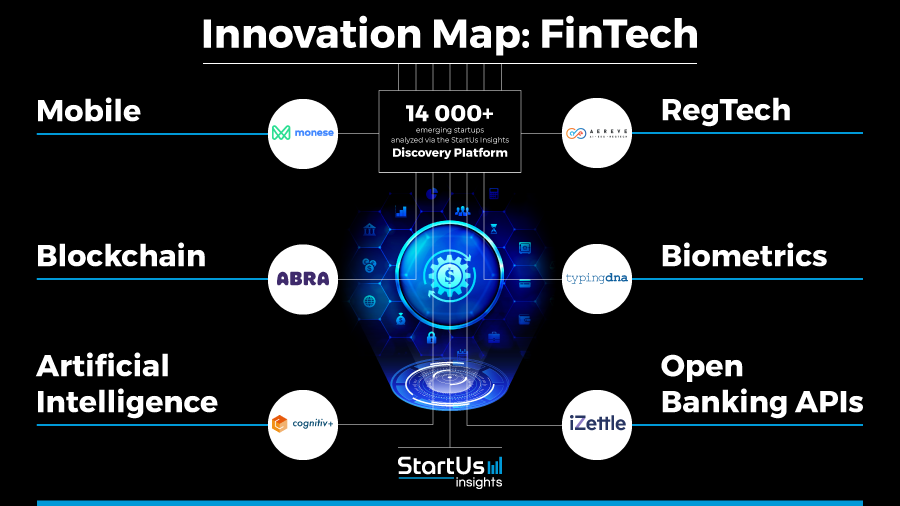
FinTech Innovation Map showing various sub-sectors like Insurtech, Regtech, and Wealthtech

Innovators in B2B and B2C Payments

Innovators in this space focus on creating frictionless transaction experiences. Key trends include the growth of embedded finance, which integrates Buy Now, Pay Later (BNPL) and other capabilities into non-financial apps.

Another major trend is the development of more efficient cross-border payment solutions for global commerce that bypass legacy banking systems.

The Rise of Blockchain and DeFi Startups

Beyond cryptocurrency trading, blockchain startups are building foundational technology. This includes applications in decentralized finance (DeFi), which aims to recreate traditional financial systems without intermediaries, as well as tokenization platforms for real-world assets and secure digital identity solutions.

The New Wave of Digital Banking

Often called neobanks, these digital banking startups are challenging traditional institutions head-on. By leveraging a mobile-first approach, they offer superior user experiences, lower fees, and specialized financial products tailored to niche demographics—like freelancers, SMBs, and Gen Z—that are often underserved by legacy banks.

How Insurtech Companies Are Transforming a Traditional Industry

Insurtech companies are using data and technology to modernize every aspect of the insurance value chain. They leverage AI for more accurate risk assessment and use IoT data to offer personalized premiums (usage-based insurance). These platforms also streamline the claims process through automation, creating a more efficient and user-friendly experience.

A Curated List of FinTech Startups to Watch

To put the discovery process into practice, here is a curated list of innovative FinTech companies making waves across key sectors. These examples represent the types of high-growth startups you can uncover.

B2B Finance & Payments

  • Company: Ramp
  • What they do: An all-in-one corporate card and spend management platform that helps businesses control spending through automated expense policies and real-time reporting.
  • Company: Plaid
  • What they do: A data network that powers the digital financial ecosystem, enabling users to connect their bank accounts to thousands of apps and services.
  • Company: Brex
  • What they do: Provides a suite of financial products, including corporate cards, business accounts, and expense management software tailored for startups and enterprises.
A visual representation of key FinTech categories

Personal Finance & WealthTech

  • Company: Chime
  • What they do: A leading digital banking platform in the U.S. offering fee-free banking services, including checking and savings accounts, through a mobile app.
  • Company: Acorns
  • What they do: A micro-investing app that automatically invests spare change from everyday purchases into a diversified portfolio of ETFs.

Insurtech

  • Company: Lemonade
  • What they do: An AI-powered insurance company offering renters, homeowners, and pet insurance with a fast, chat-based claims process.
  • Company: Hippo
  • What they do: A modern home insurance provider that uses real-time data and smart home devices to offer more accurate coverage and proactive protection.

Blockchain & Crypto Infrastructure

  • Company: Chainalysis
  • What they do: A blockchain analysis company that provides data and software to government agencies, exchanges, and financial institutions to detect and prevent cryptocurrency crime.
  • Company: Fireblocks
  • What they do: An institutional-grade platform for moving, storing, and issuing digital assets, providing a secure infrastructure for crypto operations.

FinTech Discovery Methods: A Comparison

Understanding the landscape of discovery tools helps you choose the right approach for your specific goals, from high-level trend analysis to deep-dive investment research.

Method Best For Data Freshness Scope Examples
Interactive Discovery Platforms Targeted research, real-time data High (Real-time) Broad, filterable Dedicated FinTech Tools, What Launched Today
Static Listicles General overview, initial ideas Low (Quarterly/Annual) Curated, fixed Forbes FinTech 50, Built In
Accelerator Portfolios Discovering pre-vetted, high-potential startups Medium (By batch) Specific to an ecosystem Y Combinator, Techstars, Founder Institute
VC & Investor Databases Finding who funds what, VC research High Investor-centric Harmonic.ai, PitchBook, Crunchbase
General Launch Platforms Broad tech trends, product launches High Multi-industry Product Hunt, TopStartups.io, SeedTable

How to Evaluate Early-Stage FinTech Startups

As you discover new companies, use these key signals to evaluate their potential for disruption and long-term success.

  • Strong Founding Team: Look for a blend of deep financial industry experience and strong technical expertise. A former banking compliance officer paired with a senior software architect is an ideal combination.
  • Significant Funding & Reputable Backers: Backing from top-tier venture capital firms is a powerful validation signal. It indicates that experienced investors have vetted the business model and see its market potential.
  • Clear Market Need & Problem-Solving: The best startups solve a tangible, high-value problem. This is especially true in finance, where innovation is often driven by regulatory shifts (like PSD2 in Europe) or persistent customer pain points.
  • Scalable and Secure Technology: The startup's platform must be built to handle significant growth in users and transaction volume while maintaining bank-grade security and meeting compliance requirements.
  • Defensible Competitive Moat: Identify what makes the company hard to copy. This could be proprietary technology, a network effect, exclusive partnerships, a unique data advantage, or regulatory licenses that are difficult for new entrants to obtain.

What Launched Today is a discovery platform for new startups. It allows founders to launch their product to reach thousands of other makers and founders and get a DR 49 backlink. Visitors can discover the latest, archived, and trending startups. Explore more at https://whatlaunched.today.

Frequently Asked Questions about FinTech Startup Discovery

What is the best way to discover new FinTech startups?
The most effective method combines several approaches. Use a real-time discovery platform for targeted searches, monitor accelerator portfolios like Y Combinator for vetted early-stage companies, and read curated industry reports and listicles for a high-level overview of major players.

What are the biggest trends in FinTech right now?
Key trends include embedded finance (integrating financial services into non-financial apps), AI-driven automation in underwriting and fraud detection, the tokenization of real-world assets using blockchain, and the rise of specialized neobanks serving niche markets.

How can I find early-stage or pre-seed FinTech startups?
Focus on accelerator and incubator websites (e.g., Techstars, 500 Global), attend virtual demo days, and use discovery platforms with filters for "Pre-Seed" and "Seed" funding stages. Following prominent angel investors in the FinTech space on social media can also provide early signals.

From Discovery to Distribution: The Founder’s Next Move

After using discovery tools to analyze competitors, identify market gaps, and validate your own idea, the focus must shift from analysis to action. Building a great product is only half the battle. The next, and often harder, challenge is getting your solution in front of the right audience to build the initial momentum every startup needs to survive and thrive.

This is where a dedicated launch platform becomes the logical next step. For founders and makers, the immediate bottlenecks after development are reaching early adopters, getting valuable feedback, and building foundational domain authority. What Launched Today is designed to solve this. It's a discovery platform where you can launch your product directly to an engaged audience of thousands of other makers and founders—the exact people who will become your earliest champions—and get a valuable backlink to kickstart your SEO.

Launch Your FinTech Startup on What Launched Today →

Published on April 28, 2026

By WhatLaunched Team