





April 16, 2026
5 min read
Team

Essential Traits and Skills for Successful Startup Founders

Explore the essential successful startup founder traits, from unwavering grit to a clear vision. This guide covers the skills and mindset needed to succeed.

Share this article:

A groundbreaking idea is only the starting point. The path from concept to a thriving business is navigated by the founder's character and skills. While many startups fail, the ones that succeed are almost always led by individuals who possess a unique combination of innate traits and learned abilities.

This powerful mix, sometimes called Founder DNA, defines the entrepreneurial mindset and is the critical differentiator between stalling out and scaling to greatness. This guide explores the essential traits that venture capitalists and successful entrepreneurs consistently identify as mission-critical. Use this as a framework to assess your own strengths, identify areas for growth, and evaluate potential co-founders.

1. Unwavering Grit & Determination

Founding a startup is a marathon of navigating uncertainty. Successful founders possess a unique blend of resilience, focus, and a drive for relentless execution. This foundational trait is the mental fortitude to push through investor rejections, product failures, and the inevitable "troughs of sorrow."

It’s the passion-fueled persistence that keeps a founder going when logic suggests quitting.

  • In Practice: A founder with grit sees a failed marketing campaign not as a loss, but as a purchased data point that brings them closer to understanding their customer.
  • Pros:
  • Enables founders to power through significant obstacles and setbacks.
  • Inspires confidence and loyalty within the team and among investors.
  • Drives the company forward during unavoidable slow growth periods.
  • Cons / Potential Pitfalls:
  • Can lead to burnout if not balanced with self-awareness and rest.
  • May become blind stubbornness, causing a founder to stick with a failing idea for too long.

2. A Crystal Clear Vision

A powerful vision is the founder's north star. It's the ability to see a future that doesn't exist yet and articulate it so compellingly that others are inspired to help build it. This isn't just about the product; it's about the change the startup will bring to the industry and its audience.

If you can't paint a vivid picture of the future, you can't expect anyone to help you build it.
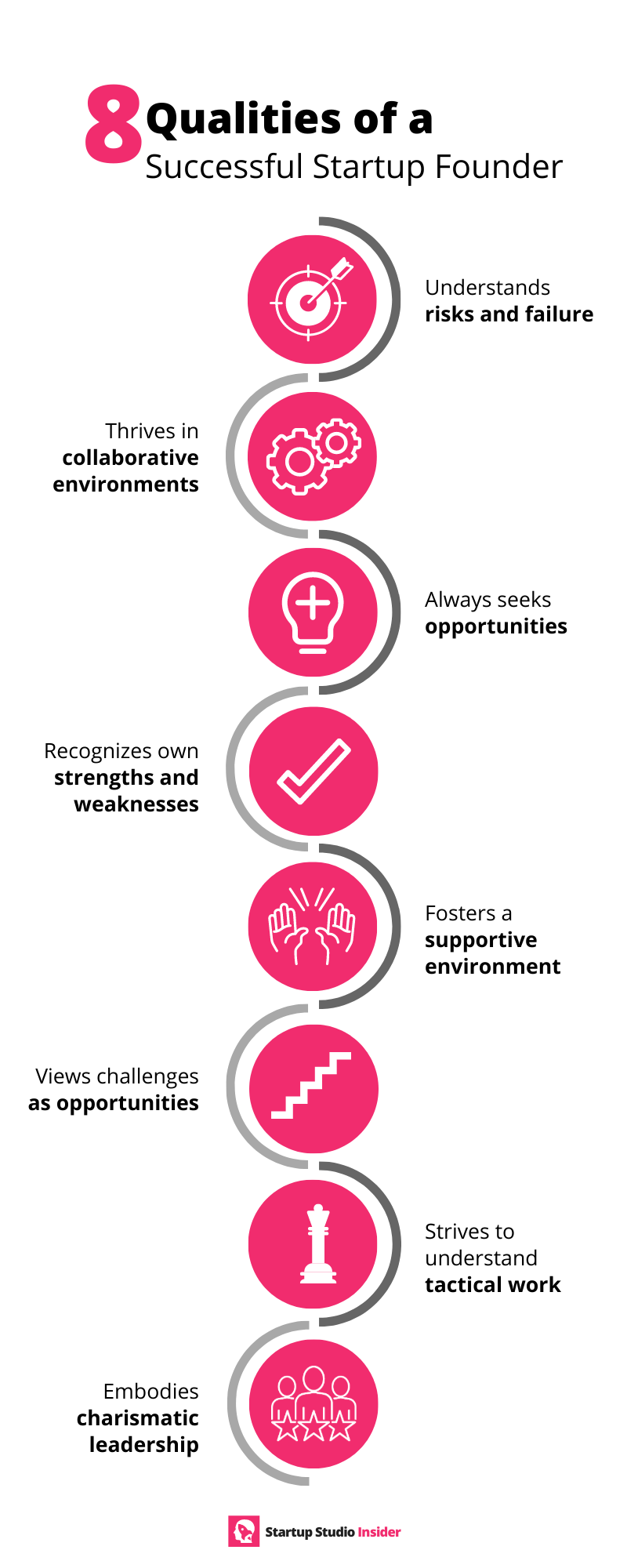
A diagram illustrating the essential traits of a successful startup founder, including vision, grit, and customer obsession.

  • In Practice: A clear vision isn't just "we build a better CRM." It's "we eliminate administrative busywork so salespeople can build genuine relationships." This clarity guides every decision.
  • Pros:
  • Aligns the entire team toward a common, ambitious goal.
  • Guides all strategic decision-making and product roadmaps.
  • Creates a powerful story for marketing, recruiting, and fundraising.
  • Cons / Potential Pitfalls:
  • Can lead to "tunnel vision," causing you to ignore critical market feedback.
  • An unrealistic or poorly communicated vision can confuse and demotivate the team.

3. Relentless Customer Obsession

Winning founders aren't just in love with their product; they have a deep obsession with their customers. They understand that success hinges on solving a real problem for a specific group of people. This means creating constant feedback loops to iterate based on user needs, not just internal assumptions.

  • Workflow Example: Schedule five customer interviews every week. Watch user session recordings. Tag every support ticket to find patterns in user friction. This process, sometimes aided by tools like ProspectBuddy, is key to finding product-market fit.
  • Pros:
  • Drives the company toward achieving product-market fit much faster.
  • Leads to higher customer retention and powerful word-of-mouth marketing.
  • Informs product development with real-world data, not just whiteboard guesses.
  • Cons / Potential Pitfalls:
  • Can lead to "feature creep" if every customer request is acted upon without strategic filtering.
  • May cause a loss of focus on the broader market if you only listen to a few loud customers.

4. The Flexibility and Ability to Pivot

While determination is key, it must be paired with flexibility. A successful founder must recognize when an approach isn't working and have the humility to change course. This ability to pivot isn't an admission of failure but a strategic maneuver to find a better path. It’s knowing when to stop running into a brick wall and look for the door.

  • Industry Example: Slack famously started as a gaming company called Glitch. When the game failed to gain traction, the founders pivoted to commercialize the internal communication tool they'd built for themselves.
  • Pros:
  • Allows the startup to adapt to changing market conditions and new information.
  • Prevents wasting valuable time and resources on a flawed strategy.
  • Demonstrates maturity and strategic thinking to savvy investors.
  • Cons / Potential Pitfalls:
  • Pivoting too frequently can signal a lack of vision and confuse the team.
  • Can lead to "shiny object syndrome," chasing new ideas without proper validation.

5. A Bias for Speed Over Perfection

In the startup world, momentum is currency. The best founders understand it's better to launch a "good enough" Minimum Viable Product (MVP) quickly than to spend months polishing a product nobody wants. This bias for action enables faster learning cycles, allowing you to outmaneuver slower competitors. Launching on a platform like Product Hunt can be a great way to get early feedback.

  • In Practice: You learn more from one day of real-world user interaction with your MVP than from six months of internal debate.
  • Pros:
  • Dramatically accelerates learning and product iteration.
  • Captures market share before competitors can react.
  • Generates real-world data and user feedback almost immediately.
  • Cons / Potential Pitfalls:
  • May result in a buggy or poor user interface that frustrates early adopters.
  • Can create significant technical debt that will need to be addressed later.

6. Relentless Resourcefulness

Ideas are cheap; execution is everything. Top founders have a knack for turning vision into tangible results, week after week. This is deeply tied to resourcefulness—the skill of achieving ambitious goals with limited resources. It means using no-code tools to build a prototype instead of waiting for an engineer, or trading services with another startup instead of spending cash. This mindset is crucial, as detailed in our beginner freelancing success guide.

This includes a practical understanding of key business drivers:

  • Conversion Rate Optimization: Knowing how to design a clear call to action (CTA) to maximize sign-ups or sales.
  • Marketing Acumen: Understanding the basics of metrics like return on ad spend (ROAS) to make informed budget decisions.
  • Financial Literacy: Being able to manage cash flow and make strategic bets on growth initiatives.
  • Pros:
  • Translates ambitious ideas into a functioning business.
  • Maximizes the efficiency of both capital and human resources.
  • Builds a powerful culture of getting things done.
  • Cons / Potential Pitfalls:
  • A pure focus on execution can sometimes neglect long-term strategic planning.
  • "Hustle culture" can easily lead to team burnout if not managed sustainably.

A startup founder working diligently on a laptop in a modern office, embodying a bias for action.

7. Creative Problem-Solving

Founders are professional problem-solvers. This trait is about thinking unconventionally to overcome the constant stream of challenges. It's the imagination to see a solution where others only see a roadblock. This often means finding clever ways to "hack" growth, like how Airbnb initially programmed a way to cross-post listings to Craigslist to tap into an existing user base.

  • Pros:
  • Leads to innovative solutions and a sustainable competitive advantage.
  • Enables the company to navigate unexpected crises effectively.
  • Fosters a more resilient and adaptable company culture.
  • Cons / Potential Pitfalls:
  • Overly "creative" solutions can sometimes be too complex, risky, or unscalable.
  • May clash with the need for structured, repeatable processes as the company grows.

8. Magnetic Leadership and Communication

A founder must sell the vision to everyone: investors, customers, partners, and—most importantly—employees. Leadership is the ability to inspire a group to work relentlessly toward a shared mission. This is impossible without strong communication skills to articulate the vision, strategy, and value proposition clearly. You are the chief storyteller, and finding the right people to bring into that story with services like BizHire is critical.

  • In Practice: This means being able to deliver a compelling elevator pitch and tailor that same core message to different audiences, from a technical hire to a potential customer.
  • Pros:
  • Attracts and retains top-tier talent who want to be part of the mission.
  • Makes fundraising efforts significantly more effective and successful.
  • Aligns the entire organization and builds a strong, unified culture.
  • Cons / Potential Pitfalls:
  • Charisma without substance can mislead the team and investors.
  • A founder-centric leadership style can become a major bottleneck as the company scales.

9. Strong Co-founder Relationships

For teams with multiple founders, the relationship is one of the most critical success factors. A strong partnership is built on mutual respect, complementary skills, and shared values. It's a business marriage where communication, trust, and a formal co-founder agreement are non-negotiable.

  • Pros:
  • Provides crucial emotional support and a shared burden during difficult times.
  • Brings diverse perspectives and a wider range of skills to the table.
  • Increases the overall capacity for work and strategic thinking.
  • Cons / Potential Pitfalls:
  • Founder conflict is one of the leading causes of startup failure.
  • Misalignment on vision, work ethic, or equity can lead to irreparable disputes.

10. Radical Self-Awareness

Self-awareness ties everything together. It’s knowing your own strengths, weaknesses, and biases. It’s the humility to recognize when you’re wrong, the wisdom to hire people smarter than you, and the emotional intelligence to manage your own psychology under pressure. Without it, grit becomes stubbornness, vision becomes delusion, and leadership becomes tyranny.

  • Workflow Example: Create a "personal board of directors"—a small, trusted group of mentors who can provide unfiltered feedback on your blind spots.
  • Pros:
  • Allows you to build a team that compensates for your weaknesses.
  • Fosters a culture of feedback and continuous improvement.
  • Helps prevent founder burnout by recognizing personal limits.
  • Cons / Potential Pitfalls:
  • Excessive introspection can lead to analysis paralysis or a lack of decisiveness.
  • Being overly critical of oneself can undermine the confidence needed to lead.

Building a Complementary Founding Team

A successful startup rarely relies on a single person's skills. High-performing teams often consist of complementary founder archetypes. Understanding your primary strengths is key to building a well-rounded team that can cover all the bases.

Founder Archetype Core Strengths Key Responsibilities
The Builder (Technical) Product development, engineering, system architecture. Building the MVP, scaling technology, leading the engineering team.
The Architect (Commercial) Business strategy, sales, fundraising, marketing. Developing the go-to-market strategy, securing funding, building partnerships.
The Expert (Domain) Deep industry expertise, research, specific knowledge. Ensuring product-market fit, navigating industry regulations, building credibility.

Final Checklist: The Anatomy of a Successful Founder

Use this checklist for self-assessment or when evaluating a potential co-founder. A great founder doesn't need to be a 10/10 on every point, but they should have a strong foundation in most and a deep self-awareness of their gaps.

  • Grit: Do they persist after failure, or do they give up?
  • Vision: Can they articulate a compelling future and a clear "why"?
  • Customer Obsession: Do they actively seek out user feedback or build in a vacuum?
  • Flexibility: Are they open to changing their mind when presented with new data?
  • Bias for Action: Do they prioritize shipping and learning over endless polishing?
  • Resourcefulness: Can they achieve significant results with limited resources?
  • Problem-Solving: Do they find creative solutions or get stopped by obstacles?
  • Leadership: Do they inspire others to join their mission?
  • Collaboration: Do they work well with others and share the same core values?
  • Self-Awareness: Do they know their weaknesses and seek help?

FAQs on Successful Founder Traits

What is the single most important trait for a founder?
While many traits are crucial, most investors and entrepreneurs point to Grit. The ability to persist through extreme adversity is often the one non-negotiable quality, as all other skills are useless if a founder gives up too easily.

Can you learn to be a successful founder?
Absolutely. While innate personality plays a role, skills like leadership, communication, and resourcefulness can be developed through experience, mentorship, and deliberate practice. The core requirement is adopting an entrepreneurial mindset focused on growth and learning through action.

What is Founder DNA?
Founder DNA is a term for the inherent set of values, behaviors, and qualities that fuel a founder's success. It's not a single trait but the powerful combination of grit, creative problem-solving, relentless execution, and an insatiable drive to build something meaningful.

What are the biggest red flags in a startup founder?
Common red flags include a lack of self-awareness, an unwillingness to listen to feedback, an inability to articulate a clear vision, and a focus on perfection at the expense of speed.

The path of a startup founder is exceptionally challenging, but its key components are not a mystery. By cultivating these essential traits—from unwavering grit to radical self-awareness—aspiring entrepreneurs can dramatically improve their odds of success. These qualities form the bedrock of a resilient, adaptable, and visionary leader ready to build something from nothing.

Next Step: Explore whatlaunched.today

If this guide was useful, visit whatlaunched.today to learn how their product can help:

  • What whatlaunched.today offers: What Launched Today is a platform for founders to launch their startups and for others to discover them. It allows founders to submit their new product, get a DR 49 backlink, and reach an audience of thousands of makers and founders.
  • Website: https://whatlaunched.today
Published on April 16, 2026

By WhatLaunched Team