



Introduction: What Defines the Hottest AI Startups Right Now?
The artificial intelligence sector is moving at lightspeed, fueled by massive breakthroughs in Generative AI. A few years ago, this technology felt like science fiction; now, it's powering a new generation of companies set to redefine entire industries. These aren't just features—they are foundational platforms. The spark for much of this fire was a 2017 paper from Google researchers titled "Attention Is All You Need," which introduced the Transformer architecture that powers nearly every major AI model today.
So, what makes a new AI company one of the "hottest" right now? We've narrowed it down to four key signals: massive Venture Capital Funding from top-tier firms like Andreessen Horowitz or Sequoia Capital; genuinely disruptive technology that represents a step-change in capability; founding teams with deep experience from places like Google Brain, Meta AI, or OpenAI; and a clear path to a massive, addressable market. This list isn't just a directory; it's a Market Trend Analysis of the most promising emerging AI companies building the future, today.
1. Perplexity AI: The Conversational Search Engine
- Description: Picture this: instead of a list of blue links, you ask a complex question like "What are the key differences between Series A and Series B funding rounds?" and get a direct, accurate summary with footnotes linking back to the original sources. That's Perplexity AI. It’s an "answer engine" that is fundamentally challenging the traditional search model we've used for over two decades.
- Why They're Hot: Perplexity has raised hundreds of millions from investors like Jeff Bezos and NVIDIA. It's seeing explosive user growth because the product is simply better for many types of research questions. With a founding team stacked with talent from Google AI and OpenAI, they have the pedigree to take on the giants in a multi-trillion dollar market.
- Pros:
- An incredibly intuitive and useful product that saves users time on complex queries.
- Backed by some of the biggest names in technology and venture capital.
- Solves a clear pain point: the clutter and SEO-driven content of modern web search.
- Cons:
- Directly competing with Google and Microsoft requires overcoming massive user inertia and the power of default search placements.
- Their long-term monetization model, which currently relies on a Pro subscription, is still evolving.
2. Adept AI: The Universal AI Teammate
- Description: Adept isn't building another chatbot. They're building a foundational AI model—an Action Transformer—that can use software the way a human does. You tell it in plain English, "pull the quarterly sales data from Salesforce, create a pivot table in Google Sheets comparing regions, and email the chart to the leadership team," and it executes the workflow across applications. It’s a universal AI agent for your digital tasks.
- Why They're Hot: The goal here is the holy grail of workplace automation: a true AI teammate that can interact with any software interface. This ambition has attracted huge Venture Capital Funding and some of the brightest minds in the AI research world. If they succeed, they could create a new category of software that changes how we interact with computers entirely.
- Pros:
- The technology is potentially transformational for business productivity and enterprise workflows.
- The market for enterprise and consumer automation is practically unlimited.
- Founded by an all-star team of the original Google Transformer paper authors and former DeepMind researchers.
- Cons:
- The technical challenge is immense, with a long road to a fully-realized, reliable product.
- Getting enterprise-grade security, permissions, and reliability right is a massive and critical hurdle.
3. Mistral AI: The European OpenAI Challenger
- Description: Based out of Paris, Mistral AI has stormed the European Tech Scene by developing powerful large language models that are open-source. They offer performance competitive with top closed-source models but with more efficiency and transparency, making them a favorite among developers who need to customize models for specific tasks.
- Why They're Hot: Mistral rapidly achieved unicorn status (a $1 billion+ valuation). Their commitment to open-source and efficient model architectures, like Mixture-of-Experts (MoE), has built a passionate community and made them a strategic choice for European companies wanting AI sovereignty.
- Pros:
- Leads the open-source AI movement, fostering collaboration, transparency, and customization.
- Their models are smaller, faster, and cheaper to run, making them easier to fine-tune on private data.
- Has strong backing from European enterprises and governments concerned with data privacy.
- Cons:
- Competing with the immense compute budgets and data moats of giants like OpenAI and Google.
- Monetizing a primarily open-source product through API access and enterprise services presents unique business challenges.
4. Reka AI: The Multimodal Intelligence Pioneer
- Description: Reka is building AI that can see, hear, and read. They focus on multimodal models that can understand and reason about text, images, audio, and video clips simultaneously. This allows for far more sophisticated and context-aware AI applications, like analyzing a product demo video and generating a technical summary, or even a new visual with an AI photo generator.
- Why They're Hot: Multimodality is the next major frontier for AI, and Reka is one of the few pure-play startups focused on cracking it. Founded by an elite team of ex-DeepMind and Google Brain scientists, their work is central to the future of AI innovation, from robotics to advanced scientific data analysis.
- Pros:
- Tackling the next big step in AI capabilities beyond simple text generation.
- Huge potential applications in creative tools, autonomous systems, and scientific research.
- The lean team consists of some of the most sought-after AI researchers in the world.
- Cons:
- Still in the early stages, with a core product under heavy research and development.
- Training powerful multimodal models requires immense computing power and vast, diverse datasets.
5. ElevenLabs: The Voice of Generative AI
- Description: ElevenLabs has set the gold standard for AI-generated audio. Their software creates incredibly realistic and emotionally-aware text-to-speech voices and can even clone a voice from just a few seconds of audio. The quality is so high it's often indistinguishable from a professional human voice actor.
- Why They're Hot: They achieved clear product-market fit almost instantly, democratizing access to high-quality voice generation. Content creators, game developers, and audiobook producers flocked to their platform, rocketing the company to a valuation of over $1 billion. They are the clear leader in the synthetic audio space.
- Pros:
- Best-in-class technology that established a new quality benchmark.
- Viral product adoption led to rapid, organic growth across multiple industries.
- Expanding into high-value enterprise markets like real-time translation and movie dubbing.
- Cons:
- The power of their voice-cloning tech raises significant ethical questions and the potential for deepfake misuse.
- Competition is growing as other major players enter the AI audio market.
Analyzing AI Startup Trends and Hubs
What are the key AI startup trends this year?
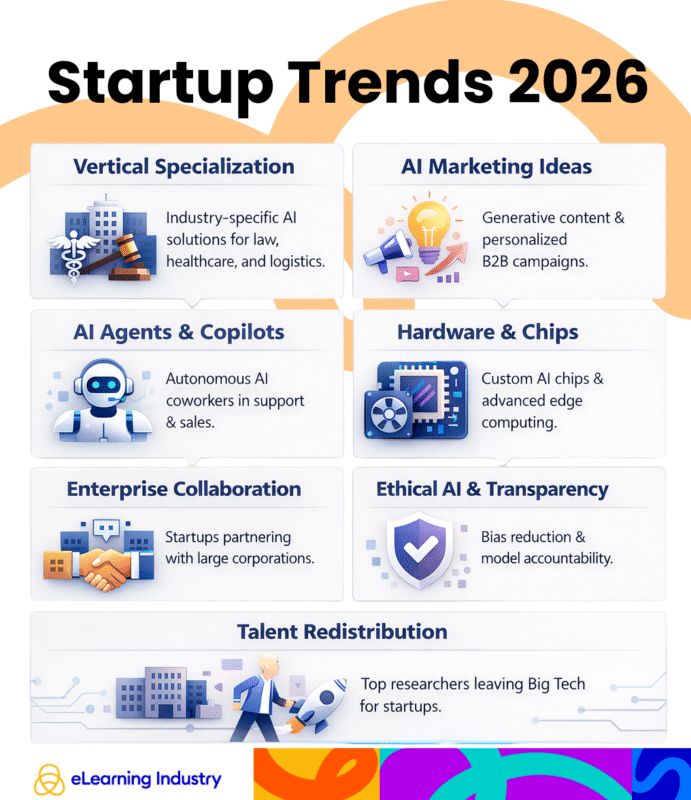
The key AI startup trends are moving beyond general-purpose chatbots. We're seeing a surge in:
- AI Agents: Autonomous systems like Adept that can execute multi-step tasks across different applications.
- Specialized Models: Smaller, fine-tuned models trained for specific industries like law (legal-tech) or biology (drug discovery).
- Multimodal Capabilities: AI that understands and generates content from text, images, and audio, as pioneered by Reka.
- AI for Code: Tools that assist or automate software development, significantly boosting developer productivity.
For more on these specific sectors, check out our guides on [Link to: The Latest FinTech Innovations: Startups Redefining Financial Services] and [Link to: Explore Innovative Healthcare Startups Driving Medical Advancements].
Hottest AI startups in Silicon Valley and SF
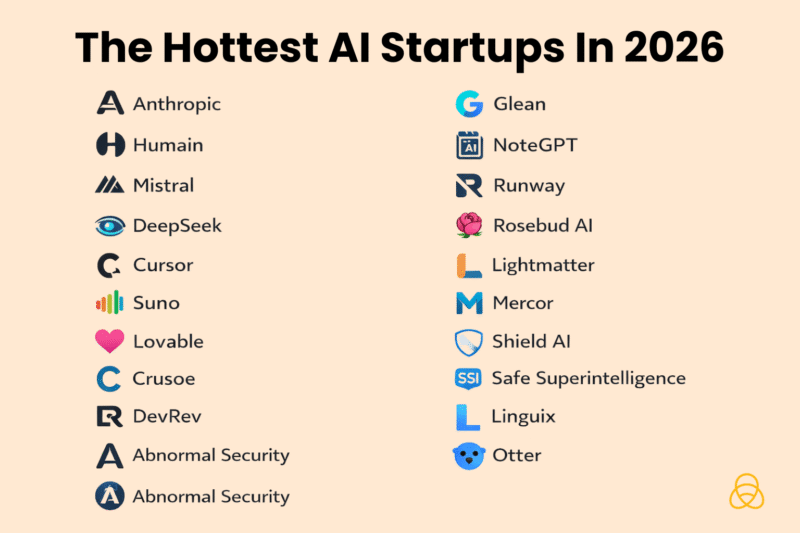
The hottest AI startups in the San Francisco Bay Area and Silicon Valley are still leading the charge. This is home base for foundational model companies like Perplexity AI, Adept AI, and countless others still in stealth mode.
The flywheel effect is undeniable: the world's highest density of top-tier AI talent, leading research universities like Stanford and Berkeley, and deep-pocketed venture capital firms keeps the Bay Area as the undisputed epicenter of AI development. For a look at how this region stacks up, see our analysis of the [Link to: US Startup Landscape: Emerging Companies Across Key States].