




Here’s a hard truth: a leading reason startups fail is because they build something nobody wants. Founders can spend months, even years, crafting a product in isolation, only to launch to the sound of crickets. It’s not a failure of engineering or vision; it’s a failure to answer one simple question: "Does anyone actually need this?"
This is why market validation is the most critical, risk-reducing process for any new venture.
What Is Market Validation?
Market validation is the process of gathering evidence to prove there’s a real, paying audience for your idea before you invest significant time, money, and energy into building the full product. It’s the shift from a "build it and they will come" mindset to a "learn first, build smarter" approach.
For pre-seed and seed-stage startups, using a mix of lean, targeted tactics is the fastest way to de-risk your business and find a path to product-market fit. This guide covers the essential tactics you need, from low-cost discovery to high-conviction tests that prove people will actually open their wallets.
Before You Validate: Define Your Core Assumptions
Before you test anything, you need to know what you're testing. A business idea is a bundle of unproven assumptions. Your first job is to get them down on paper.
Use a Framework to Map Your Hypotheses
The Business Model Canvas (or the more problem-focused Lean Canvas) is your one-page business plan. It forces you to articulate your initial hypotheses about the key components of your venture.
For initial validation, focus intensely on two boxes: Customer Segments (who are they?) and Value Propositions (what problem do we solve for them?). Filling this out quickly reveals the biggest leaps of faith in your model.
Formulate a Testable Hypothesis
Now, turn your core assumptions into a clear, testable statement. A good hypothesis is specific and falsifiable. Use this template:
"We believe [Target Audience] struggles with [Customer Pain Points] when trying to [Job-to-be-Done]. We believe they will adopt a solution that provides [Key Benefit] because it is [Differentiator]."
For example: "We believe early-stage B2B SaaS founders struggle with getting initial, unbiased user feedback for new features. We believe they will adopt a platform that connects them with verified product testers because it is faster and more targeted than asking on social media."
This sentence is your north star. Every tactic that follows is designed to prove or disprove it.
Low-Cost, Pre-Product Validation Tactics
Start with tactics that are cheap, fast, and generate rich qualitative and quantitative data before you write a single line of code.
1. Conduct Customer Discovery Interviews
This is ground zero. Before you build anything or pitch your solution, talk to your target audience. The goal isn't to sell them on your idea; it's to understand their world, their problems, and their current workflows.
- Pros:
- Provides deep qualitative insights and often uncovers pain points you never considered.
- Helps you build relationships with potential Early Adopters who can become your first champions.
- Extremely low cost with incredibly high learning value.
- Cons:
- Time-consuming and requires skill to ask non-leading questions. It's easy to hear what you want to hear.
- A small sample size can be misleading if you don't talk to a representative group.
- Execution Tip: Avoid questions like, "Would you use a product that does Y?" Instead, ask open-ended, problem-focused questions like, "Tell me about the last time you dealt with X" or "What's the hardest part about doing Z?" You're searching for problems, not praise for your solution. An AI-powered tool like InterviewPal can help structure these conversations effectively.

2. Analyze Online Demand and Trends
While interviews provide depth, digital signals provide breadth. Analyze how people are currently searching for solutions and discussing the problem you aim to solve. This tells you if the pain is strong enough for people to actively seek help.
- Pros:
- A quick, very low-cost way to estimate market interest and awareness.
- Search Volume Analysis reveals the exact language your audience uses—gold for your future marketing copy.
- "Social listening" helps you find unfiltered conversations and competitors.
- Cons:
- Doesn't work for truly innovative ideas where no search behavior exists yet.
- Search intent can be ambiguous; not every search indicates a desire to buy.
- Execution Tip: Use tools like Google Keyword Planner to check "problem-aware" keywords (e.g., "how to reduce employee churn"), not just "solution-aware" ones ("HR software"). Then, search those same terms in relevant Reddit communities, Quora threads, or industry forums to see how people describe their issues in their own words.
3. Launch a "Smoke Test" Landing Page
This is a classic lean validation tactic. Create a simple landing page that describes your product's value proposition as if it already exists. Then, ask for a micro-commitment, like an email address to join a waitlist.
- Pros:
- Delivers hard, quantitative data (your conversion rate) on how much your messaging resonates.
- Builds a waitlist of potential first users you can contact for interviews or at launch.
- It's cheap and fast to set up with modern website builders.
- Cons:
- An email signup is not a sale. Don't mistake a long waitlist for guaranteed revenue.
- You'll likely need a small ad budget (e.g., on LinkedIn for B2B or Instagram for B2C) to drive targeted traffic.
- Execution Tip: Keep it simple: one clear headline communicating the core benefit, a brief explanation, and a single, obvious call-to-action ("Join the Early Access Waitlist"). Drive targeted traffic; a strong sign-up rate is a very positive signal.
High-Fidelity Validation: Prototypes & Early Products
Once you have initial evidence, it's time to increase the fidelity of your tests to see if people will commit time or money.
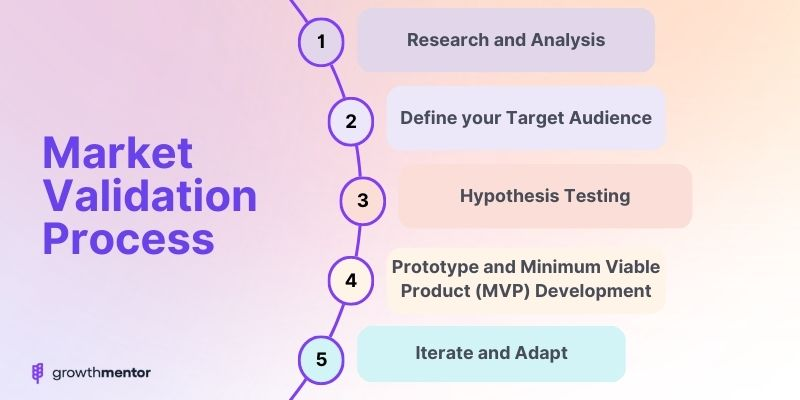
4. Simulate Your Solution with a Concierge or Wizard of Oz MVP
Before building an automated product, deliver the value manually.
- A Concierge MVP is where you manually provide the service, and the customer knows it's a high-touch, human-powered process. If you're building a reporting tool, you create the reports by hand.
- A Wizard of Oz MVP is similar, but you create the illusion of a fully functional product. The customer interacts with a normal interface, unaware that a human is pulling the levers behind the scenes.
- Pros:
- The fastest way to start serving customers with nearly zero development cost.
- Provides unparalleled, direct insight into what features are truly necessary.
- Builds deep relationships and powerful case studies with your first users.
- Cons:
- Completely unscalable and requires a huge amount of founder time.
- Not suitable for products that require complex, real-time computation.