



Wellfound is the superior platform for early-stage startups hiring core tech roles, offering a high-intent, startup-savvy talent pool and unmatched cost-effectiveness. LinkedIn provides the unparalleled scale necessary for sourcing diverse, senior, or passive candidates for growth-stage companies and building a long-term employer brand. Deciding between them isn't about which is "better," but which is the right tool for your startup's current stage, budget, and the specific role you need to fill.
| Feature | Wellfound | |
|---|---|---|
| Ideal User | Early-stage startups (Pre-seed to Series A) | Growth-stage companies & enterprises (Series A+) |
| Best For Hiring | Core tech roles (engineers, product, design) | Diverse roles (sales, marketing, ops) & senior leadership |
| Key Strength | High-intent, startup-savvy candidates at low cost | Unmatched scale for sourcing any professional, especially passive talent |
| Main Weakness | Limited talent pool outside of tech; poor for passive sourcing | High cost for premium tools; low signal-to-noise from "Easy Apply" |
| Typical Cost | Free, with an optional $29/month Pro plan | Free (limited visibility) to $15,000+/year for a Recruiter seat |
For founders, hiring is the lifeblood of the company. Your first ten hires don't just build the product; they build the culture, set the pace, and define your trajectory for years to come. In a hyper-competitive talent market, the question isn't just who to hire, but where to find them.
Two names dominate this conversation: Wellfound (the platform formerly known as AngelList Talent) and LinkedIn. They both serve the fundamental purpose of connecting companies with talent, but their philosophies, candidate pools, cost structures, and user experiences are worlds apart. This guide provides a founder's perspective on this critical choice. We'll move beyond surface-level features to dissect the practical realities of hiring on each platform. We will analyze candidate quality, cost-benefit trade-offs, and which platform wins for specific roles, offering a clear framework to build your A-team without burning through your runway.
Feature-by-Feature Showdown: Wellfound vs. LinkedIn for Hiring
Wellfound excels in candidate intent and cost-efficiency for niche tech roles, whereas LinkedIn dominates in candidate scale, passive sourcing capabilities, and comprehensive employer branding tools. The best choice depends entirely on whether a founder needs a focused, high-signal pipeline for core roles or broad market reach for scaling diverse teams.
| Feature | Wellfound (formerly AngelList Talent) | Winner / Best For | |
|---|---|---|---|
| Primary Candidate Pool | Tech-focused, startup-savvy, active job seekers (engineers, designers, product managers). High concentration in major tech hubs. | Global, multi-industry professional network. Includes every role imaginable, from entry-level to C-suite. | Wellfound: Niche tech and product roles. LinkedIn: Scale, role diversity, and global reach. |
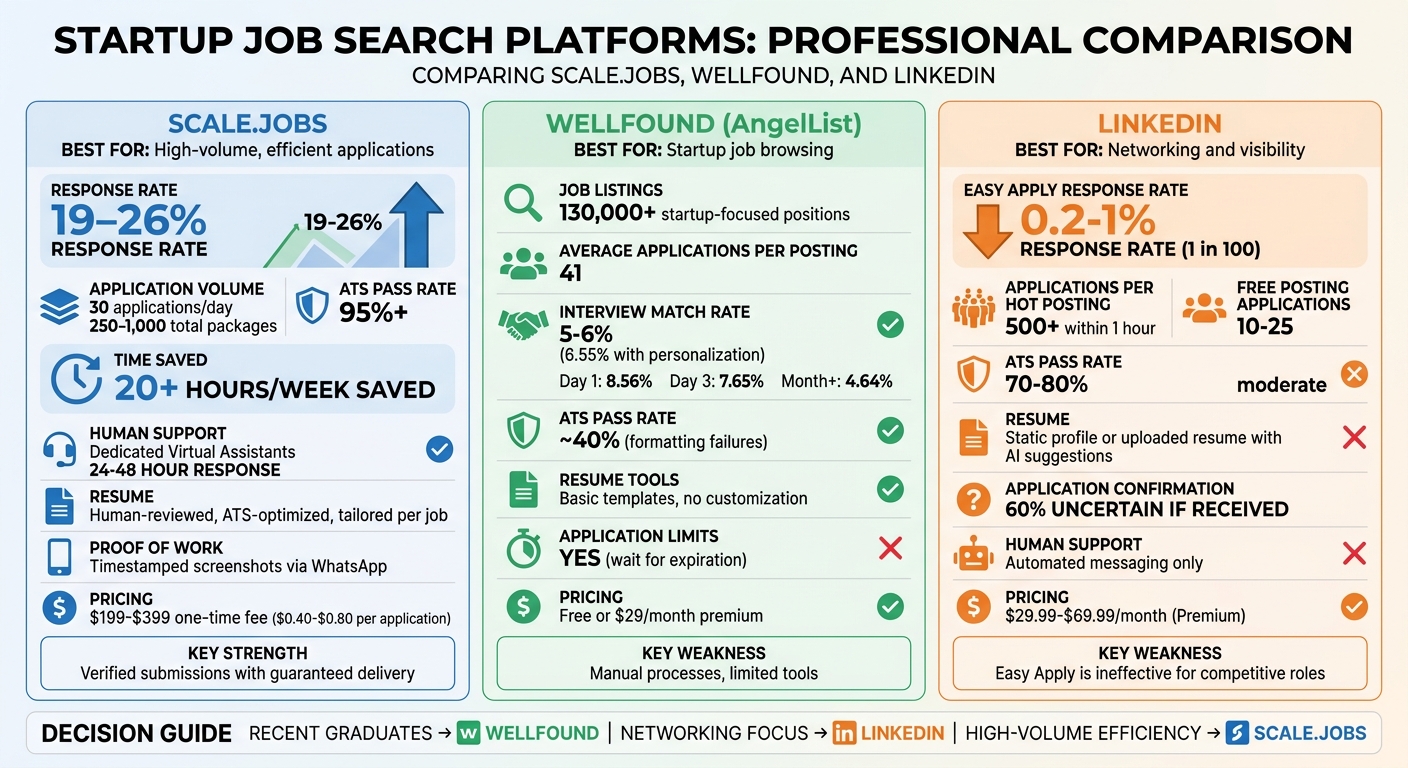
| Candidate Intent & Quality | Higher intent; candidates are specifically seeking startup roles with an appetite for risk and equity. Data suggests a ~6% application-to-interview rate. | Mixed intent; "Easy Apply" can lead to high volume but low-quality applications (often 0.2%–3% conversion rate), requiring heavy filtering. | Wellfound: Higher signal-to-noise ratio. |
| Sourcing Passive Candidates | Limited. Primarily serves active job seekers who have opted into the platform. Some search functionality in Recruit Pro. | Excellent. Tools like LinkedIn Recruiter and InMail are the industry standard for outbound sourcing and engaging top talent not actively looking. | LinkedIn: Reaching top-performers who aren't on the job market. |
| Pricing & Cost-Effectiveness | Highly cost-effective. A robust free tier allows unlimited job posts. Recruit Pro is an affordable $29/month subscription. | Expensive for full functionality. LinkedIn Recruiter seats cost thousands annually ($8,400–$15,600+ per seat). Sponsored jobs add variable costs. | Wellfound: Budget-conscious, early-stage startups. |
| Employer Branding Tools | Basic company profiles and job listings. Focus is on the role and direct founder connection, not elaborate branding. | Robust company pages, content marketing (articles, video), employee advocacy tools, and detailed analytics to measure brand reach. | LinkedIn: Building a long-term, scalable employer brand. |
| Hiring Speed | Can be faster for high-demand tech roles due to a concentrated, high-intent talent pool and direct communication channels. | Varies. Can be slow due to the need to sift through many applications, but potentially faster for sourcing niche senior roles with a dedicated recruiter. | Tied: Heavily depends on the role and resources invested. |
| Ease of Use & Workflow | Simple, streamlined interface focused purely on hiring. Minimalistic and intuitive for founders acting as recruiters. | More complex ecosystem with features spanning networking, sales, and marketing. Requires more training to use effectively, especially Recruiter. | Wellfound: Simplicity and focus for lean teams. |
| Direct Founder Access | Encouraged and built into the platform's DNA. Facilitates direct, authentic conversations between founders and candidates. | Possible, but the platform's structure often intermediates conversations through HR departments, external recruiters, or a general careers inbox. | Wellfound: Cutting through red tape and selling the vision. |
| ATS Integration | Limited, with some basic integrations. Primarily designed to be a self-contained system for smaller teams. | Extensive. Integrates seamlessly with nearly every major Applicant Tracking System (ATS) like Greenhouse, Lever, and Workable. | LinkedIn: Companies with established HR tech stacks. |
Deep Dive: What is Wellfound for Startup Hiring?
Wellfound is a specialized job board and hiring platform meticulously designed to connect startups with high-intent, tech-savvy candidates who are actively seeking roles within the startup ecosystem. Born from AngelList, the platform that democratized startup investing, its entire DNA is built around the unique needs of new ventures: speed, cultural fit, risk tolerance, and direct access between founders and potential hires.
Think of Wellfound as a curated community rather than an open marketplace. Unlike the sprawling, multi-industry metropolis of LinkedIn, it's a focused district where everyone speaks the language of equity, MVPs, venture capital, and agile development. For founders, this translates to a dramatically higher signal-to-noise ratio. You aren't just posting a job into the void; you're tapping into a pre-qualified talent pool that already understands and desires the high-risk, high-reward environment of a startup.
Source: assets.seobotai.com
The Pros: Why Founders Choose Wellfound
Founders consistently choose Wellfound for its high-quality, niche talent pool, superior cost-effectiveness, and a platform culture that facilitates direct, meaningful connections, resulting in a significantly higher application-to-interview conversion rate. It is the quintessential platform for building a core tech team on a startup budget.
- Niche, High-Intent Talent Pool: This is Wellfound's superpower. The candidates are there specifically for startup jobs. This self-selection process acts as a powerful first-pass filter, weeding out individuals seeking the stability of a large corporation. You get applicants who are genuinely excited by your mission and understand what "equity" means. This focus pays dividends, with Wellfound's application-to-interview conversion rate reportedly doubling that of LinkedIn (around 6% vs. 3%).
- Direct & Authentic Connections: Wellfound culture champions the idea of founders as the primary recruiters. It’s designed to bypass traditional HR gatekeepers, allowing you to sell your vision directly and assess cultural fit from the first interaction. Features like prompts for why a candidate is interested act as mini-cover letters, giving you immediate insight into their motivations.
- Superior Cost-Effectiveness: For a company counting every dollar, this is a game-changer. You can post jobs, source candidates, and make hires on Wellfound for free. Its premium tier, Recruit Pro, unlocks advanced search features for a nominal monthly fee, a stark contrast to LinkedIn's four and five-figure annual commitments.
- Streamlined, Founder-Friendly Workflow: The platform is built for speed and simplicity. A typical founder workflow looks like this:
- Create a Profile: Spend 30 minutes crafting a compelling company profile that highlights your mission, traction, and team.
- Post a Job: Use a clear, concise job description focusing on impact. Set salary and equity ranges transparently.
- Review Inbound Candidates: Wellfound's matching algorithm presents you with relevant, active candidates. You can quickly review profiles that show experience, salary expectations, and a personalized note.
- Initiate Contact: Send a direct message to promising candidates. The whole process feels more like a conversation than a formal application review.
The Cons: Where Wellfound Falls Short
Wellfound's primary weaknesses are its limited candidate scale compared to LinkedIn, its near-exclusive focus on active job seekers, and its less effective platform for sourcing non-technical roles. It is a masterfully crafted specialized tool, not an all-in-one hiring solution for a scaling company.
- Limited Candidate Scale: The talent pool is a fraction of LinkedIn's billion-plus members. This is a challenge when you need to hire for a highly specialized senior role or when you're hiring outside major tech hubs like San Francisco, New York, or London.
- Primarily Active Candidates: The platform is architected for people actively browsing job listings. It lacks the sophisticated tools LinkedIn offers for "passive candidate sourcing"—the art of engaging top-performers who are happy in their current role but might be persuaded by the right opportunity.
- Basic Employer Branding: While you can create a detailed company profile, the tools for building a rich, long-term employer brand are minimal. You can't publish articles, share rich media updates, or leverage employee advocacy in the same systematic way you can on LinkedIn.
- Less Effective for Non-Tech Roles: Wellfound's reputation and network effects remain strongest in tech-adjacent roles: product, design, and engineering. When it's time to hire your first salesperson, head of marketing, or finance controller, the talent pool is significantly shallower.
Deep Dive: What is LinkedIn for Startup Hiring?
LinkedIn is the world's largest professional network, functioning as a massive, multi-industry talent database and a powerful dual-purpose platform for both managing inbound job applications and conducting outbound sourcing of passive candidates. For startups, it represents unparalleled reach and versatility, but also introduces significant challenges of cost, competition, and candidate quality control.
If Wellfound is a specialist's workshop, LinkedIn is a global professional superstore. It has an audience that spans every conceivable industry and geography. Its core value proposition is scale. You can find virtually any professional, in any function, at any level of seniority. This makes it an indispensable tool for growth-stage startups (typically Series A and beyond) looking to build out diverse teams beyond their core engineering group.
Source: instagram.com

The Pros: The Power of the Global Network
LinkedIn's core strengths are its unmatched scale for finding any type of professional, its industry-leading tools for sourcing passive candidates, and its robust platform for building and communicating a long-term employer brand. It is the definitive platform for hiring non-tech roles, senior leadership, and building a globally distributed team.