



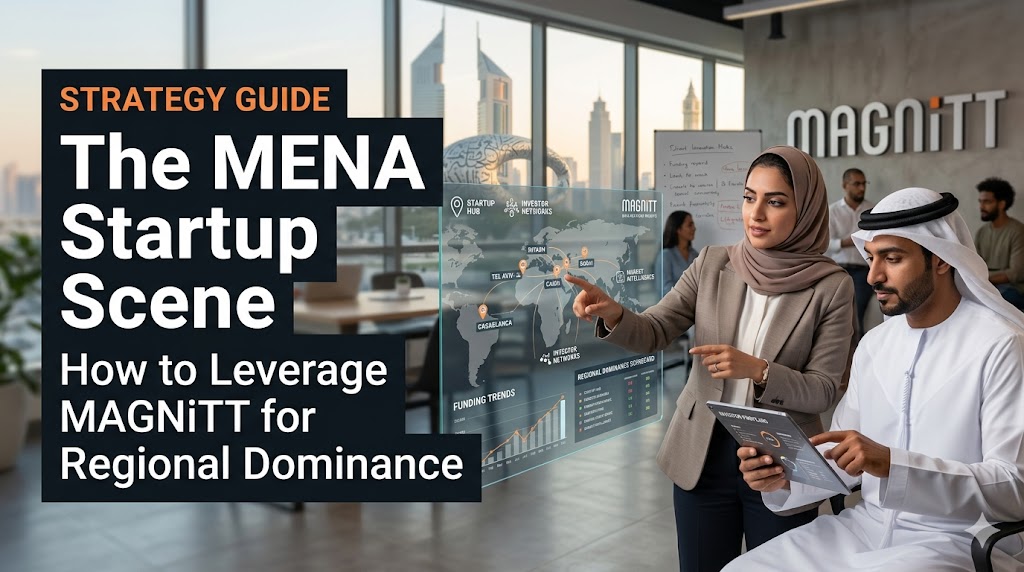
The MENA Startup Scene: How to Leverage MAGNiTT for Regional Dominance

Published on May 27, 2026

Dominate the MENA startup scene. This guide shows you how to leverage a MENA startup directory like MAGNiTT for fundraising, market analysis, and strategic growth.

The MENA Startup Scene: How to Leverage MAGNiTT for Regional Dominance

The MENA Startup Ecosystem at a Glance

The MENA startup ecosystem is a rapidly expanding network of innovative companies, venture capitalists, and government initiatives, primarily centered in the United Arab Emirates, Saudi Arabia, and Egypt. This region has transformed from an emerging market into a global hotspot for venture capital and technological innovation. Its most-funded startups have raised nearly $3 billion in total capital, signaling a new era of economic diversification.

The convergence of significant infrastructure investment, widespread digital adoption by a young, tech-savvy population, and a new generation of ambitious founders has created fertile ground for high-growth ventures. This momentum is underscored by a doubling in both the total number and value of late-stage funding rounds over the last five years—a clear indicator of market maturation and increasing investor confidence. Sovereign wealth funds, such as Saudi Arabia's Sanabil Investments and the UAE's Mubadala Investment Company, are now actively pouring capital into local tech champions, further accelerating this growth.

Metric Region/Country Value
Total Funding (Top 50 Startups) MENA Ecosystem ~$3 Billion
Dominant Hub (by Funding) United Arab Emirates ~$1.8 Billion
Second-Leading Hub Saudi Arabia ~$520.4 Million
Third-Leading Hub Egypt ~$248.6 Million
Top Emerging Hubs Global Rankings Dubai, Cairo, Riyadh, Abu Dhabi

Key Hubs of Innovation

Innovation across MENA is concentrated in several key city-hubs, each with distinct sector specializations, regulatory advantages, and government-backed support systems.

  • Dubai, UAE: A globally recognized hub for Finance & Venture Capital, Dubai excels in FinTech, E-commerce, and logistics. Its business-friendly environment and specialized free zones like the Dubai International Financial Centre (DIFC) create a powerful regulatory sandbox for financial innovation.
  • Riyadh, Saudi Arabia: Experiencing explosive growth driven by the ambitious Vision 2030 initiative, Riyadh is a powerhouse in B2B SaaS and FinTech. The Saudi government's deep investment in technology infrastructure and giga-projects like NEOM is creating unparalleled opportunities.
  • Cairo, Egypt: A leader in the sheer volume of deals, Cairo is known for its large consumer market and deep, affordable talent pool. The ecosystem shows significant strength in HealthTech, E-commerce, and transportation solutions, with startups like MaxAB raising over $60 million to digitize the retail market.
  • Abu Dhabi, UAE: The UAE's capital is carving out a niche as a hub for deep tech, AgriTech, and FinTech, anchored by the Hub71 technology ecosystem and the Abu Dhabi Global Market (ADGM) financial free zone.
  • Casablanca, Morocco: A key gateway to North Africa and Francophone markets, Casablanca has a vibrant scene with notable strengths in FinTech and B2B E-commerce. Companies like Chari and Cashplus are digitizing local economies.

Dominant Sectors Driving Growth

Fintech and e-commerce are the most represented sectors by deal volume, but FoodTech startups have attracted the most capital, largely due to mega-rounds. This distribution highlights a market driven by the digital transformation of core consumer and business services.

MENA Fintech Market Map showing key hubs and startups
Source: Fintech News Middle East

  • FinTech: The most crowded and competitive field, with 13 of the top 50 funded startups. The boom is driven by a large underbanked population and high smartphone penetration. Buy-Now-Pay-Later (BNPL) platforms like tabby and Tamara have become regional unicorns.
  • E-commerce & Q-commerce: Homegrown giants are scaling rapidly. Breadfast in Egypt is redefining grocery delivery, while B2B platforms like Chari in Morocco are digitizing traditional retail supply chains.
  • FoodTech & Cloud Kitchens: This sector claims the largest share of funding, dominated by Kitopi's massive $804 million raise. The success of the cloud kitchen model is a direct response to the high cost of retail real estate and massive demand for food delivery.
  • HealthTech: A growing area of focus, accelerated by the pandemic. Startups are pioneering telehealth, online pharmacies, and digital health records across the region.

Spotlight: Notable MENA Startups to Watch

While funding isn't the only measure of success, these companies represent key trends and have achieved significant scale, making them important players to track in the ecosystem.

Startup Country Sector Why They're Notable
Kitopi UAE FoodTech A "unicorn" that raised over $800M to pioneer the cloud kitchen model globally.
Swvl Egypt/UAE Mobility A ride-hailing and mass transit company that went public on the Nasdaq via a SPAC.
tabby UAE FinTech One of the region's leading Buy-Now-Pay-Later platforms, achieving unicorn status.
Tamara Saudi Arabia FinTech A major BNPL player in Saudi Arabia and the UAE with $116M in funding.
Pure Harvest UAE AgriTech A leader in sustainable agriculture, using technology to grow produce in arid climates.
Anghami Lebanon/UAE MediaTech The region's leading music streaming service, also listed on the Nasdaq.
Sary Saudi Arabia B2B E-commerce A platform connecting small businesses with a network of wholesale suppliers.
MaxAB Egypt B2B E-commerce A platform digitizing the traditional "mom-and-pop" retail supply chain in Egypt.

Who are the Key Founders and Investors?

The MENA ecosystem is powered by a new class of entrepreneurs who are building companies of regional and global significance. Leaders from companies like Anghami and Swvl have provided clear exit roadmaps, demonstrating the potential of MENA-born startups. This success creates a "founder flywheel" effect: successful entrepreneurs become angel investors and mentors, recycling capital and operational expertise back into the ecosystem, often using modern sales and outreach tools like Highreach to build their new ventures.

On the investment side, beyond the sovereign wealth funds, a robust network of regional Venture Capital firms is fueling growth. Firms like MEVP (Middle East Venture Partners), BECO Capital, and Wamda Capital were early pioneers, while newer funds continually emerge to support startups from pre-seed to later stages.

How to Choose the Right MENA Startup Directory

A startup directory is a public platform that aggregates company information for discovery by investors, customers, and talent. Choosing the right one—whether a comprehensive data platform or a simple discovery tool—is crucial for founders seeking funding, investors sourcing deals, and professionals tracking industry trends.

Why Regional Directories Offer a Competitive Edge

Region-specific startup directories offer superior data granularity, stronger local network effects, and deeper cultural context compared to their global counterparts. While a global platform like Crunchbase is invaluable, it often lacks the nuanced data required for MENA-specific strategies.

Regional platforms capture funding rounds from local VCs, track government grants, and understand the unique market dynamics that define success in Riyadh or Cairo. This localized intelligence provides a significant competitive advantage for hyper-targeted analysis and networking.

A graphic detailing the startup ecosystem landscape
Source: LinkedIn

Comparison of Top MENA Startup Data Platforms

The best directory depends on your goal, whether it's deep data analysis for investment, simple company discovery, or tracking ecosystem news.

Platform Primary Focus Data Depth Ideal User Submission Process Unique Feature
MAGNiTT Venture Data & Analytics Very High (Funding rounds, valuations, investors, exits, reports) VCs, Corporate M&A, Governments, Analysts Verified profile management (often paid) Premium market intelligence reports and in-depth analytics.
menagrid.co Filterable Startup Directory Moderate (Funding Stage, Sector, Location) Founders, Job Seekers, Explorers Free Submission Form Clean, user-friendly interface with simple filtering.
500 Global (MENA) VC Portfolio Showcase Moderate (Funding Stage, Sector) Founders seeking a specific VC, Researchers Portfolio Companies Only Direct insight into the investment thesis of a major global VC.
StartupList.africa Pan-African Data Platform Varies (Funding, Team Size) Pan-African/MENA Investors and Researchers Varies Focus on connecting the African and MENA ecosystems.

Getting Listed: A Founder's Guide to Maximum Visibility

Creating a complete and compelling profile on a MENA startup directory is a critical, low-effort, high-impact step for attracting investors, talent, and partners. Your listing acts as your company's digital business card within the ecosystem. Gather these assets before you begin to streamline the submission process.

Pre-Submission Checklist:

  • Company One-Liner: A single, powerful sentence describing what you do.
  • Detailed Description: 2-3 paragraphs covering the problem, solution, and target market.
  • High-Resolution Logo: Both full and icon versions.
  • Accurate Tags: A list of 5-10 industry, technology, and business model tags.
  • Funding History: Dates, amounts, stages, and lead investors for all rounds.
  • Founder Bios: Short professional biographies and LinkedIn profile URLs.
  • Website & Social Links: All relevant company URLs.

A Step-by-Step Guide to Submitting Your Startup

Submitting your startup typically involves a multi-step online form. Most directories offer a straightforward, free submission process.

  1. Find the Submission Portal: Look for a prominent "Submit Your Startup," "Add Company," or "Join the Grid" call-to-action on the directory's homepage.
  2. Complete Core Company Information: Enter your official company name, website, launch date, and headquarters location. Precision is key, as this data powers the platform's search filters.
  3. Craft a Compelling Pitch: Your one-liner and description are critical.
  • Weak: "We are a technology platform."
  • Strong: "A B2B e-commerce and fintech platform digitizing the supply chain for small retailers in Morocco."
  1. Tag for Discoverability: Select the most accurate industry (FinTech, AgriTech), business model (B2B, B2C), and technology tags (AI, SaaS). This is how investors running filtered searches will find you. This also helps with discoverability in search engines, a key part of any startup's strategy which tools like UpSEO are designed to improve.
  2. Detail Your Funding History: Accurately input every funding round, including stage (Pre-Seed, Seed, Series A), date closed, amount raised, and key investors. If you are Bootstrapped, state it clearly.
  3. Showcase Your Team: Add profiles for the founders and key executives with links to their LinkedIn profiles. A strong team is a major asset, especially in the early stages.
  4. Await Review: After submission, your profile will likely enter a verification queue. Platform administrators check for data accuracy before making the profile public.

Using Directory Data for Strategic Growth

A MENA startup directory is a powerful tool for market analysis, investor prospecting, and competitive intelligence. By treating the directory as a dynamic database, you can uncover opportunities, validate assumptions, and mitigate risks.

A Playbook for Market Analysis, Fundraising, and More

  • Market & Competitor Analysis: Use filters to isolate your vertical (e.g., "HealthTech") and country (e.g., "Egypt"). Map the landscape, benchmark funding, and identify "white space"—market segments with few competitors. A PropTech founder in Riyadh could use a directory to map all competitors and discover that while residential tech is crowded, commercial property management is underserved.
  • Investor Prospecting: Identify 5-10 startups similar to yours. On a platform like MAGNiTT, list every VC and angel who participated in their seed and Series A rounds. Research these investors to see if their thesis aligns with your business, creating a highly qualified, data-driven outreach list.
  • Partnership & M&A Identification: Corporate development teams can identify companies in adjacent verticals for potential partnerships. For example, a BNPL FinTech could search for the top e-commerce platforms in Saudi Arabia to propose an integration, perhaps even using a platform like BatchOffers to manage outreach.
  • Talent Acquisition: Job seekers can use directories to find well-funded startups that are likely hiring. Analyzing a company's funding history provides insight into its trajectory and financial stability—a useful due diligence tool before accepting a role.

Understanding Different "Startup Directory" Searches

The term "startup directory" has multiple meanings. While this guide focuses on platforms for discovering companies, search intent often includes queries related to software on personal computers.

The Windows Startup Directory

The startup directory in Windows 10 and 11 is a system folder containing shortcuts to applications that automatically launch when a user logs on. This is a technical feature of the operating system, accessed by typing shell:startup in the Run dialog box (Windows Key + R).

The YC Startup Directory

The YC startup directory is a searchable database of all companies that have graduated from the prestigious Y Combinator accelerator. It is an essential resource for tracking emerging technology trends and identifying breakout companies at their earliest stages. A listing here is a powerful signal of quality within the venture capital world.

Global vs. Regional Directories: A Quick Comparison

Different ecosystems are served by specialized directories reflecting their unique markets.

  • India: Platforms like Tracxn and YourStory provide deep coverage of a market known for B2C ConsumerTech and SaaS.
  • USA: Dominated by data giants like Crunchbase and PitchBook, with numerous niche directories for hubs like Silicon Valley and New York.
  • UK: Served by resources like Beauhurst and Seed-DB, with a strong focus on London's FinTech scene and deep tech from university ecosystems.

Beyond the Listing: Activating Your Ecosystem Presence

A profile on a MENA startup directory is a foundational asset, not a passive tool. Simply creating a listing is the first step. The real value is unlocked when you use that visibility as a launchpad for building relationships and staying informed.

Follow regional tech news, connect with key players at events like GITEX in Dubai or LEAP in Riyadh, and treat your profile as a living document. An outdated listing signals a lack of momentum.

Your Post-Listing Activation Plan:

  1. Announce It: Share your new, polished profile on LinkedIn, tagging the directory platform.
  2. Add a Badge: Place the directory's badge or link in the footer of your website for social proof.
  3. Set a Reminder: Create a quarterly calendar event to review and update your profile with new traction metrics, team members, or funding news.
  4. Leverage Insights: Use data and reports from these platforms to inform your own content marketing and strategic planning.

At Whatlaunched, we know visibility is the precursor to traction. A polished directory profile is essential for being discovered by investors. But discovery by investors is different from discovery by your first users. After establishing your presence for the investment community, the next challenge is getting your product in front of early adopters who provide invaluable feedback. This is where a launch platform becomes the logical next move.

Launch on Whatlaunched →

What Launched Today is a directory where founders can launch their startups to be discovered by thousands of other founders. The platform helps new products get initial users and a high domain rating backlink. Explore more at https://whatlaunched.today.

Frequently Asked Questions (FAQ)

What is the best AI startup directory for the MENA region?

The best way to find AI startups is to use the filtering capabilities on comprehensive MENA directories like menagrid.co or MAGNiTT. Currently, there isn't a prominent, dedicated "AI startup directory" for the region. By filtering for tags like "AI," "Artificial Intelligence," or "Machine Learning," you can create a customized, up-to-date list of all relevant AI companies, from those developing cinematic video generators like SoraVideo to B2B SaaS platforms.

How can I find contact information for MENA startups?

Most directory profiles list the company's official website. The "Contact Us" or "About Us" page on their site is the most direct way to find an appropriate email address. For reaching specific founders or executives, professional networking platforms like LinkedIn are the most effective channel.

Who are the main VCs and investors in the MENA region?

Key investors include regional VC firms like MEVP, Wamda Capital, and BECO Capital, as well as the venture arms of sovereign wealth funds like Sanabil Investments (Saudi Arabia) and Mubadala (UAE). Many global VCs and a growing network of angel investors are also highly active in the ecosystem.

What is a startup directory listing?

A startup directory listing is a structured profile of a company on a website that aggregates and organizes business information. These profiles typically include the company's name, industry, location, funding history, and key personnel, serving as a vital research tool for investors, job seekers, and founders.

Can I use a MENA startup directory to find co-founders?

While not their primary function, directories can be an effective research tool. You can search for founders with experience in your industry or a complementary skillset. Once you've identified individuals, you can connect with them through professional networks like LinkedIn or at local startup events to explore potential collaborations.

What’s the difference between a startup directory and a launch platform?

Startup directories are databases for long-term company research and due diligence. A launch platform, such as Product Hunt or Whatlaunched, is for generating short-term buzz, user acquisition, and critical feedback for a specific new product release. A directory is a library; a launch platform is a stage.