





Beyond the Ivy League: 15 University Startup Directories for Early Traction

Published on May 25, 2026

Discover 15 top university startup directories beyond the Ivy League. Learn how these platforms help founders gain early traction, access investors, and leverage their academic ecosystem.

Beyond the Ivy League: 15 University Startup Directories for Early Traction

University startup directories are curated databases of companies founded by a university's students, alumni, and faculty. These platforms serve as launchpads for early-stage ventures, providing critical validation, networking opportunities, and access to a supportive ecosystem.

Think of them as a walled garden of high-signal talent and support. A listing on a reputable university's site is more than just a line item; it’s a stamp of approval that provides crucial social proof for potential customers, investors, and partners. It signals that your venture has roots in a center of innovation and has passed at least a basic level of institutional vetting.

The benefits go far beyond a simple backlink. Founders gain access to a powerful, targeted network of alumni investors, seasoned mentors, and potential co-founders who are often predisposed to support ventures from their alma mater. This built-in community creates a "warm intro" effect, opening doors that would otherwise remain closed.

These directories are also the public-facing component of a university's broader entrepreneurial support system, often managed by the institution's Technology Business Incubator (TBI) or Technology Transfer Office (TTO). This connection can unlock a suite of invaluable resources, including funding, mentorship, and subsidized business services.

Entity Core Purpose & Value
University Startup Directory Showcases ventures from the university community, providing social proof and networking access to investors, talent, and partners.
Technology Business Incubator Nurtures new companies by providing services like mentorship, funding access, and physical office space.
Technology Transfer Office Facilitates the commercialization of university-developed intellectual property (IP), often forming the basis for deep-tech spin-outs.

University Directories vs. Major Accelerators: Y Combinator as a Benchmark

University startup directories prioritize showcasing an academic ecosystem, while major accelerators like Y Combinator focus on funding and scaling elite, globally-sourced startups. University platforms offer community validation, whereas a Y Combinator startup directory listing signifies competitive, global validation.

It's easy to look at the massive Y Combinator startup directory and think it's the only list that matters. YC is the gold standard for global startup visibility. However, university directories play a different, more foundational role.

The core difference lies in philosophy. University directories are about nurturing an ecosystem. Their primary goal is to foster the university's internal community and celebrate the innovative output of their students and faculty. In contrast, getting into YC is about picking winners. It's a global competition where a listing signals that your company has been vetted as a potential billion-dollar business.

Feature University Startup Directories Y Combinator (YC) Directory
Eligibility Typically restricted to students, alumni, or faculty of a specific institution. Open to global applicants; extremely competitive selection process.
Network Focus Deep, concentrated alumni network often strong in specific industries. Broad, global network of top-tier founders, operators, and VCs.
Cost / Equity Usually free to list. Associated incubators may take 2-10% equity. Standardized deal, typically 7% equity for a significant investment.
Primary Goal Showcase university innovation and foster alumni connections. Identify, fund, and rapidly scale the next generation of top-tier companies.
Pace & Support Ongoing, often unstructured support available through the university. Intense, three-month program focused on extreme growth.
Validation Signal "This team has a strong academic and community foundation." "This company has been selected as one of the top 1% of startups globally."

The Definitive List of University Startup Directories

Here is a comprehensive look at the top university-affiliated startup directories and ecosystems. Each offers unique strengths, from deep-tech portfolios to globally diverse founder communities.
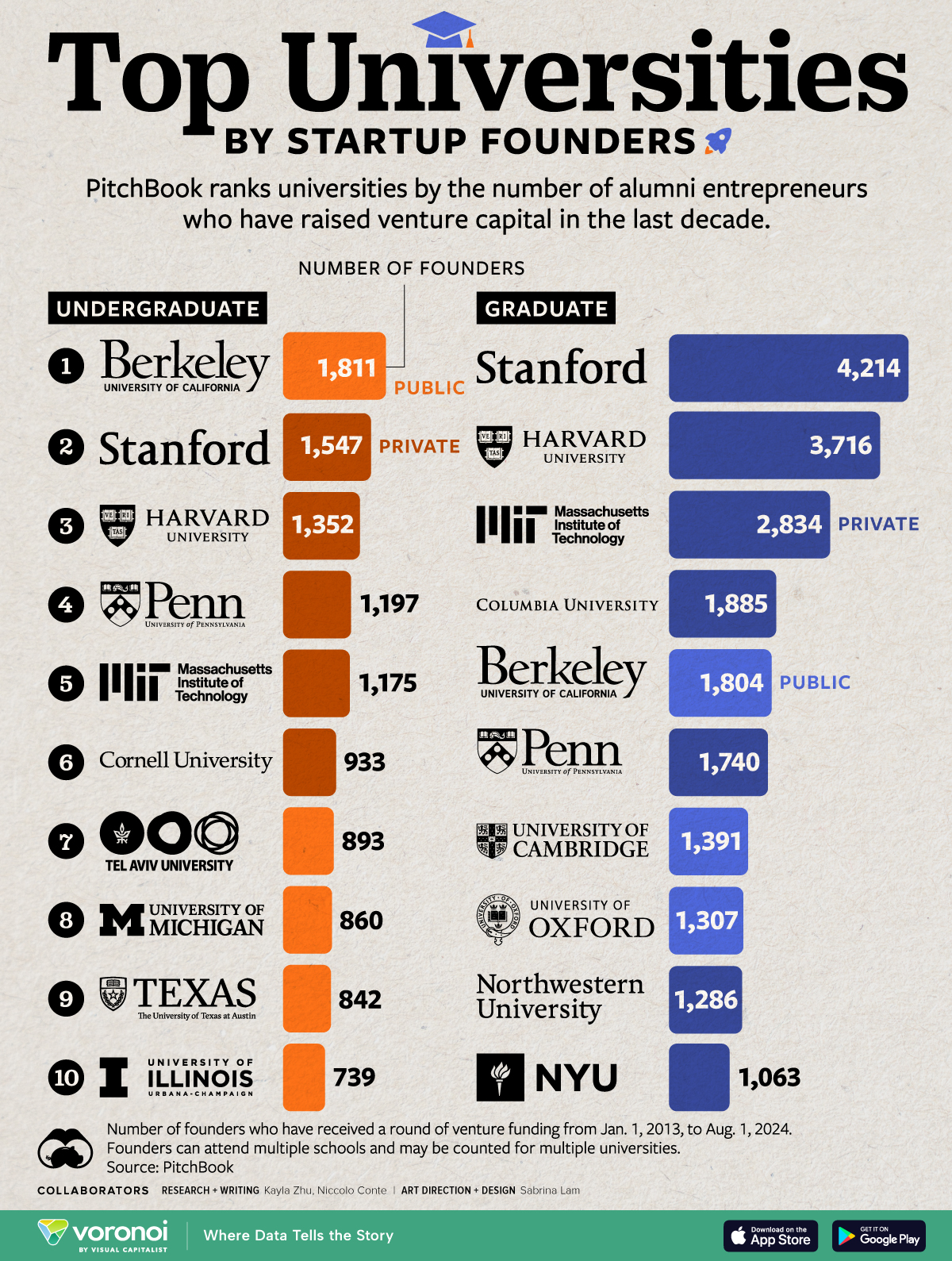
A chart ranking the top universities by the number of startup founders they produce.
Source: Visual Capitalist

Master Comparison of Top University Startup Ecosystems

University Program/Directory Name Location/Focus Type
Columbia University Columbia Entrepreneurship New York City, USA / General Public Directory
University of Toronto U of T Startups Toronto, Canada / Deep Tech Filterable Public Directory
University of Virginia UVA Foundry Virginia, USA / General Curated Showcase
UW–Madison Innovate UW–Madison Wisconsin, USA / Resources Resource Meta-Directory
Stanford University StartX Silicon Valley, USA / Tech Accelerator Portfolio
MIT The Engine Boston, USA / "Tough Tech" VC Firm & Accelerator Portfolio
University of Cambridge Cambridge Enterprise Cambridge, UK / Deep Tech Commercialization Portfolio
IIT Bombay SINE Mumbai, India / Tech Incubator Portfolio
UC Berkeley Berkeley SkyDeck Silicon Valley, USA / Tech Accelerator Portfolio
Carnegie Mellon Project Olympus Pittsburgh, USA / Early-Stage Incubator "Project" List
University of Michigan Zell Lurie Institute Michigan, USA / Business Program-Based Showcase
University of Pennsylvania Penn Wharton Entrepreneurship Philadelphia, USA / Business Program-Based Showcase
ETH Zurich ETH Zurich Spin-offs Zurich, Switzerland / Deep Tech Formal Spin-off List
INSEAD INSEAD Startup Directory Global (FR, SG, UAE) / MBA Alumni Network Directory
University of Waterloo Velocity Waterloo, Canada / Deep Tech Incubator Portfolio

1. Columbia University - Columbia Entrepreneurship Startup Directory

The Columbia Entrepreneurship Startup Directory is a central platform showcasing ventures from its New York City campus community. It offers a straightforward submission process for affiliated founders to gain visibility within Columbia's influential network in finance, media, and tech. The platform highlights "All-Stars" to leverage the success of past ventures, boosting the profile of the entire community.

  • How to Get Listed: Founders with a Columbia affiliation (student, alumni, faculty, or staff) can add their venture via a simple submission form on the Columbia Entrepreneurship website.
  • Pros: Extremely easy submission, powerful NYC-based alumni network, strong brand association.
  • Cons: The public interface is less feature-rich, lacking advanced filtering.
The Columbia Entrepreneurship All-Stars website showcasing successful startups from the university.
Source: Columbia Entrepreneurship

2. University of Toronto - U of T Startups

The University of Toronto's startup directory is a comprehensive, public database of over 790 ventures connected to the university. It is highly filterable by industry, demonstrating the school's significant role in Canada's tech ecosystem, especially in AI and life sciences. The directory is a searchable database that allows investors and job seekers to easily navigate the massive innovation ecosystem.

  • How to Get Listed: Eligibility is broad, open to companies founded by U of T affiliates, those using U of T IP, or participants in one of its 10+ campus accelerators.
  • Pros: Highly filterable and user-friendly, showcases deep-tech ventures, provides strong economic impact data.
  • Cons: Network influence is heavily concentrated within the Canadian tech scene.

3. University of Virginia - UVA Foundry Startup Directory

The UVA Foundry Startup Directory is a curated, actively managed showcase of high-potential ventures with ties to the University of Virginia. It emphasizes quality over quantity, featuring well-crafted profiles for companies like Reddit. It functions as a high-quality portfolio focused on storytelling, making it a high-signal source for investors.

  • How to Get Listed: The directory is curated by the Batten Institute. Founders typically need to engage with the institute's programs (like the E-Cup competition or i.Lab Incubator) to be considered.
  • Pros: High-quality, curated list implies vetting; excellent startup descriptions; association with major successes.
  • Cons: Smaller, exclusive list with no direct submission form for all alumni.

4. University of Wisconsin–Madison - Innovate UW–Madison Directory

The Innovate UW–Madison Directory is a unique meta-directory that lists on-campus entrepreneurial resources, not the startups themselves. It serves as a navigational tool for founders to find the right support program, clinic, or lab within the university's sprawling ecosystem, solving the challenge of finding the right starting point at a large research institution.

  • How to Get Listed: This directory is for campus partner organizations, not individual startups. Founders use it to find a program that can support them.
  • Pros: Extremely useful for navigating a complex university; acts as a gateway to mentorship and funding.
  • Cons: It is not a directory for showcasing a startup to external investors or customers.

5. Stanford University - StartX

StartX is a prestigious accelerator and founder community for Stanford's top entrepreneurs, whose directory functions as a who's who of Silicon Valley. A listing signifies acceptance into an exclusive, high-performance ecosystem. Being a "StartX company" carries significant weight. It has supported hundreds of startups that have raised billions in funding.

  • How to Get Listed: A startup must be accepted into the StartX accelerator program, which requires a highly competitive application and at least one Stanford-affiliated founder.
  • Pros: Incredible brand recognition, direct access to top-tier VCs, strong community, takes no equity.
  • Cons: Extremely competitive and exclusive.

6. MIT - The Engine

The Engine, an entity spun out of MIT, is an accelerator and venture firm whose portfolio serves as a directory for "Tough Tech" companies. It focuses on startups solving significant global challenges through deep science and engineering breakthroughs. They provide patient capital and access to specialized infrastructure, including lab space and expensive equipment.

  • How to Get Listed: Startups must be part of The Engine's investment portfolio or utilize their specialized infrastructure, which involves a rigorous diligence process.
  • Pros: Access to unparalleled lab facilities, a network of patient investors, deep technical expertise.
  • Cons: Primarily focused on hardware, biotech, and deep-tech; less relevant for pure software startups.

7. University of Cambridge - Cambridge Enterprise

Cambridge Enterprise is the commercialization arm of the University of Cambridge, and its portfolio is a key player in the UK startup scene. The directory is rich with life sciences and deep-tech companies spun out from the university's world-leading research, providing a clear and credible link back to the source innovation.

  • How to Get Listed: The portfolio primarily features spin-out companies created from university research or that have received investment from the Cambridge Enterprise Venture Funds.
  • Pros: Powerful validation for science-based startups in Europe, direct link to a globally respected research institution.
  • Cons: Highly focused on research commercialization, making it inaccessible to general student/alumni startups.

8. Indian Institute of Technology Bombay - SINE

The Society for Innovation and Entrepreneurship (SINE) at IIT Bombay is a premier Technology Business Incubator in India. Its directory of incubated companies is a top resource for discovering the country's best deep-tech and B2B SaaS talent. SINE leverages the immense engineering prowess of IIT Bombay to nurture high-growth startups.

  • How to Get Listed: Companies must apply and be accepted into the highly competitive SINE incubation program.
  • Pros: The IIT brand carries enormous credibility in India and Asia; access to government grants and a strong domestic investor network.
  • Cons: The process is rigorous and tied to a physical incubation program in Mumbai.

9. UC Berkeley - Berkeley SkyDeck

Berkeley SkyDeck is a top global accelerator whose portfolio acts as a directory of high-growth startups from the University of California system and beyond. It is renowned for its unique model, which pairs startups with expert advisors and provides access to a large, active fund. The program is particularly strong in AI, robotics, and life sciences.

  • How to Get Listed: Acceptance into SkyDeck's Cohort (for equity) or Hot Desk (no equity) program is required through a highly competitive application process.
  • Pros: Access to a massive network of UC Berkeley alumni and faculty advisors, direct investment opportunities.
  • Cons: Global competition makes acceptance rates very low.

10. Carnegie Mellon University - Project Olympus

Project Olympus at Carnegie Mellon's Swartz Center for Entrepreneurship serves as an incubator and directory for the earliest-stage ideas within the CMU community. It's a "pre-accelerator," helping students and faculty de-risk their concepts with micro-grants and mentorship before formal company creation.

  • How to Get Listed: CMU-affiliated individuals and teams can apply to the program with a raw or early-stage idea.
  • Pros: Excellent for very early-stage ideas, provides a safe educational environment to test a concept.
  • Cons: The directory contains "projects," not just incorporated companies, requiring more diligence from investors.

11. University of Michigan - Zell Lurie Institute Startup Directory

The Zell Lurie Institute at the University of Michigan's Ross School of Business maintains a directory of startups from its action-based learning programs. This directory is a strong source for ventures in mobility, healthcare, and consumer goods, often led by MBA talent that has undergone business plan scrutiny.

  • How to Get Listed: Participation in ZLI programs or receiving investment from its affiliated student-led funds is the primary path to being featured.
  • Pros: Strong focus on business model validation, access to a powerful Midwest alumni network.
  • Cons: The directory is more of a collection of success stories than a comprehensive, searchable database.

12. University of Pennsylvania - Penn Wharton Entrepreneurship

Penn Wharton Entrepreneurship's directory showcases ventures from its globally recognized programs, with a heavy emphasis on fintech, e-commerce, and SaaS. The list is a goldmine for investors looking for startups with polished business models, featuring winners of the Penn Wharton Startup Challenge.

  • How to Get Listed: Active participation in Penn Wharton Entrepreneurship programs, competitions, or the Venture Lab incubator is the gateway to inclusion.
  • Pros: Strong signal of business viability, deep network in finance and venture capital on the East Coast.
  • Cons: Highly competitive environment; listing is tied to success within their specific programs.

13. ETH Zurich - ETH Zurich Spin-offs

The ETH Zurich Spin-offs directory is a premier European database of deep-tech companies born from one of the world's leading science and technology universities. The "ETH Zurich Spin-off" label is a protected trademark that signifies a high degree of technological innovation and a strong link to university research.

  • How to Get Listed: Companies must go through a formal application process to earn the label, requiring the business to be based on an ETH technology or knowledge transfer.
  • Pros: The "ETH Spin-off" label is a highly respected seal of quality in Europe; access to groundbreaking research.
  • Cons: The process is formal and limited to ventures with a direct, demonstrable link to ETH research.

14. INSEAD - Startup Directory

The INSEAD Startup Directory leverages the school's "Business School for the World" ethos, showcasing a globally diverse portfolio of MBA-founded companies. It is an excellent resource for finding startups founded by seasoned professionals and built for international scale from day one.

  • How to Get Listed: The directory is open to submission from INSEAD alumni founders via the school's alumni portal.
  • Pros: Founders often have significant prior industry experience; strong international network across Europe, Asia, and North America.
  • Cons: Less focused on deep-tech and more on innovative business models and international strategy.

15. University of Waterloo - Velocity

Velocity is the University of Waterloo's leading entrepreneurship program, whose founder directory highlights top Canadian startups with a strong focus on deep tech and B2B SaaS. It is known for its founder-friendly, creator-owned IP policy and its track record of producing resilient, product-focused companies.

  • How to Get Listed: Startups must be accepted into one of Velocity's programs, which range from pre-seed concept labs to the full-fledged Velocity Incubator.
  • Pros: Creator-owned IP policy is extremely attractive to founders; strong pipeline of technical talent.
  • Cons: Entry is competitive and requires a formal application and review process.

How to Get Your Startup Listed and Maximize Your Profile

To maximize your startup directory listing, you must treat your profile as a strategic asset, not a one-time submission. This involves crafting a clear one-liner, using high-quality visuals, completing every data field, and keeping the profile updated with milestones. Getting listed is just the first step.

A Founder's Pre-Submission Checklist

Before you hit "submit," ensure you have these assets ready. This will make your profile stand out and save you time.

Asset Best Practice Why It Matters
One-Liner "We help [X Customer] do [Y Thing] with [Z Secret Sauce]." Be clear, not clever. An investor or journalist should grasp your entire business in 5 seconds.
Company Logo High-resolution (at least 1024x1024px) PNG with a transparent background. This is your digital handshake. A blurry logo signals a lack of attention to detail.
Founder Photos Professional or semi-professional headshots. Consistent lighting and style. People connect with people. It builds trust and shows there's a real team behind the idea.
Concise Description 2-3 paragraphs. Problem, Solution, Market, and Traction. Use bullet points for key features. This is your elevator pitch. Make it scannable and compelling. Quantify your claims.
Key Links Your main website, a polished company LinkedIn page, or a centralized link page, and one key social profile. Create a clear path for interested parties to learn more and engage with your brand.
Milestone Tracking A list of 2-3 key achievements (e.g., "Launched MVP," "Reached 1,000 users," "Closed $500k pre-seed"). This shows momentum. Plan to update this every quarter or after every major achievement.

For Investors: How to Use These Directories for Deal Flow

Investors can use university startup directories for early-stage deal flow by developing a university-specific thesis, systematically tracking ventures, and leveraging the alumni network for warm introductions. These platforms offer a curated, high-signal source of pre-vetted talent.

1. Develop a University-Specific Thesis. Don't browse randomly. Align your investment thesis with a university's strengths. Are you a deep-tech investor? Focus on MIT, Cambridge, and ETH Zurich. Interested in high-growth B2B SaaS? Stanford and Waterloo are key targets.

2. Build a Systematic Pipeline. Treat this like a professional sourcing operation. Use a simple CRM or spreadsheet to track companies, founders, industries, and your contact status. This turns browsing into a repeatable process.

3. Leverage the "Warm Intro." Your single biggest advantage is the shared affiliation. Cold emails have low response rates. A warm outreach mentioning your shared alma mater dramatically increases your chances of getting a reply. Start with, "Hi [Founder], I'm a fellow [University] alum and an investor..."

4. Acknowledge the Stage. Be aware that many companies in these directories are very early. The university listing gets them a first look, but it doesn't replace the need for rigorous due diligence on the team, technology, and market.

Understanding the Ecosystem: Incubators vs. Accelerators

While directories are fantastic for visibility, many of these universities also host structured programs. Understanding the difference is key. A directory is a showcase; an accelerator or incubator is a program.

  • University Incubator: Focuses on the earliest stages. It "incubates" an idea, providing space, resources, and mentorship to help it hatch. Examples include Project Olympus at CMU. They often take little to no equity.
  • University Accelerator: This is a step up. It "accelerates" a startup that has a product and some early traction. It's a time-bound program (usually 3-6 months) with intensive mentorship and a focus on hitting growth metrics, culminating in a Demo Day. Examples include StartX and SkyDeck, which often provide funding for equity.

Conclusion: Leverage Academia for Your Launchpad

University startup directories are curated gateways to the talent, funding, and credibility required for a successful launch. By strategically engaging with these academic ecosystems, founders can tap into a powerful and loyal community that is predisposed to support their success.

These platforms are far more than just lists; they are living ecosystems. While global directories like the YC startup directory are an essential target, the power of your academic network should never be underestimated. Securing a spot in your alma mater's directory provides a foundational layer of social proof, signaling that you come from a place of innovation. Explore the directories from your university, connect with the program managers, and claim your place in a community that genuinely wants you to win.

What Launched Today is a directory where founders can launch their startups to be discovered by thousands of other founders. The platform helps new products get initial users and a high domain rating backlink. Explore more at https://whatlaunched.today.

Frequently Asked Questions (FAQ)

What is a startup directory?

A startup directory is an online list or database of new businesses, often organized and filterable by industry, location, or funding stage. These directories serve as a discovery tool for investors, customers, job seekers, and journalists looking to see what's trending.

How do I submit my startup to a directory?

Most startup directories have a "Submit Startup" or "Add Your Company" link on their website that leads to a submission form. This form typically requests your company's name, website, a brief description, and founder information. University directories almost always require proof of affiliation (student, alumni, faculty).

What is the difference between a startup directory and the Windows startup directory?

A business "startup directory" is a list of companies, whereas the "Windows startup directory" is a specific system folder on a computer. The latter contains programs configured to launch automatically when the Windows operating system starts up. The two concepts are completely unrelated.

Are there startup directories for specific countries like the USA, UK, or India?

Yes, numerous startup directories are country-specific. University platforms often serve as top-tier national directories, but many independent platforms also exist. The universities in this list like Stanford (USA), Cambridge (UK), and IIT Bombay (India) represent hubs within their respective national ecosystems.

Besides visibility, what's the biggest benefit of being in a university directory?

The biggest benefit is access to the "warm" alumni network. It provides a level of trust and shared identity that makes it significantly easier to connect with potential investors, mentors, co-founders, and early employees who are also affiliated with the university.

What if my university doesn't have a public startup directory?

If your university lacks a directory, connect with the alumni association, the entrepreneurship center, or the career services office. They often maintain internal lists or can connect you to relevant resources and alumni groups on platforms like LinkedIn. These channels can provide many of the same networking benefits.