





The 2026 Active Startup Investor Directory: 35+ Places to Find Funding

Published on May 23, 2026

Our 2026 active startup investor directory lists 35+ platforms to find funding. Discover top venture capitalists, angel investors, and VCs to fuel your growth.

The 2026 Active Startup Investor Directory: 35+ Places to Find Funding

An active startup investor directory is a curated database or platform that lists venture capitalists, angel investors, and investment firms who are currently making new investments in early-stage companies. In a fundraising landscape where capital is competitive, these directories are not just lists; they are essential strategic tools for founders seeking to connect with the right partners to fuel their growth.

This guide provides over 35 essential platforms and, more importantly, explains precisely how to use them to secure funding for your new product launch.

Understanding the Fundraising Ecosystem: Types of Investor Directories

An investor directory is not a monolithic entity; different types serve distinct purposes for founders at various stages. Understanding these categories is the first step to a targeted and efficient fundraising strategy, preventing wasted effort on mismatched investors and maximizing your chances of a warm reception.

Think of it this way: you wouldn't use a map of the subway to navigate a cross-country road trip. Similarly, using a late-stage private equity directory for your pre-seed idea is a recipe for frustration. The key is matching the directory type to your startup's specific needs, funding stage (Pre-Seed, Seed, Series A), and industry.

  • Broad Databases: These are the massive encyclopedias of the startup world, like Crunchbase or PitchBook. They aim to catalog every company, fund, and investor. They are incredibly powerful for macro-level research and building your initial "long list" of potential investors, but can be overwhelming without a paid subscription and a clear plan.
  • Angel Networks & Syndicates: These platforms, such as AngelList or Gust, are designed to connect founders with groups of high-net-worth individuals, known as angel investors. These investors often pool their capital and expertise into syndicates, making them a primary source for pre-seed and seed-stage funding. Angels often invest their own money and can be more flexible and founder-friendly than institutional funds.
  • VC Firm Lists & Portfolios: These aren't directories in the traditional sense. Instead, they are the public lists of companies a venture capital firm has already funded. They are invaluable for "pattern matching"—understanding a VC's investment thesis before you even think about outreach. This is the most crucial source for finding investors who have a proven track record in your specific domain.
  • Accelerator Directories: Lists of startups associated with elite programs like Y Combinator or Techstars are a goldmine for both founders and investors. For founders, studying a YC startup directory shows you what "good" looks like to top-tier funders. For investors, these directories are a curated source of high-potential deal flow.
  • Niche & Regional Platforms: These directories focus on a specific industry (e.g., an AI startup directory) or a particular geography (e.g., startup directory USA, startup directory UK). They offer a more concentrated and often more accessible pool of relevant investors who have deep domain expertise and local network connections.

A Quick Clarification: Business Directories vs. The Windows "Startup" Folder

A common point of confusion arises from the term "startup directory," which has a completely different meaning in the world of computing. It's vital to distinguish this technical term from the business context of fundraising.

What is the "startup directory" in Windows 10 or 11?

The "startup directory" in Windows 10 and Windows 11 refers to a specific system folder that contains shortcuts to applications set to run automatically when the computer starts. This is a technical operating system function that allows users to customize which programs launch on boot for convenience. It has absolutely no connection to business, venture capital, or finding investors.

This article focuses on the business meaning: a startup directory listing where you can find active investors to fund your company. We're talking about raising capital, not launching applications on boot.

Entity Attribute Value
Startup Directory (Windows) Purpose Stores shortcuts for apps that run on computer startup.
Startup Directory (Business) Purpose Lists startup companies for discovery by users, investors, or partners.
Active Investor Directory Purpose Lists investors and firms actively seeking new companies to fund.

Top-Tier Investor Databases & Platforms

These platforms are the cornerstones of professional fundraising research. They are dense with data and require a strategic approach, but the insights you can pull from them are unmatched for building a targeted investor outreach list.

1. Crunchbase

Crunchbase is a crowdsourced database platform that provides extensive information on private and public companies, investors, and funding rounds. It's the go-to starting point for mapping out an industry, researching competitor funding, and identifying who is actively investing in your space.

  • Pros: Massive, comprehensive database; powerful search and filtering (e.g., by recent investment date, geography, industry) are indispensable with a Pro subscription; great for setting up alerts on competitors or target investors.
  • Cons: The most valuable data and search tools are behind a paywall; because it's crowdsourced, data can occasionally be out of date, requiring verification.
Entity Attribute Value
Crunchbase Primary Use Case Market research, investor discovery, funding round analysis.
Crunchbase Pricing Model Freemium with a Pro subscription for advanced features.
Crunchbase Key Feature Detailed profiles on companies, people, and investors with funding histories.

2. PitchBook

PitchBook is a premium financial data and software company that provides highly detailed, verified data on venture capital, private equity, and M&A transactions. This is the professional-grade tool used by VCs and investment bankers to conduct deep due diligence and track key business analytics.

  • Pros: Incredibly accurate and high-quality data, verified by a large team of analysts; excellent for deep dives on an investor's track record, fund performance, and specific portfolio details.
  • Cons: Extremely expensive. Its enterprise-focused pricing makes it inaccessible for most early-stage, bootstrapped founders.
Entity Attribute Value
PitchBook Primary Use Case Deep due diligence, private market intelligence, deal sourcing.
PitchBook Target Audience VCs, private equity firms, investment banks, enterprise corporations.
PitchBook Key Differentiator Human-verified data quality and depth.

3. AngelList (now Wellfound)

AngelList is a foundational platform in the startup ecosystem, designed to connect startups with angel investors and talent. While it has rebranded its talent side to Wellfound, it remains a critical hub for fundraising, especially for connecting with early-stage syndicates and individual angels.

  • Pros: One of the largest and most active communities of angel investors; excellent for discovering "syndicates" (groups of angels led by an experienced investor).
  • Cons: The platform has become increasingly crowded, making it a challenge to stand out; the rebrand to Wellfound has shifted some of the focus toward recruiting.
Entity Attribute Value
AngelList Primary Use Case Connecting with angel investors, finding syndicates, startup hiring.
AngelList Cost Free for startups to create a profile.
AngelList Investor Type Angel Investors, Seed Funds, Syndicates.

4. Signal NFX

Signal is a free tool from venture firm NFX that maps your social connections to show you the warmest introduction path to thousands of investors. It's built on the principle that a warm intro from a trusted contact is exponentially more effective than a cold email.

  • Pros: Completely free to use; laser-focused on solving the crucial "warm intro" problem; leverages your existing network to find powerful connections.
  • Cons: Its effectiveness is directly proportional to the strength and breadth of your existing network; it's a tool for finding paths, not for initial investor discovery.
Entity Attribute Value
Signal NFX Primary Use Case Finding warm introduction paths to investors.
Signal NFX Cost Free.
Signal NFX Core Concept Network graph analysis for fundraising.

5. CB Insights

CB Insights is a business analytics platform that uses data to predict technology trends. For founders, it's less of an outreach tool and more of a strategic intelligence platform to build a data-driven narrative for their pitch deck.

  • Pros: Fantastic for high-level market research and understanding "what's next"; identifies the most active investors in a specific tech vertical; great for sourcing charts and data to strengthen your pitch.
  • Cons: Subscription is expensive; it's a market intelligence tool, not a direct investor matchmaking or outreach platform.
Entity Attribute Value
CB Insights Primary Use Case Market trend analysis, competitive intelligence, tech discovery.
CB Insights Target Audience Corporate strategy, venture capital, innovation teams.
CB Insights Key Feature "Expert Collections" and data visualizations of market trends.

Leading Angel Investor Networks & Prominent Individuals

Angel networks are where the action happens for many pre-seed and seed-stage companies. These aren't just lists; they are organized communities of active investors who meet regularly to review deals.

6. Tech Coast Angels (TCA)

Tech Coast Angels is one of the largest and most active angel investor networks in the United States, focused on funding startups in Southern California. They provide not just capital but also hands-on mentorship from a network of seasoned operators and executives.

  • Pros: Highly respected and well-connected network; provides mentorship and business connections in addition to capital; strong track record.
  • Cons: Geographically focused on Southern California; the application and pitching process is rigorous.

7. TiE SoCal Angels

TiE SoCal is a network of successful entrepreneurs and professionals who invest in and mentor the next generation of founders. It is part of the global TiE (The Indus Entrepreneurs) network, giving it a broad and diverse reach.

  • Pros: Strong emphasis on mentorship from experienced operators; access to a global network of mentors and potential customers.
  • Cons: Regional focus on Southern California, though its global network is a significant advantage.

8. Gust

Gust is a global SaaS platform that powers a vast number of angel investor groups and accelerators, providing a centralized system for them to manage deal flow. For founders, it's a one-stop-shop to apply to many different groups using a single, standardized profile.

  • Pros: A single application can be seen by multiple investor groups you apply to; streamlines the application process.
  • Cons: You're still applying to individual groups, each with its own criteria and review process. The platform is a facilitator, not a magic bullet.

9. F6S

F6S is a massive global community platform for founders, startups, and investors. Its sheer scale makes it a useful tool for making initial connections with a wide array of early-stage funders from around the world.

  • Pros: Huge global reach; a great source for finding accelerators and grants, not just direct investment; frequent pitch opportunities.
  • Cons: Its size can make it feel unfocused and noisy; less about deep investor matchmaking and more about broad community networking.

10. SeedInvest

SeedInvest is a prominent equity crowdfunding platform that allows startups to raise capital from both accredited and non-accredited investors. It attracts a mix of traditional angel investors and VCs to its deals.

  • Pros: Provides a structured, compliant fundraising process; access to a large pool of potential investors can create buzz and momentum.
  • Cons: Extremely competitive, with a rigorous due diligence process; only a small fraction (around 1%) of applicants are accepted.

Notable Individual Angel Investors

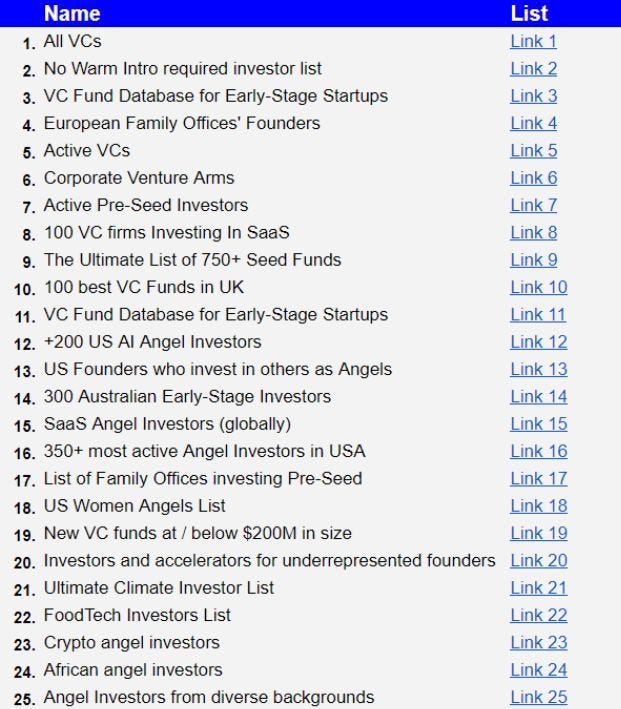
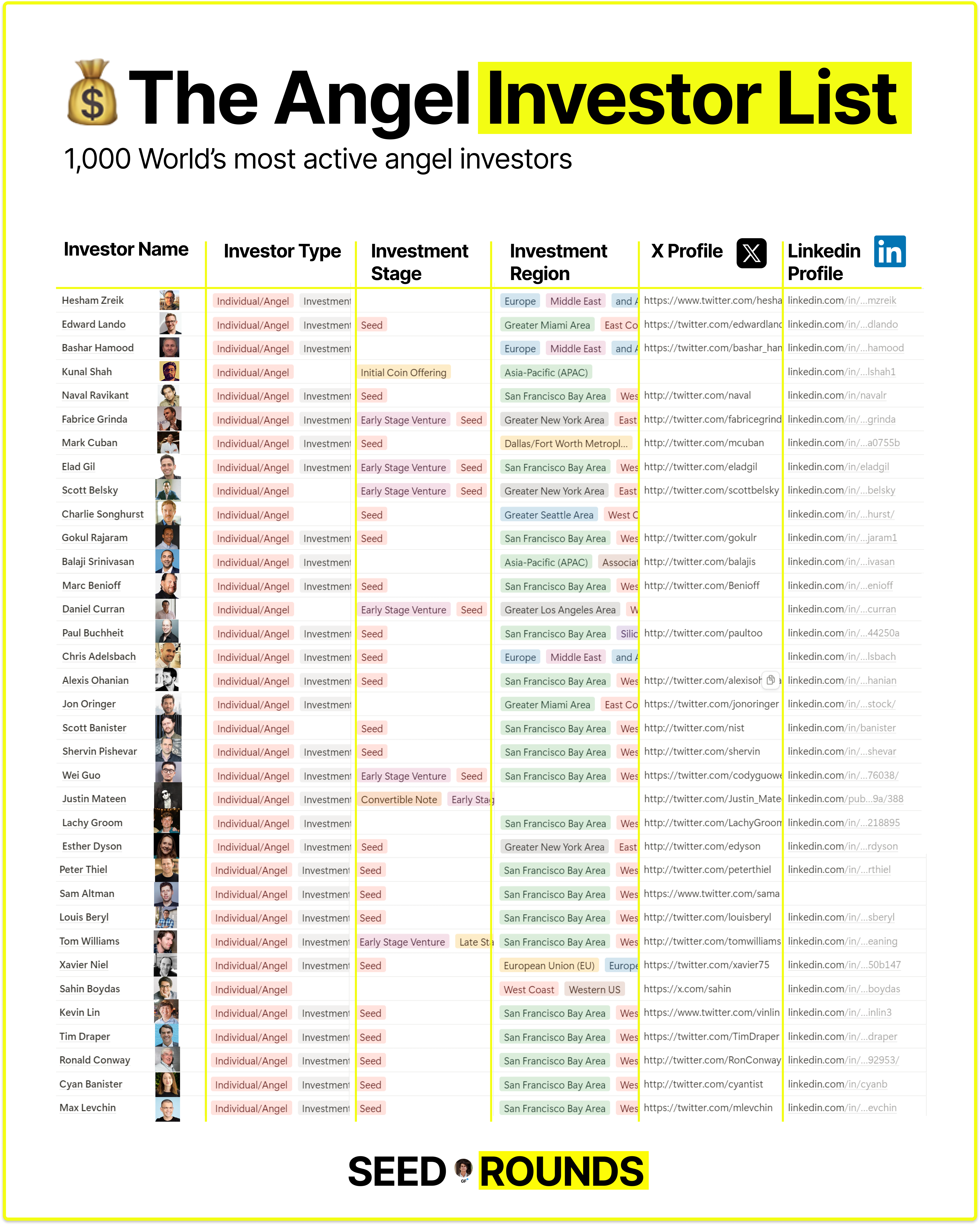
Beyond networks, many prolific individual angel investors have a public Investor Profile and are receptive to well-crafted outreach. You can often find them on platforms like AngelList, by tracking deals on Crunchbase, or by being active on social media.
Portrait of notable angel investor Naval Ravikant.
Source: substackcdn.com

  • Naval Ravikant: Co-founder of AngelList. Known for philosophical insights and investments in companies like Uber.
  • Mark Cuban: Entrepreneur and investor. Known for a diverse portfolio across many sectors, often from his role on "Shark Tank."
  • Hesham Zreik: One of the most prolific angels listed on platforms, with hundreds of investments including Vroom.
  • Fabrice Grinda: A prolific investor with a focus on marketplaces and a massive portfolio.
  • Scott Belsky: Founder of Behance and Adobe's Chief Strategy Officer. Invests in creator economy and future-of-work startups.
  • Elad Gil: Former Google/Twitter exec and author of the "High Growth Handbook." A highly sought-after investor and advisor.

VC & Accelerator Portfolios: The Art of "Portfolio Mining"

Here’s a professional strategy that most founders miss. The best way to understand if a VC is a good fit is not by reading their blog, but by meticulously studying their portfolio. This is "Portfolio Mining." You're looking for patterns. Who do they invest in? At what stage? Who did they co-invest with? This is detective work that pays massive dividends.

11. The Y Combinator Startup Directory

The Y Combinator Startup Directory is arguably the most prestigious list of early-stage companies in the world. Investors constantly monitor this directory for new opportunities.

  • Pros: Getting listed is a powerful stamp of validation; the YC startup directory is a primary source of deal flow for nearly every top-tier investor.
  • Cons: It's exclusive to companies accepted into YC. You can't just submit your startup; you have to earn your way in.
  • Actionable Workflow: Search the directory for companies in your space. Use Crunchbase to see which VCs and angels invested in their seed rounds immediately following YC Demo Day. These are your prime targets.

12. Techstars Portfolio

The Techstars Portfolio is a searchable database of all companies that have completed one of their numerous global accelerator programs. It's an excellent resource for researching investors active in your niche or region.
  • Pros: A large, diverse portfolio spanning many industries and geographies; showcases companies that are well-mentored and venture-ready.
  • Cons: It's a research tool, not a direct contact list. You need to do the work to connect a portfolio company to its specific seed-stage investors.

13. 500 Global Portfolio

The 500 Global portfolio features thousands of startups from over 80 countries, reflecting their mission to invest in talent globally. Their list shows a wide investment appetite and is particularly strong for identifying investors open to international deals.

  • Pros: Incredibly diverse and global portfolio, perfect for identifying international VCs and trends.
  • Cons: Like other portfolio lists, it's a starting point for research, requiring you to dig deeper to find the right contacts.

14. Andreessen Horowitz (a16z) Portfolio

The a16z portfolio is a curated list of companies backed by one of the most influential venture capital firms in the world. It serves as a bellwether for major technology trends.

  • Pros: Studying their portfolio helps you understand what a truly "category-defining" thesis looks like. Their content is an invaluable education for any founder.
  • Cons: Not a tool for outreach. Access is almost exclusively through warm introductions from trusted sources in their network.

15. Sequoia Capital Portfolio

The Sequoia Capital portfolio is a hall of fame of tech companies, from Apple and Google to Airbnb and Stripe. Analyzing their investments provides a masterclass in what it takes to build an enduring, iconic company.

  • Pros: Offers unparalleled insight into the DNA of legendary companies; a clear signal of the types of "outlier" businesses they seek.
  • Cons: The absolute pinnacle of VC; not a realistic target for most early-stage startups without a game-changing breakthrough or a very warm introduction.

Geographically-Focused Investor Directories

Fundraising is often a local game, especially at the pre-seed and seed stages. Building relationships with investors in your city or region can provide a significant advantage.

16. Startup Directory USA: State & Local Angel Groups

The United States startup ecosystem is a vibrant collection of regional hubs. Success lies in tapping into powerful, local groups.

  • Examples: New York Angels (NYC), Tech Coast Angels (SoCal), Central Texas Angel Network (CTAN, Austin), Alliance of Angels (Seattle), and Hyde Park Angels (Chicago).
  • Pros: Local investors are often more accessible and host regular pitch events; they are deeply embedded in the local talent and customer ecosystem.
  • Cons: Requires research to identify the most active and relevant group for your specific city, state, or region.

17. Startup Directory UK: UK Business Angels Association (UKBAA)

The UKBAA is the national trade association for angel and early-stage investment, making its member directory the definitive starting point for finding vetted investors in the UK.

  • Pros: The most credible and comprehensive source for vetted, active angel groups, funds, and individuals across the United Kingdom.
  • Cons: Full access to the member directory may require a paid membership or attendance at their events.

18. Startup Directory India: Indian Angel Network (IAN)

The Indian Angel Network is one of the largest and most influential angel networks in India, with a vast group of investors and a diverse, successful portfolio.

  • Pros: A high-profile network that provides strong mentorship and opens doors in the complex Indian market.
  • Cons: The application process is extremely competitive due to its high profile and success rate.

19. Hypepotamus (Southeast USA)

Hypepotamus provides a curated investor list specifically focused on venture capital firms and angel groups active in the Southeastern United States.

  • Pros: A fantastic, targeted resource for founders in burgeoning tech hubs like Atlanta, Nashville, and Miami.
  • Cons: Highly regional. It is only useful for founders building in or targeting the Southeast US.

Niche & Industry-Specific Investor Discovery

Generalist investors are great, but specialist investors are better. They speak your language, understand your market's nuances, and have a "rolodex" of relevant customers and partners.

20. AI Startup Directory: Portfolio Mining

To find investors for an AI startup, you must analyze the portfolios of AI-first venture capital firms like Emergence Capital, Glasswing Ventures, or Radical Ventures. Find the investors who live and breathe your specific niche for tools like Codaone AI.

  • Pros: These investors have deep domain expertise in AI/ML and can help with technical and go-to-market challenges specific to AI products.
  • Cons: Requires significant manual research to identify the right partners within these firms and understand their specific investment theses.

21. SaaS Startup Directory: Portfolio Mining

The best way to create a SaaS-focused investor list is to study the portfolios of top SaaS VCs like SaaStr Fund, OpenView, or Bessemer Venture Partners.

  • Pros: These investors live and breathe SaaS metrics (MRR, LTV:CAC, Churn). Their mentorship on pricing, sales, and marketing is invaluable.
  • Cons: The top SaaS firms are highly sought-after, making a warm introduction and crisp metrics essential.

22-28+. Further Niche & Regional Examples

This strategy of 'portfolio mining' can be applied to virtually any industry. Here are some of the leading specialist firms to start your research in key sectors:

Industry Key VC Firms to Research
FinTech Ribbit Capital, F-Prime Capital, QED Investors
HealthTech Rock Health, a16z Bio+Health, General Catalyst
Climate Tech Lowercarbon Capital, Breakthrough Energy Ventures, Congruent Ventures
Enterprise Software Insight Partners, 8VC, Lightspeed Venture Partners
Consumer Tech Accel, First Round Capital, Forerunner Ventures
Logistics & Supply Chain Playground Global, Eclipse Ventures, Schematic Ventures
Canadian Startups MaRS IAF, Real Ventures, Georgian

Investor Vetting Checklist: How to Qualify Your Targets

Before you spend a single second on outreach, you must vet your potential investors. Sending an email to the wrong investor is worse than sending no email at all. Use this checklist to qualify every name on your list.

  • ✅ Thesis Alignment: Does their website's stated thesis explicitly match your industry, business model (e.g., B2B SaaS, D2C), and stage (pre-seed, seed, Series A)? If not, disqualify immediately.
  • ✅ Recent Activity: Have they announced a new fund or a new investment in the last 6-12 months? Check Crunchbase or their blog. An investor who just raised a new fund is actively looking for deals.
  • ✅ Portfolio Synergy/Conflict: Look at their portfolio. Do they have companies you could partner with? More importantly, do they have a direct competitor? Pitching an investor who funded your rival is a fatal error.
  • ✅ Partner-Level Expertise: Don't target the firm; target a specific partner at the firm. Check LinkedIn to see which partner has the most relevant operating experience or investment history for your startup.
  • ✅ Reputation Check (The Backchannel): This is the pro move. Find founders of their portfolio companies and ask for a quick, confidential chat. Ask them: "What was your experience like? Were they helpful during tough times?" Their answers are gold.
  • ✅ Value-Add Beyond Capital: What do they offer besides money? Look for evidence of a platform team that helps with recruiting, marketing, sales, or future fundraising. A great investor is a partner, not just a bank.

How to Effectively Use an Active Startup Investor Directory

Finding a list is step one. Using it effectively is what separates successful founders from those who just spin their wheels. Fundraising is a sales process that requires a systematic, funnel-based approach.

Step 1: Build Your Long List (Top of Funnel)

Using tools like Crunchbase and portfolio mining, create a "long list" of 100-200 potential investors. At this stage, be inclusive. The goal is to cast a wide but relevant net.

Step 2: Qualify and Tier Your List (Middle of Funnel)

Apply the Investor Vetting Checklist to every name on your long list. This is where the real work happens. Be ruthless. Your goal is to narrow your list down to a "short list" of 20-40 highly-qualified, best-fit investors.

Diagram showing a startup fundraising sales funnel.
Source: substackcdn.com

Step 3: Engineer the Warm Introduction

For your top-tier list, a warm intro is non-negotiable. Use LinkedIn and Signal NFX to search for a path to an introduction. When you ask a mutual contact for an intro, make it easy for them. Provide a short, forwardable blurb about your company that they can copy and paste.

Step 4: Craft Personalized Outreach

Whether your email is cold or warm, personalization is key.

  • Concise Subject Line: "Intro from [Mutual Connection]: [Your Company], the [X] for [Y]"
  • The Hook: In the first sentence, demonstrate you've done your research. "Saw you invested in [Relevant Portfolio Co.] and thought our work in [adjacent space] would be of interest."
  • The Pitch: In 3-4 sentences, explain the problem, your solution, your traction (one key metric), and your team's unique insight.
  • The Ask: Clearly state what you are asking for. "We are raising a [$X] seed round. Would you be open to a brief 15-minute call next week?"
  • The Link: Link to your concise, well-designed pitch deck.

Step 5: Track Everything Like a Sales Funnel

Use a simple spreadsheet or CRM to track every interaction. Your columns should include: Investor Name, Firm, Partner, Status (Researched, Outreach Sent, Meeting Set, Passed), Last Contact Date, and Notes. This process can take months, and without a system, you will fail to follow up effectively.

Alternative Funding Resources: Beyond the VC Directory

Venture capital is a powerful tool, but it's not the right fit for every business. It often requires a "growth-at-all-costs" mindset and a clear path to a massive exit. Consider these alternatives.

  • Bootstrapping: The process of self-funding your company through personal savings or revenue. It ensures you retain full control. Communities like Indie Hackers are built around this ethos.
  • Grants: Non-dilutive capital from government programs (like SBIR/STTR in the US) or private foundations. These are highly competitive but are essentially free money.
  • Revenue-Based Financing (RBF): For companies with predictable revenue (like SaaS), platforms like Pipe or Capchase provide cash upfront in exchange for a percentage of future revenues.
  • Venture Debt: Loans designed for venture-backed startups that have already raised an equity round. It provides a less dilutive way to extend your runway.
  • Equity Crowdfunding: Platforms like Republic and Wefunder allow you to raise capital from a large number of unaccredited investors, turning your community into owners.

Comparison Table: Choosing the Right Investor Platform

Platform Best For Cost Investor Type Key Feature
Crunchbase Broad market research, building a "long list" Freemium, Pro starts at $49/mo VC, Angel, PE Comprehensive funding data & alerts
AngelList Early-stage startups, connecting with syndicates Free Angel, Syndicates Large, active community of angels
PitchBook Deep due diligence, enterprise-grade analysis Very High (Enterprise) VC, PE, M&A High-quality, human-verified data
Signal NFX Finding warm introduction paths to your target list Free VC, Angel Leverages your existing social graph
Portfolio Mining Finding the best-fit, specialist VCs for your niche Free (Time-intensive) VC, Specialist Angels Uncovers true investment thesis and relevance.

What Launched Today is a directory where founders can launch their startups to be discovered by thousands of other founders. The platform helps new products get initial users and a high domain rating backlink. Explore more at https://whatlaunched.today.

Frequently Asked Questions About Investor Directories

What is the best directory for finding startup investors?

There is no single "best" directory. A combination of tools is most effective. Use Crunchbase for broad research, AngelList for connecting with angel syndicates, and "Portfolio Mining" (researching VC websites) to find specialists in your industry.

How can I find investors for free?

Many powerful methods are free. You can use the free versions of Crunchbase and AngelList, leverage the completely free Signal NFX tool to find warm intros, and conduct portfolio mining research on VC websites. The most valuable resource you will spend is your time.

What's the difference between an angel investor and a venture capitalist (VC)?

Angel investors are typically high-net-worth individuals investing their own money into very early-stage (pre-seed/seed) companies. VCs are firms that invest other people's money from a large fund (Limited Partners) into startups across various stages, usually from seed to late-stage growth rounds.

Should I pay for a service like Crunchbase Pro or PitchBook?

For most early-stage founders, Crunchbase Pro offers a strong return on investment with its advanced search filters, which are crucial for building a targeted list. PitchBook is an enterprise-grade tool and is generally too expensive for bootstrapped startups unless you can get access through an accelerator or university program.

From Directory to Deal: What Comes Next?

Navigating these active investor directories is a critical part of the fundraising process. It requires research, diligence, and a strategic mindset. But finding the right investor is only half the battle. When you finally get that meeting, investors will ask one simple question: "What traction do you have?" They want to see proof that you're not just an idea on a slide deck, but a real product that people are already using. This is where many founders get stuck.

At Whatlaunched, we help solve that exact problem. Before you even send that first investor email, you need to generate buzz, attract your first users, and build social proof. Getting your product in front of thousands of fellow founders on our platform provides the initial momentum and validation that investors are looking for. It's the step before the pitch—the one that makes the pitch ten times more compelling. A launch on our directory gives you a tangible result: real users, valuable feedback, and a high-authority backlink that signals to the world, and investors, that you're building something people want.

Launch Your Startup on Whatlaunched →