



April 16, 2026
5 min read
Team

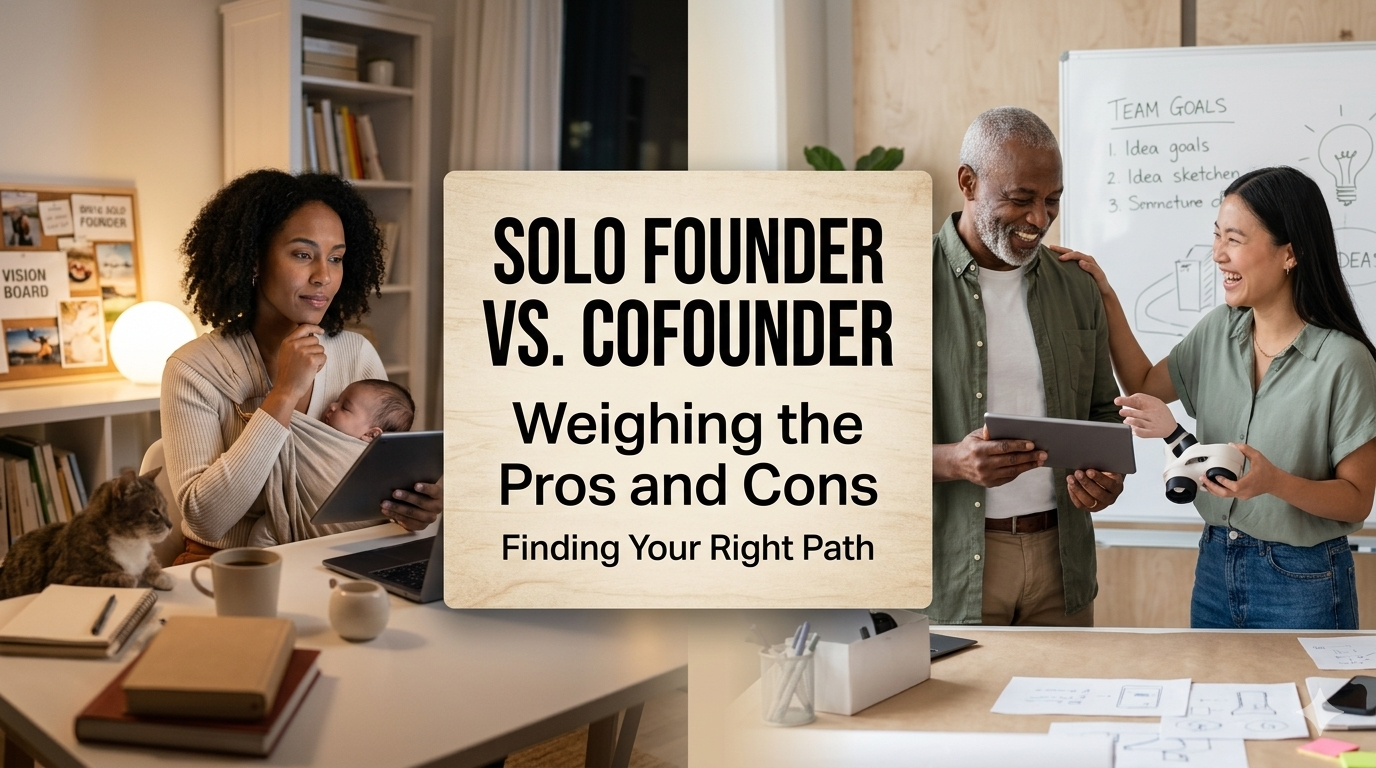
Solo Founder vs. Cofounder: Weighing the Pros and Cons

Deciding between being a solo founder vs. a cofounder? This guide weighs the solo founder pros cons against building a team, covering equity, control, and more.

FounderstartupStartup Launch
Share this article:
Solo Founder vs. Cofounder: Weighing the Pros and Cons

Choosing to go it alone or build a founding team is one of the first, and most consequential, decisions you'll make as an entrepreneur. It’s a choice that directly impacts your equity, your speed, your sanity, and your company's long-term odds of success. While the Silicon Valley narrative often glorifies the dynamic duo, some of the world's most iconic companies—like Amazon and Spanx—were built by a single, determined visionary.

So, what's the right move? There's no single answer, but there is a right answer for you. This guide breaks down the critical differences, the raw pros, and the serious cons of each path to help you decide on the right founding team structure for your venture.

Side-by-Side Comparison: Solo Founder vs. Founding Team

Let's cut to the chase. The fundamental trade-offs between flying solo and building a team boil down to a few key areas.

Decision Making & Control

  • Solo Founder: You have absolute autonomy. You are the captain, the crew, and the ship. This means you can decide to kill a product feature on Monday morning and have the team executing a new marketing strategy by Monday afternoon—no committee meeting required. You see an opportunity, you take it. This complete control is intoxicating and powerful.
  • Founding Team: Decisions are a team sport. This collaboration can lead to more thoughtful, well-vetted strategies. Different perspectives can poke holes in a bad idea before it costs you time and money. The downside? It’s slower. Debating a key hire or a pricing change can stall momentum when speed is your greatest asset.

Equity Split & Financial Reward

  • Solo Founder: You retain 100% of the founder's equity. If the company becomes a massive success, the entire financial upside is yours. You own all of a potentially huge pie, not just a slice of it. This is a massive motivator and simplifies the cap table significantly in the early days.
  • Founding Team: The pie gets sliced. Equity is split among co-founders, diluting your individual financial reward. A typical 50/50 split means you're building for half the upside. A bad split, especially one without a proper vesting schedule, can create "dead equity" on your cap table for years if a co-founder leaves early.

Fundraising & Investor Perception

  • Solo Founder: Get ready for more scrutiny. Investors, especially at the seed stage, will hammer you on key-person risk. Their thinking is simple: "What happens if you get hit by a bus?" or "Who handles enterprise sales while you're coding?" They see a single point of failure. Raising capital is often a steeper uphill battle.
  • Founding Team: Investors love teams. A solid founding team signals that the idea has been validated by at least one other smart person and that the founder can recruit top talent. It implies a broader skill set and built-in redundancy, which de-risks their investment. All things being equal, VCs will almost always bet on the team over the individual.

Workload & Skill Coverage

  • Solo Founder: You do everything. Literally. One day you're a product manager defining specs, the next you're a salesperson running demos, and by night you're the accountant reconciling expenses. Your bandwidth is finite, and you will inevitably have major skill gaps. No one is an expert in everything.
  • Founding Team: The workload is distributed. A well-structured team can bring complementary skills—the classic hacker (product/tech), hustler (sales/marketing), and designer (UX/brand) trio. One person can focus on building the product while the other is out selling it. This division of labor allows for deeper focus and better execution across the board.

Emotional Support & Accountability

  • Solo Founder: It can be an incredibly lonely road. The constant pressure, the weight of every decision, the failures—you bear it all alone. This is the root of founder loneliness and a primary driver of burnout risk. You lack a true peer who is in the trenches with you, sharing the same existential dread and exhilarating wins.
  • Founding Team: You have a built-in support network and an accountability partner. Your co-founder understands the pressure in a way no one else can. They are there to celebrate the highs, navigate the lows, and serve as a critical sanity check on your ideas. This shared emotional journey makes the startup rollercoaster more sustainable.

At a Glance: Solo Founder vs. Cofounder Comparison Table

Here’s a quick-reference table to break down the core trade-offs.

Feature Solo Founder Founding Team
Control Complete Control Shared Control & Consensus
Speed Fast Decision Making Slower, More Deliberate
Equity 100% Ownership Split Equity
Risk High Personal & Financial Risk Shared Risk
Investor Perception Higher Scrutiny, Perceived Risk Generally Preferred
Workload All Responsibilities Distributed Responsibilities
Skill Set Limited to One Person Complementary Skills
Loneliness High Potential Built-in Support
Conflict Internal Only Potential for Founder Disputes

The Advantages of Being a Solo Founder (Pros)

The conventional wisdom often overlooks the massive benefits of going solo.

Unrivaled Agility and Speed

As a solo founder, you can move at the speed of thought. There's no committee, no need for consensus. You can test a new pricing model, launch a feature, or kill a product line based on your own conviction and data. In a market where speed is a competitive advantage, being a solo founder is like driving a sports car while teams are often stuck piloting a cargo ship.

Undiluted Equity and Vision

You retain 100% of the company you're building. Every drop of sweat equity translates directly to your cap table. This isn't just about the money; it's about control. Your vision for the company remains pure.

Consider Sara Blakely, who founded Spanx with her own savings and retained 100% ownership for over two decades, turning it into a billion-dollar brand on her terms. You don't have to compromise on product direction, company culture, or long-term strategy.

Simplicity in Operations

No co-founder drama. It's a leading cause of startup death, and you get to sidestep it entirely. You'll never have to mediate a dispute over titles, argue about strategy until 2 a.m., or deal with a partner who has checked out but still holds 40% of the equity.

The chain of command is simple: it starts and ends with you. This operational simplicity frees up immense mental energy.

Forced Self-Reliance and Growth

When you're the only one, you have to learn. You are forced to become competent in sales, marketing, finance, and product management. You can't pass the buck.

This forces a level of personal and professional growth that is hard to achieve otherwise. You develop a "T-shaped" skillset: deep expertise in one core area (like engineering) and broad, functional knowledge across many others.

The Challenges of Going It Alone (Cons)

The solo path is fraught with unique and significant challenges.

The Weight of Responsibility

Every decision, every mistake, every payroll cycle rests squarely on your shoulders. There is no one to blame and no one to share the burden with. This immense pressure can be crushing.

When things go wrong—and they will—the psychological toll is heavy, making the burnout risk exponentially higher.

Significant Skill Gaps

You can't be an expert at everything. You will have blind spots. A technical founder might build a beautiful SaaS product but have no idea how to structure a sales contract.

A marketing-focused founder might generate thousands of leads but lack the technical knowledge to spec out a scalable backend. As a solo founder, these gaps become gaping holes that you have to plug by hiring, outsourcing, or learning on the fly as part of your startup launch strategy.

Investor Hesitation and Key-Person Risk

Investors are pattern-matchers, and the dominant pattern they see is successful teams. When they see a solo founder, a red flag immediately goes up. They call it the "bus factor"—if you get hit by a bus, the company dies.

To overcome this bias, you need overwhelming evidence of traction and a clear plan to de-risk their investment by hiring a strong leadership team. It's not impossible, but the bar is significantly higher.

Pervasive Founder Loneliness

This is the most underestimated con. The startup journey is an emotional rollercoaster of extreme highs and terrifying lows. Facing those lows without a peer who has equal skin in the game is profoundly isolating. Your spouse, friends, and family can offer support, but they can't truly understand the specific pressure of making payroll or dealing with a critical server outage at 3 a.m.

The Advantages of Having a Cofounder (Pros)

Why does nearly everyone, from VCs to accelerators, recommend a team?

Complementary Skills and Shared Workload

The dream team is a partnership where 1+1=3. A technical founder paired with a business/sales founder can cover the two most critical early-stage functions. This division of labor not only ensures that key areas are covered by an expert but also splits the insane startup workload, allowing one person to take a vacation or handle a family emergency without halting all progress.

Improved Decision Making and Brainstorming

Two heads are often better than one. A good co-founder is your best sparring partner. They challenge your assumptions, poke holes in your logic, and help you see problems from a different angle.

This constructive conflict leads to better, more resilient decisions. Bouncing ideas off someone who is just as invested as you are is a powerful way to refine strategy and avoid costly mistakes.

Emotional Support System

Startups are a marathon of sprints, and it's exhausting. Having a partner to share the journey with makes it more sustainable. You have someone to celebrate the wins with, making them feel more meaningful.

More importantly, you have someone to lean on during the inevitable failures and setbacks. This shared experience creates a powerful bond and acts as a crucial buffer against the mental health challenges of entrepreneurship.

Increased Investor Confidence

As mentioned, investors bet on teams. A strong founding team is one of the most important factors for many early-stage VCs. It signals that the founder can sell their vision and recruit A-players. It also shows a lower risk profile, a wider range of skills, and a higher probability of navigating the challenges ahead. Having a co-founder instantly makes your startup more "investable."

The Disadvantages of a Cofounder (Cons)

A bad partnership is worse than no partnership at all—it’s a fatal anchor.

Founder Conflict and Misalignment

This is the number one killer of co-founded startups. Disagreements over vision (e.g., bootstrap vs. venture-backed), strategy (e.g., product-led vs. sales-led growth), or work ethic can become toxic. What starts as a small crack in alignment can widen into a chasm that rips the company apart.

Slower Decision-Making

The need for consensus kills speed. Instead of making a decision in five minutes, it can turn into a five-day debate. Every major strategic choice requires discussion, persuasion, and agreement. In a fast-moving market, this built-in delay can be a significant competitive disadvantage. While collaborative decisions can be stronger, they are almost always slower.

Complex and Diluted Equity

The equity split is a permanent decision. If you give away 50% of your company to someone who ends up underperforming or leaving, that "dead equity" sits on your cap table forever, complicating future fundraising and poisoning morale. The initial negotiation is fraught with emotion, and it’s a marriage with no easy divorce.

The Wrong Partner is Worse Than No Partner

This cannot be overstated. A misaligned, incompetent, or toxic co-founder will sink your company faster than any market competitor. They will drain your energy, create a negative culture, and actively sabotage your efforts. Rushing into a partnership out of fear or convenience is one of the worst mistakes an entrepreneur can make.

The Investor View: Solo Founder vs. Cofounder

Let's be blunt: most investors are biased against solo founders. They are in the business of mitigating risk, and a one-person show looks risky. When pitching, be prepared to address this head-on. A strong answer might sound like: "I am the solo founder, which has enabled us to move incredibly fast to achieve X traction. My first use of funds will be to hire a VP of Engineering and a Head of Sales, whose roles are already defined."

However, this bias is not absolute. A solo founder with undeniable traction, deep domain expertise, and a strong network can absolutely overcome it. Your results have to speak louder than their pattern recognition.

A Note on Y Combinator's Stance

Y Combinator, arguably the world's most influential startup accelerator, has a well-known preference for teams. This is a key data point for anyone weighing the debate. Paul Graham, YC's co-founder, has written that while they have funded many famous solo founders (like Drew Houston of Dropbox, who later brought on a co-founder), the data from their batches shows that the success rate is statistically lower for solo acts. They attribute this to the immense pressure and overwhelming workload that is much harder for a single person to sustain.

Strategies to Mitigate the Risks of Going Solo

While the challenges are real, they are not insurmountable. Successful solo founders are masters of mitigation. Here’s how you can build a structure around yourself to offset the biggest disadvantages.

Build Your Personal "Board of Directors"

You may not have a co-founder, but you shouldn't operate in a vacuum. Proactively build a network of mentors and advisors who you can turn to for specific challenges.

  • Mentors: Experienced entrepreneurs who have been in your shoes and can offer guidance and emotional support.
  • Advisors: Formal or informal experts in areas where you are weak, like finance, law, or enterprise sales.
  • Peer Groups: Join a founder community or mastermind group. Sharing challenges with other founders who "get it" is the closest thing to co-founder support.

Hire to Fill Your Gaps, Not Your Strengths

Your first few hires are critical. Don't hire people who are just like you. Instead, map your weaknesses and hire to fill those gaps.

  • Technical Founder? Your first key hire might be a sales or marketing lead.
  • Business Founder? Prioritize a senior engineer or product lead.
  • Leverage Fractional Help: Consider part-time (fractional) executives like a CFO or CMO to get senior-level guidance without the full-time salary commitment.

Overcommunicate Your Vision and De-Risk for Investors

To combat investor bias, you need a compelling narrative. Show them you've already thought about and solved the "key-person risk."

  • Document Everything: Create clear processes and playbooks so the business isn't entirely "in your head."
  • Showcase Your Advisors: Mention your key advisors in your pitch to demonstrate that you have a strong support system and have accounted for your blind spots.

Which Path Is Right for You? The Final Verdict

There is no universally correct answer. The right choice depends entirely on your personality, your skills, your idea, and your tolerance for risk.

  • Choose the Solo Founder path if: You have an unshakeable, executable vision and the T-shaped skillset to build and sell the initial product. You have a high tolerance for stress, a financial cushion for the early days, and have already started building a support network of mentors. You fundamentally believe that no partner is better than the wrong partner.
  • Choose the Cofounder path if: You are self-aware about your skill gaps (e.g., "I'm a great engineer but a terrible salesperson"). You thrive on collaborative problem-solving and believe a shared vision is more powerful. You are willing to invest significant time to find a perfectly aligned partner and are prepared to trade equity for a higher probability of success and a more sustainable journey.

Ultimately, the worst decision you can make is to bring on a co-founder simply because you think you're "supposed to." The second-worst is to stubbornly go it alone when your idea is too big for one person to handle. Be honest with yourself about what your specific venture truly needs to succeed.

FAQs About Being a Solo Founder

Can a one founder startup be successful?

Yes, a one founder startup can absolutely be successful. History is filled with examples. Jeff Bezos started Amazon alone. Sara Blakely started Spanx with $5,000 of her own money. Aaron Patzer built and sold Mint.com to Intuit for $170 million. Success depends on the founder's resilience, skill set, and idea, not the number of people on the founding team.

What is the success rate for solo founders?

Data on the solo founder success rate is mixed. Some studies and analyses suggest that solo-founded companies can be highly successful, sometimes even outperforming teams once they are established. Conversely, influential accelerators like Y Combinator report that, within their programs, founding teams tend to have a higher success rate on average, often due to the shared workload and emotional support.

How do solo founders handle skill gaps?

Solo founders handle skill gaps by being resourceful. They become aggressive learners, make strategic early hires, and build a powerful advisor network. They often leverage fractional executives (like a part-time CFO or CMO) for senior-level expertise without the full-time cost, and use freelancers or agencies for specialized tasks like legal or performance marketing.

How can a solo founder overcome investor bias?

A solo founder overcomes investor bias with undeniable proof. The best way is through traction—paying customers, impressive user growth, or strong engagement metrics. You can also mitigate their concerns by showcasing deep domain expertise, building a formal advisory board, and presenting a pitch deck slide that clearly outlines your "first five hires" to eliminate the key-person risk.

How do solo founders combat loneliness and burnout?

They combat loneliness by intentionally building community. This includes joining founder groups (online or in-person), nurturing relationships with mentors, and maintaining a life outside of the startup. To prevent burnout, they implement strict boundaries around work, prioritize physical health (sleep, exercise), and learn to delegate tasks instead of shouldering every single burden.

Next Step: Explore whatlaunched.today

If this guide was useful, visit whatlaunched.today to learn how their product can help:

  • What whatlaunched.today offers: What Launched Today is a platform for founders to launch their startups and for others to discover them. It allows founders to submit their new product, get a DR 49 backlink, and reach an audience of thousands of makers and founders.
  • Website: https://whatlaunched.today
Published on April 16, 2026

By WhatLaunched Team