







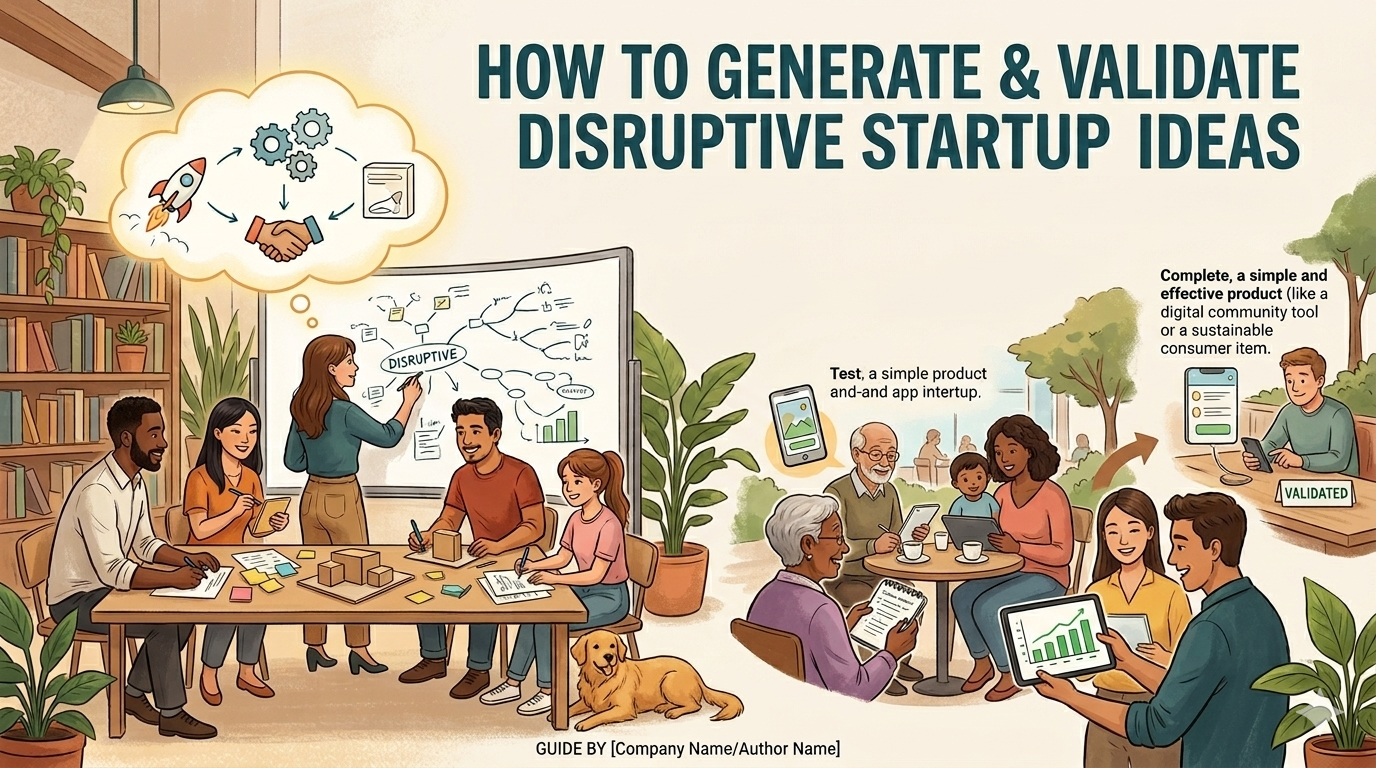
The Foundation of Disruption: Understanding Business Idea Generation
Startup idea generation is the systematic process of creating new, innovative, and commercially viable business concepts by identifying market gaps, solving problems, or improving existing solutions. It's the crucial first step in the entrepreneurial journey, laying the groundwork for a potentially disruptive startup venture.
A successful process moves beyond the myth of a single "eureka" moment, providing a structured approach to discovering and refining concepts that have the potential for significant market impact and growth.
The Business Idea Generation Process: A Step-by-Step Framework
The business idea generation process is a structured, five-stage funnel that takes entrepreneurs from broad exploration to a single, validated concept. Following this framework increases the probability of landing on an idea with genuine market demand.
Step 1: Preparation & Mindset
The preparation stage is about cultivating an entrepreneurial mindset. This involves developing a heightened sense of curiosity, honing observational skills, and actively looking for problems, inefficiencies, and frustrations in your daily life and the world around you. Adopt the perspective that every problem is a potential opportunity. Read widely across different industries, follow technological shifts, and keep a "problem journal" to log pain points you or others experience.
Step 2: Ideation
Ideation is the active phase of generating a high volume of raw ideas. The primary goal is quantity over quality. During this step, judgment is suspended to allow for free-flowing creativity. For example, if your theme is "improving urban commuting," ideas could range from a simple app for tracking bus times to a futuristic concept for personal transport pods. The aim is to create a large pool of concepts from which you can later filter and refine.
Step 3: Incubation & Illumination
The incubation phase is a subconscious process where you step away from active ideation. Go for a walk, work on an unrelated project, or engage in a hobby. This allows the ideas you've generated to cross-pollinate and connect in the back of your mind. Illumination, often called the "aha" moment, occurs when a new, clear, and powerful idea emerges from this subconscious processing. This can happen at any time, which is why entrepreneurs often keep a tool like Notion or a simple notebook handy to capture these sudden insights.
Step 4: Evaluation
Evaluation is the first filtering stage. Here, you begin to assess the raw ideas generated in Step 2 against a set of initial criteria. This is not yet deep validation but a high-level check for feasibility and fit. A simple scoring matrix can help: rate each idea from 1 to 5 on criteria like:
- Personal Passion: Are you genuinely interested in this problem space?
- Founder-Market Fit: Do your skills, experience, and network give you an advantage?
- Market Potential: Does this idea seem to address a large or growing market?
- Obvious Flaws: Are there any immediate, insurmountable technical, legal, or market barriers?
Step 5: Validation
Validation is the most critical stage. It involves systematically testing your most promising idea with real-world feedback and data before committing significant time and capital. This process, known as startup concept validation, turns assumptions into facts. It confirms whether a real problem exists, whether your proposed solution is desirable, and whether customers are willing to pay for it. This stage is the bridge from a good idea to a viable business.
Business Idea Generation Techniques in Entrepreneurship Development
Effective idea generation relies on proven techniques that provide structure to creative thinking. These methods help entrepreneurs look at problems and markets from new perspectives.
Brainstorming & Brainwriting
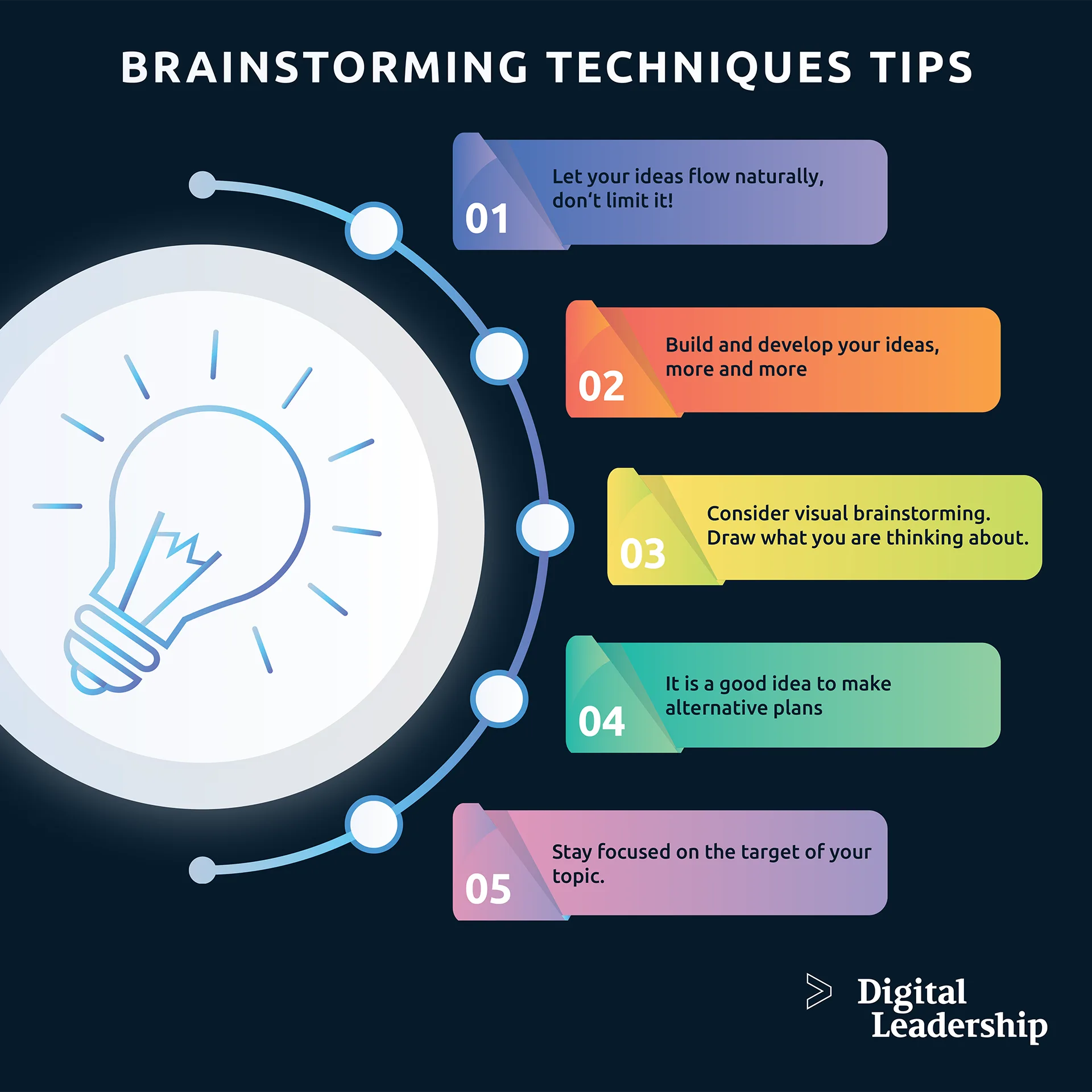
Brainstorming is a classic group activity where participants share ideas freely to generate a large list of potential concepts. The core rule is to defer criticism and encourage wild ideas. Brainwriting, a variation, involves participants writing down ideas silently on paper or a digital document before sharing. This method is highly effective for introverted team members and prevents the discussion from being dominated by a few voices.
The SCAMPER Method
The SCAMPER method is a checklist-style framework that encourages you to think about how you can transform existing ideas. Applying it to a "local coffee shop" could look like this:
- Substitute: Swap out dairy milk for plant-based alternatives as the default.
- Combine: Combine a bookstore or co-working space with the cafe.
- Adapt: Adapt the model for a mobile coffee truck that serves office parks.
- Modify: Modify the service to offer a hyper-personalized subscription box for coffee beans.
- Put to another use: Use the space in the evenings for community events or classes.
- Eliminate: Eliminate the physical storefront and operate as a delivery-only service.
- Reverse: Reverse the payment model—offer a monthly subscription for unlimited coffee.
Trend-Spotting and Future-Casting
This technique involves analyzing macro-level trends to anticipate future needs. By studying shifts in technology (AI adoption), society (the creator economy), economics (remote work), and demographics (an aging population), you can identify emerging markets. For example, the rise of Over-the-Top (OTT) media services created numerous startup opportunities in content creation, streaming analytics, and niche subscription platforms.
Problem-First Approach
The Problem-First Approach dictates that you start by identifying and deeply understanding a significant pain point before even thinking about a solution. This customer-centric method ensures you are building something people actually need. Dropbox, for example, started because the founder was frustrated with forgetting his USB drive. [Link to: Defining Your Startup's Core Problem with a Strong Problem Statement] provides a detailed guide for articulating the issue you aim to solve.
Analyzing User-Generated Content (UGC)
User-Generated Content (UGC) is a goldmine for startup ideas. Scour app store reviews, Reddit threads (like r/SaaS), B2B software review sites, and social media comments related to products in an industry you're interested in. Look for recurring complaints, feature requests, and wishes. Phrases like "I wish this could do X" or "The most annoying part is Y" are direct pointers to unmet customer needs and potential startup concepts.
Business Idea Generation Using Mind Mapping
Mind mapping is a powerful visual technique for business idea generation. It helps structure thoughts, explore relationships between concepts, and unlock new avenues of thinking.
To use mind mapping, start with a central theme in the center of a page (e.g., "Sustainable Urban Living"). From this central node, create main branches for sub-topics like "Energy," "Waste Management," and "Transportation." From "Transportation," branch out further with specific ideas like "micromobility charging stations," "AI-powered traffic routing software," or "shared EV maintenance services." This non-linear structure allows your brain to make connections you might miss in a linear list.
AI-Powered Business Idea Generation
Business idea generation AI involves using artificial intelligence tools to accelerate the ideation process. These platforms can analyze vast datasets to identify opportunities.
For a practical workflow, you can prompt a tool like ChatGPT or Claude with a specific request: "Act as a venture analyst. Generate 10 startup ideas at the intersection of fintech and creator economy. For each idea, define the core user problem, the proposed solution, a primary monetization model, and a key risk factor." While AI-generated ideas still require human evaluation and rigorous validation, they serve as an excellent starting point for rapidly producing a high volume of diverse concepts.
From Concept to Confirmation: Business Idea Generation and Validation
Generating an idea is only half the battle. Business idea generation and validation are two sides of the same coin. Validation is the methodical process of de-risking your startup idea by testing your core assumptions before you build a full product. This process saves resources and dramatically increases your chances of achieving product-market fit.
Stage 1: Conduct Thorough Startup Idea and Market Research
The first step in validation is to confirm that a market for your idea actually exists. This involves gathering data to support your initial hypothesis.
Preliminary Research
Use accessible tools to get an early signal of market interest. Google Trends can show you if search interest for your core problem or solution is growing. Industry reports from firms like Gartner or Forrester provide high-level data on market size. Keyword research tools reveal the monthly search volume for terms related to your idea, indicating active demand.
Competitor Deep Dive
Identify and analyze both direct and indirect competitors. For each, document their pricing model, core features, marketing channels, and customer reviews. This research reveals market gaps and potential differentiation strategies and is a fundamental part of [Link to: Conducting a Thorough Competitive Analysis for New Startups].
Market Sizing
You must estimate the potential scale of your opportunity. This is often done by calculating the Total Addressable Market (TAM), Serviceable Available Market (SAM), and Serviceable Obtainable Market (SOM). This exercise forces you to quantify your target market and provides investors with a clear picture of the potential return. The framework for this is detailed in [Link to: Understanding TAM, SAM, and SOM to Define Your Market Opportunity].
Stage 2: Define and Interview Your Target Audience
Quantitative market data is important, but qualitative feedback from real potential customers is invaluable.
Create User Personas
Develop detailed, semi-fictional profiles of your ideal customers. A persona includes demographics, goals, motivations, and pain points. For example: "Meet 'Marketing Manager Maria,' 32, who struggles to consolidate analytics from five different marketing platforms into a single, easy-to-read dashboard."
Conduct Customer Discovery Interviews
The goal is not to sell your idea but to learn. Ask open-ended questions about your potential customers' current workflows, challenges, and past attempts to solve the problem. Ask questions like, "Tell me about the last time you dealt with [problem]," not "Would you buy a product that did [solution]?" [Link to: Mastering Customer Interviews for Product-Market Fit] is an essential resource for learning how to conduct these conversations effectively.
