


April 20, 2026
5 min read
Team

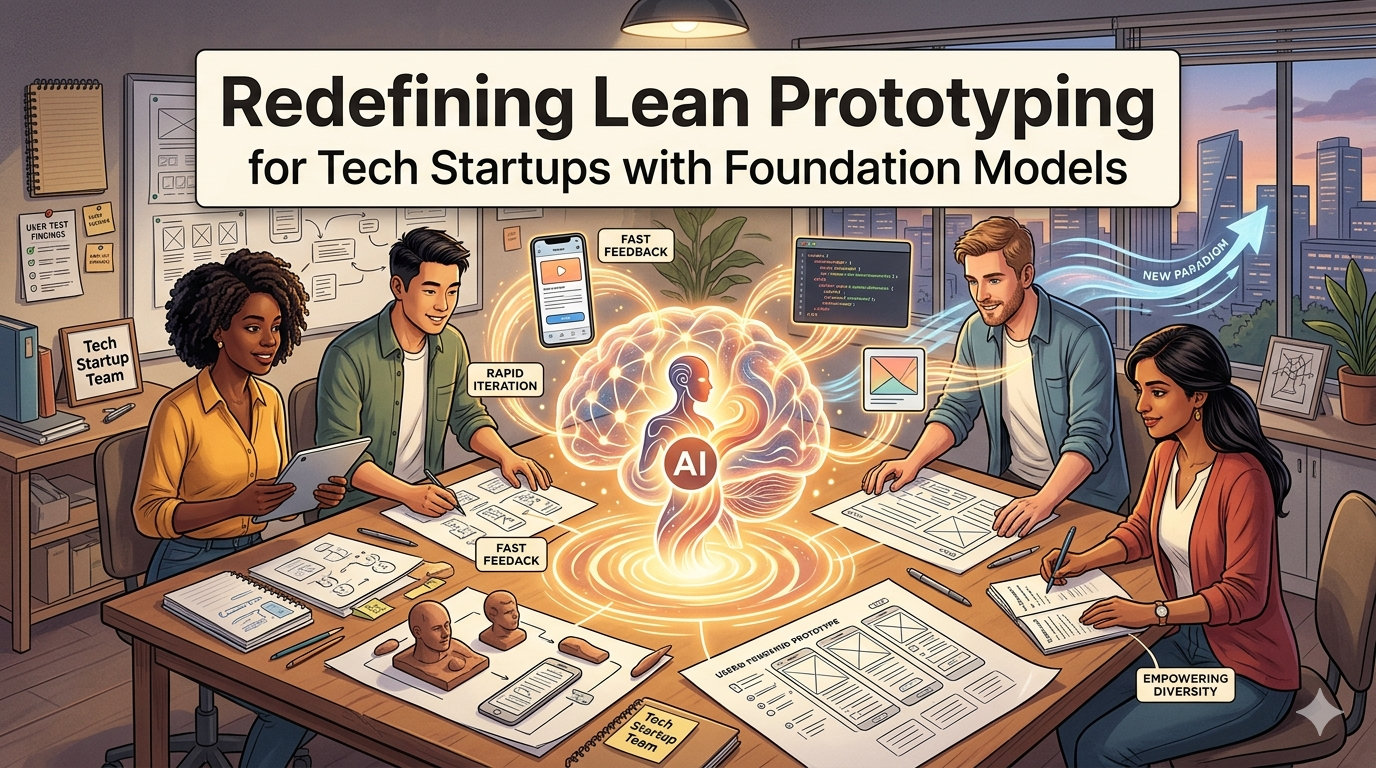
Redefining Lean Prototyping for Tech Startups with Foundation Models

Discover how lean prototyping with foundation models is redefining product development for tech startups. Learn to build, test, and validate your MVP faster than ever.

Startup Launchesstartup
Share this article:
Redefining Lean Prototyping for Tech Startups with Foundation Models

Startups are in a race against time. Founders need to de-risk ideas, show traction to investors, and find product-market fit before the runway runs out. Traditional product development is often too slow and expensive, creating a huge gap between a concept and a working demo that can validate the core business hypothesis.

This is where lean prototyping with foundation models changes the game. This approach combines the speed and efficiency of lean methodology with the generative power of large-scale AI. What once took a team of engineers weeks to build can now be prototyped by a single founder in days. This guide provides a practical framework for using foundation models to build, test, and validate product ideas faster than ever before.

The Core Concepts: Lean Principles and Foundation Models

The synergy between lean's focus on validated learning and AI's generative speed forms the basis of this modern approach to innovation. By leveraging pre-built AI capabilities, startups can create functional prototypes that generate real user feedback, dramatically reducing waste and accelerating the path to a viable product.

What is Lean Prototyping?

Lean prototyping is a product development methodology centered on speed, learning, and minimizing wasted effort. Derived from lean startup principles, its goal is to test a core business hypothesis as quickly as possible.

The process involves building a Minimum Viable Product (MVP)—a version of a product with just enough features to be usable by early customers who can then provide feedback for future development. By gathering early user feedback, teams iterate on the product, steering it toward a solution that resonates with the market and ultimately achieves product-market fit. This iterative cycle is designed to prevent startups from building products that nobody wants.

What Are Foundation Models?

Foundation models are large-scale AI systems trained on vast, diverse datasets. This extensive pre-training gives them a general-purpose understanding of language, code, images, and other data modalities. Prominent examples are accessible through platforms like OpenAI, Anthropic, Google, and open-source alternatives like Mistral.
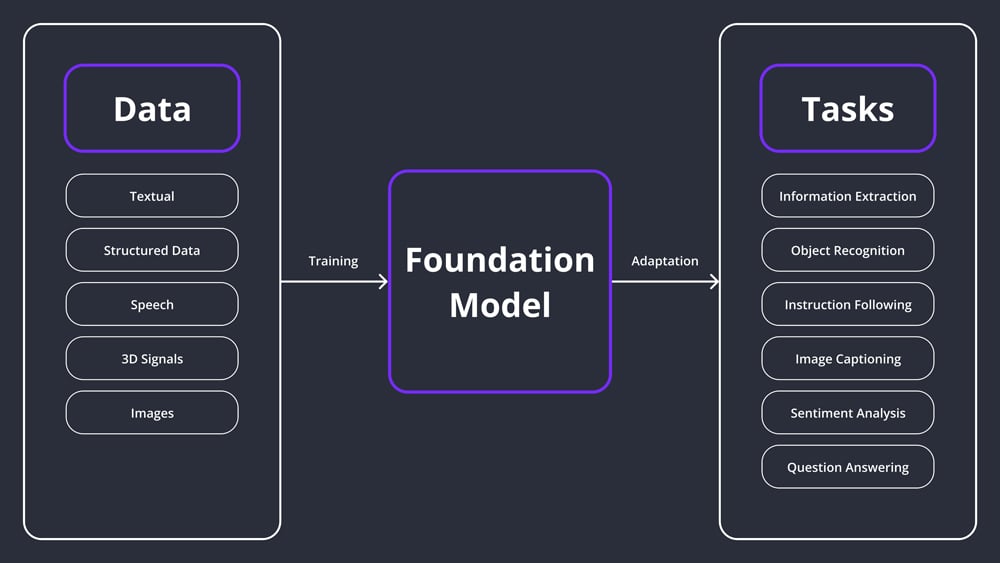
Diagram explaining what a foundation model is and how it's trained on diverse data.

Their key capability is adaptability. They can be applied to a wide range of tasks—including text generation, code completion, and image creation—with minimal additional fine-tuning. For startups, this dramatically lowers the barrier to entry for creating sophisticated, AI-powered features, allowing small teams to build products that were once the exclusive domain of large tech corporations.

Why Foundation Models are a Game-Changer for Startup Innovation

Foundation models serve as a powerful accelerator for lean startup practices, transforming theoretical development cycles into tangible, interactive prototypes in a fraction of the time.

  • Instant Functionality: Models can generate functional code for user interfaces (e.g., React, HTML/CSS), backend logic (Python, Node.js), and complex SQL queries, allowing founders to create core features without writing everything from scratch.
  • Drastically Reduced Costs: This approach reduces the need for large, specialized engineering teams. A single developer can prototype what once required front-end, back-end, and ML specialists, extending runway and focusing capital on growth.
  • Accelerated Iteration Cycles: Moving from idea to testable prototype in days instead of weeks enables more cycles of user feedback. This rapid loop is crucial for honing the product's value proposition.
  • Democratized Creativity: Founders can rapidly explore ambitious features, from conversational chatbots to AI-powered data analysis. Foundation models provide the toolkit to test big ideas that would otherwise be too resource-intensive to prototype.

Table: Traditional Lean vs. Foundation Model-Enhanced Prototyping

Phase Traditional Lean Prototyping Foundation Model-Enhanced Prototyping
UI/UX Mockup Manual design in Figma/Sketch (days) AI-generated mockups & user flows (hours)
Code Generation Manual coding by developers (weeks) Functional code generation for components (days)
Data Population Manual creation of test data (days) Generation of rich synthetic datasets (minutes)
Feedback Loop 1-2 weeks per iteration cycle 2-3 days per iteration cycle
Time-to-First-Demo 4-8 weeks 1-2 weeks

Choosing the Right Foundation Model for Your Prototype

Selecting the right model is a critical first step. The goal is not to find the "best" model overall, but the best one for your specific task, budget, and timeline.

Criteria Considerations Example Models/Platforms
Task Specialization Does your prototype need text generation, code, image analysis, or a mix (multimodality)? Choose a model optimized for your core task. Text: GPT-4o, Claude 3, Llama 3
Code: GPT-4o, CodeLlama
Image: Midjourney, Stable Diffusion
Performance vs. Cost Top-tier models offer the best reasoning but come at a higher API cost. Cheaper or smaller models may be sufficient and more cost-effective for simpler tasks. High-Performance: OpenAI's GPT-4o, Anthropic's Claude 3 Opus
Cost-Effective: Mistral's models, Google's Gemini Flash
API vs. Open-Source API-based models are easy to use and maintain. Open-source models offer more control and lower long-term costs but require hosting and management. API (Easy Start): OpenAI, Anthropic, Google AI Platform
Open-Source (Control): Llama 3, Mistral 7B (via Hugging Face)
Speed & Latency For real-time user interactions like chatbots, low latency is crucial. Some models are optimized for speed over pure reasoning quality. Check provider benchmarks for latency. Models like GPT-3.5-Turbo or Gemini Flash are often faster.

For prototyping, start with a versatile, well-documented, API-based model. You can always switch or fine-tune a specialized model later as you scale.

A 4-Week Framework for Rapid MVP Development with AI

This roadmap provides a structured approach for moving from concept to a demo-ready prototype.

Illustration of AI and foundation models being used for rapid product development.

Week 1: Isolate the Problem and Generate the First Flow

The goal is to establish a narrow focus and create a tangible version of a single user journey.

  • Define a Single Hypothesis: Isolate one high-value user problem. For example, instead of a full project management suite, focus only on a tool that automates daily stand-up reports.
  • Generate Initial Assets: Use a foundation model to brainstorm. Prompt it to generate user stories ("Act as a senior PM and write 5 user stories for a tool that automates stand-up reports for a 'Project Manager' persona."), UI copy, and text-based mockups of the user flow.
  • Build the Scaffolding: Use an AI-assisted IDE (like GitHub Copilot) or a code generation model to create the basic front-end and back-end structure. This could be HTML/CSS for the interface and a simple Express.js or Flask server. The goal is one complete, simple user journey.

Week 2: Deploy, Test, and Gather Real-World Feedback

This week is about exposing the prototype to real users to get raw, unfiltered feedback.

  • Deploy on a Budget: Use low-cost services like Vercel, Netlify, or Heroku's free tier to get your prototype online quickly.
  • Conduct User Testing: Recruit 10-15 target users. Give them a task to complete and observe their interactions without pitching the product. Use session replay tools or simple screen sharing to see where they struggle or get confused.
  • Focus on Learning, Not Validation: Document every instance where the AI's output misses the mark or the user flow is unintuitive. This qualitative data is more valuable than any metric at this stage.

Week 3: Refine the AI and Enhance the Experience

With user feedback, shift focus to improving the model's performance and the prototype's usability.

  • Master Prompt Engineering: This is the most critical skill for lean AI prototyping. Craft specific, context-rich prompts. Instead of "generate a product description," use: "Generate a 50-word product description for a B2B SaaS tool called 'SynthScribe'. The tone is professional yet approachable, targeting marketing managers. Highlight the key benefit: converting webinar videos into blog posts in minutes."
  • Consider Lightweight Fine-Tuning: If prompt engineering isn't enough, you can fine-tune a model. This doesn't require a massive dataset. A curated set of 50-100 high-quality examples (e.g., ideal email outputs) can be used to specialize the model for your domain and improve output relevance.

Week 4: Polish, Harden, and Prepare for Showcase

The final week is about preparing the prototype for investors, pilot customers, or advisors.

  • Add Basic Analytics: Integrate simple tools (e.g., Mixpanel, Google Analytics) to track one or two key user behaviors that prove your core hypothesis, like the completion rate of the main task.
  • Implement Guardrails: AI outputs can be unpredictable. Implement basic safeguards like API rate limiting, cost monitoring, and content moderation filters. For the user, this means input validation and helpful error messages.
  • Refine the UI/UX: Make targeted improvements to remove friction points identified in Week 2. The goal is a polished demo that tells a compelling story about your product's value.

Essential Tools and Platforms to Accelerate Development

Building a lean AI prototype involves a stack of modern tools that work together seamlessly.

  • Foundation Model APIs: The core engine of your prototype.
  • OpenAI: Provider of GPT-4o, known for its strong general reasoning and multimodal capabilities.
  • Anthropic: Creator of Claude 3, which excels at handling large contexts and complex instructions.
  • Google AI Platform: Offers the Gemini family of models, known for speed and integration with the Google ecosystem.
  • Prototyping & No-Code Platforms: To build the front-end and orchestrate API calls without deep coding.
  • Bubble: A powerful no-code platform for building interactive web applications.
  • Retool / Appsmith: Excellent for building internal tools and dashboards quickly.
  • Developer & Orchestration Tools: For founders who code.
  • GitHub Copilot: An AI-powered code completion tool that dramatically speeds up development.
  • LangChain / LlamaIndex: Frameworks that simplify building applications with LLMs by managing prompts, chains, and data connections.
  • Deployment Platforms:
  • Vercel / Netlify: Simple, fast, and often free platforms for deploying web front-ends.

Case Study: How "SynthScribe" Validated a Market Need in Two Weeks

  • The Challenge: A non-technical founder hypothesized that B2B marketers were spending too much time repurposing video content. The idea: an AI tool to instantly convert webinar videos into blog posts, social media updates, and newsletters.
  • The FM-Powered Prototype: The founder used Bubble connected to the OpenAI API. A multimodal model processed video transcripts to identify key topics. A separate language model was then prompted to generate marketing copy based on those topics. The entire functional prototype was built in two weeks.
  • The Outcome: The founder created a demo video, shared it on LinkedIn, and pre-sold dozens of annual subscriptions. This clear market signal validated the core hypothesis without a single line of production code, helping them secure pre-seed funding to hire a technical team.

Common Pitfalls and How to Avoid Them

While powerful, this approach has unique challenges.

  • Chasing the Hype Cycle: New AI models are released constantly. Avoid switching your core model frequently. Instead, pick a stable, well-documented model that is "good enough" and focus on user learning.
  • Over-relying on Synthetic Data: Synthetic data is great for getting started, but it's not a substitute for real user behavior. Avoid making major product decisions based on it. Instead, prioritize data from real user sessions.
  • Ignoring the "Human in the Loop": AI outputs can be inaccurate or nonsensical. Avoid deploying a fully autonomous AI feature without oversight. Instead, plan for a human review step, especially in sensitive applications.
  • Neglecting Scalability and Security: Speed is the goal, but not at the expense of fundamentals. Avoid hardcoding API keys or ignoring costs. Instead, use environment variables, monitor API usage, and follow basic security practices, even in a prototype.

Frequently Asked Questions

How much does it cost to build a prototype with foundation models?

Costs can be surprisingly low. By using API-based models and focusing on efficient prompt engineering, initial prototyping can often be done for under $1,000. This is a fraction of the $50,000-$100,000+ cost of traditional MVP development.

Do I need a machine learning expert on my team?

Not for the initial prototyping phase. The accessibility of foundation models via APIs has democratized AI development. A product-minded developer or technical founder can achieve significant results with prompt engineering alone. An ML expert becomes more critical for extensive fine-tuning or building custom models later.

What is the difference between prompt engineering and fine-tuning?

Prompt engineering is crafting effective inputs (prompts) to guide a model's output without changing the model itself. It is low-cost and high-leverage. Fine-tuning is the process of further training a pre-trained model on a smaller, domain-specific dataset. It specializes the model but requires more data and resources.

Can foundation models generate a full-stack application?

They can generate significant portions of an application—front-end components, backend logic, and database schemas. However, they currently act as an extremely powerful co-pilot, not a fully autonomous developer. Human oversight is essential to assemble, test, and deploy the generated code into a functional product.

The Bottom Line: A New Era of Efficient Product Testing

For tech startups, foundation models represent a fundamental shift in how products are built and validated. By integrating these AI systems into lean prototyping workflows, founders can de-risk their ventures, conserve capital, and build what customers truly want with unprecedented speed. This approach is no longer a competitive advantage—it is rapidly becoming the new standard for building the next generation of successful technology companies.

Next Step: Explore whatlaunched.today

If this guide was useful, visit whatlaunched.today to learn how their product can help:

  • What whatlaunched.today offers: What Launched Today is a platform for discovering the latest startups. It allows founders to launch their own products to gain exposure, get a DR 49 backlink, and reach an audience of thousands of other makers and founders.
  • Website: https://www.whatlaunched.today
Published on April 20, 2026

By WhatLaunched Team