



Product Hunt is a titan in the startup world. A successful launch there can feel like hitting the jackpot, flooding your servers with traffic and your inbox with investor interest. But relying on a single platform is a high-risk strategy.
Smart founders and makers diversify their launch to reach the right audiences, not just the largest one. Searching for Product Hunt alternatives isn’t about replacing it; it’s about building a smarter, multi-layered launch campaign, just as many of the [Link to: https://whatlaunched.today/blog/best-new-startups] do.
Why Look for Product Hunt Alternatives?
- Reach Niche Audiences: While Product Hunt has a massive, tech-savvy user base, it’s a generalist audience. Niche platforms cater to specific communities, such as developers, B2B SaaS buyers, or bootstrapped founders. Launching a new API on a developer-focused site will generate higher-quality leads than on a general platform.
- Cut Through the Noise: Product Hunt's popularity is also its biggest challenge—it's incredibly competitive. A product can get buried in minutes. A launch on a smaller, more focused startup discovery platform can give your project the breathing room it needs to be seen, leading to more thoughtful engagement.
- Achieve Different Launch Goals: Not every launch is about getting to #1. Your goal might be to gather critical beta feedback, drive high-intent B2B leads, or connect with fellow makers. A staggered launch strategy lets you use different platforms for different objectives.
- Simpler Submission Processes: Navigating the unwritten rules and network effects of Product Hunt can be complex. Many alternatives offer more straightforward, transparent, or free submission processes, making them more accessible for early-stage startups on a tight budget.
The Best Product Hunt Alternatives (Categorized)
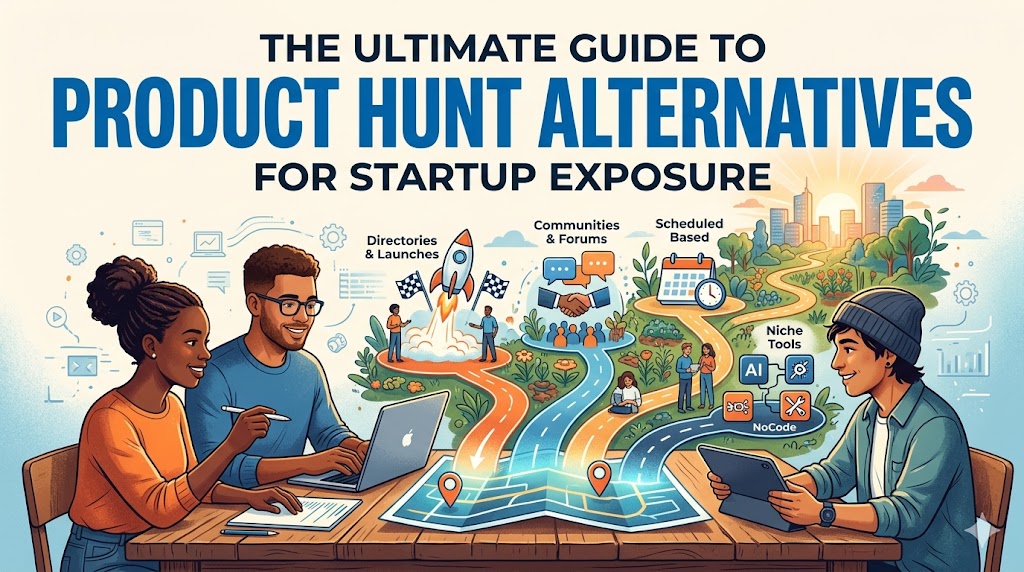
To help you find the right fit, we've grouped these platforms by the primary goal they help you achieve: community feedback, technical validation, or long-term discovery.
For Community Feedback & Peer Validation
These platforms are less about a single-day launch and more about joining a conversation with other founders, makers, and potential users.
1. Indie Hackers: The Community for Bootstrappers and Makers
Indie Hackers is a transparent, digital town square for entrepreneurs. It’s a community where founders openly share revenue numbers, growth strategies, and the real stories behind their businesses.
A launch here is an ongoing conversation with a supportive group of peers who value authenticity and sustainable growth over hype.
- Pros:
- Highly engaged community of experienced founders who provide actionable, non-sugarcoated advice.
- Focus on transparent metrics and sustainable business models attracts serious users.
- Best approach: Share a milestone like "My SaaS just hit $1,000 MRR" or "Learnings from my first 100 users" to spark genuine conversation.
- Cons:
- The audience is more interested in products with a clear path to profitability than "shiny new things."
- Requires active and authentic participation; you can't just drop a link and expect results.
2. Reddit: The Power of Niche Communities
Reddit is a collection of thousands of hyper-focused communities (subreddits). This makes it one of the most versatile alternatives. The key is finding the right subreddit—whether that's r/startups, r/sideproject, r/SaaS, or an industry-specific community like r/gamedev or r/webdev.
- Pros:
- Access to passionate, targeted niche audiences who are deeply invested in specific problems.
- Opportunity for direct, conversational feedback with potential end-users in a casual environment.
- Completely free to post and engage.
- Cons:
- Most subreddits have strict rules against overt self-promotion. You must provide value before asking for attention.
- Success requires being an authentic member of the community first and a promoter second.
For Technical Audiences & Developer Tools
If your product is an API, an open-source library, or any tool built for a technical user, these are your best bets.

3. Hacker News (Show HN): The Premier Developer Hub
Hacker News, run by Y Combinator, is the high-stakes, high-reward arena for tech launches. A successful "Show HN" post can drive a tsunami of traffic from a deeply technical audience of developers, engineers, and VCs. This is where you launch when your product's technical execution is its strongest selling point.
- Pros:
- Potential for massive, high-quality traffic that can stress-test your infrastructure in minutes.
- The comments section provides direct, often brutally honest, technical feedback from experts.
- Hitting the front page is a powerful validation signal within the engineering and VC communities.
- Cons:
- It's extremely difficult to gain traction. Posts have a short lifespan and require immediate engagement.
- The community is famously critical and unforgiving of marketing jargon. Your post title must start with "Show HN:".
4. Dev.to: A Launchpad for Developer Tools
Dev.to is a massive, thriving online community where software developers share knowledge. If your product is a new API, an open-source library, or a VS Code extension, a well-written launch article here can be far more effective than a generic post elsewhere.
- Pros:
- Direct access to a large, engaged, and highly technical developer audience.
- The content-driven format allows for in-depth explanations, code snippets, and tutorials to demonstrate value.
- Example Post Formats: "How we built [X] with [Y technology]" or "I made a free, open-source alternative to [Z]."
- Cons:
- Strictly for developer-focused products. A consumer-facing app would be out of place.
- Success depends entirely on the quality of the technical content, not just the product.
For Pre-Launch & Long-Term Discovery
These directories and platforms are designed to build a waitlist or create a permanent, discoverable listing that drives traffic over the long haul.
5. BetaList: For Startups in the Pre-Launch Phase
BetaList does one thing exceptionally well: it showcases startups before they officially launch. If you're in private beta and your primary goal is to build a waitlist and gather feedback from early adopters, this is the perfect platform.
- Pros:
- The entire audience consists of early adopters actively looking to test new products.
- Excellent for validating a market need and building an initial email list before a public launch.
- Its strict focus on pre-launch companies means you aren't competing with established products.
- Cons:
- Free submissions can have a long wait time (weeks or months). Paid "skip the line" options are available.
- Only accepts startups that are not yet publicly launched, and a high-quality landing page is a must.
6. AlternativeTo: Gain Visibility Through Comparison
AlternativeTo is a brilliant long-term strategic play. It's a crowdsourced platform where users find alternatives to existing software. The strategy is simple: list your product as a direct alternative to a well-known competitor, such as finding [Link to: https://whatlaunched.today/alternatives/buffer]. This allows you to tap into a stream of high-intent users who are actively looking to switch.
- Pros:
- Attracts users with high purchase intent who are already problem-aware and shopping for a solution.
- Provides a steady, passive stream of referral traffic for months or even years.
- [Link to: https://whatlaunched.today/blog/how-to-get-backlinks-startup-seo-guide] by positioning your product directly against market leaders.
- Cons:
- Not a "launch day" platform; it is a slow-burn discovery channel.
- Visibility depends on positive user upvotes and reviews to climb the rankings.
7. TopStartups.io: The Curated Startup Directory
TopStartups.io is a startup discovery platform that acts as a clean, curated directory. It allows users to discover new companies by industry, with dedicated feeds for [Link to: https://whatlaunched.today/launch/point-of-ai]. This is less about a one-day event and more about creating a permanent, discoverable listing for your project.
- Pros:
- A clean, visual interface makes it easy for investors, journalists, and customers to browse.
- Industry-specific filters help you get seen by a relevant audience.
- Contributes to your long-term SEO and digital footprint.
- Cons:
- Less community interaction and "launch day buzz" compared to platforms like Indie Hackers.
- Exposure is based on being listed in a directory rather than a dynamic, comment-driven event.
Product Hunt vs. Alternatives: A Quick Comparison
To simplify your decision, here’s a breakdown of where each platform shines.
| Platform | Audience Focus | Best For | Submission Cost | Community Interaction |
|---|---|---|---|---|
| Product Hunt | General Tech Enthusiasts, VCs | Generating broad "launch day" buzz | Free | High |
| Indie Hackers | Bootstrappers, Solopreneurs | Validating business models & getting peer advice | Free | Very High |
| Hacker News | Developers, Engineers | Stress-testing servers & getting expert code review | Free | High (and critical) |
| BetaList | Early Adopters | Building a pre-launch waitlist & collecting feedback | Free (long wait) / Paid | Low |
| Niche Communities | Engaging hyper-targeted user groups | Free | Varies (High in-niche) | |
| Dev.to | Software Developers | Launching technical tools & open-source projects | Free | High (content-based) |
| AlternativeTo | Solution-Aware Buyers | Long-term, high-intent lead generation | Free | Medium (reviews) |
How to Choose the Right Startup Launch Platform
Choosing where to launch isn’t about picking the biggest platform. It’s about [Link to: https://whatlaunched.today/blog/startup-launch-strategy-guide]. Ask these critical questions:
- What is my primary goal? Are you seeking beta testers, your first paying customers, investor attention, or raw technical feedback? BetaList is built for testers, while Hacker News is the ultimate gauntlet for technical review.
- Who is my ideal customer? If you're building a tool for data scientists, launching on Hacker News or a specific data science subreddit is a no-brainer. Don't show up to a party where none of your customers are invited.
- What is my product's stage? Is it a pre-launch idea or a V1 ready for prime time? Use BetaList to build a waitlist, then leverage that early traction for a bigger launch on a platform like Indie Hackers once you have testimonials.
- What resources can I commit? Do you have the time to actively manage a Hacker News or Reddit thread for 12 hours straight? Or is a lower-maintenance directory listing a better fit? Be realistic about the commitment required.
Getting the Most from Your Launch
A successful launch is not a single event; it's a well-orchestrated campaign that respects each community you enter. The goal is to create a sequence of events that builds momentum over time.
Consider a "launch stacking" strategy:
- Week 1 (Pre-Launch): Submit to BetaList to build an email list of early adopters.
- Week 2 (Technical Launch): Post a deep-dive article on Dev.to to get feedback from fellow developers.
- Week 4 (Community Launch): Share your progress and early learnings on Indie Hackers to engage with other founders.
- Week 6 (Public Launch): Use the momentum and social proof from the previous stages for a bigger, public launch on a platform like Product Hunt.
This approach transforms a one-day spike into a sustained campaign, turning short-term buzz into a durable asset for your business.
Frequently Asked Questions (FAQ)
1. Is Product Hunt still relevant in 2024?
Absolutely. Product Hunt remains a powerful platform for generating broad awareness, attracting investors, and driving significant traffic. However, its high level of competition means a launch there should be part of a broader strategy, not the entire strategy itself.
2. How many different platforms should I launch on?
For most early-stage startups, a sequence of 2-4 platforms is effective. Start with a pre-launch platform like BetaList, followed by one or two niche communities (like Reddit or Dev.to) to gather targeted feedback, and then consider a broader launch on a generalist site once you have traction and social proof.
3. What is the most common mistake founders make when launching?
The most common mistake is the "drive-by" post—dropping a link in a community without any prior engagement or context. Platforms like Reddit and Indie Hackers reward genuine participation. Invest time to understand the community's culture and provide value before you ask for attention.
4. Do I need a 'hunter' for these alternative sites like on Product Hunt?
No. The concept of a "hunter" with a large following is unique to Product Hunt's ecosystem. On almost all alternative platforms, success comes from the quality of your product, the authenticity of your story, and your direct engagement with the community. You are your own best advocate.
