





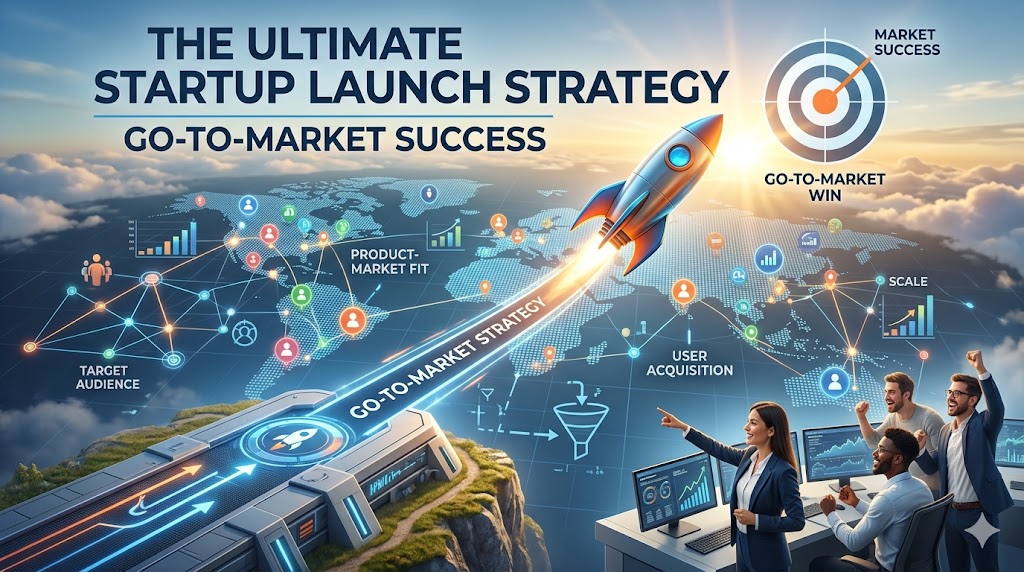
The Ultimate Guide to Startup Launch Stratego
A startup launch strategy is a meticulously planned roadmap outlining all activities, from market research and product development to marketing and fundraising, essential for successfully introducing a new venture or product to its target audience. It defines the tactical steps founders take to gain initial traction, secure funding, and establish a sustainable business.
I. Laying the Foundation: Pre-Launch Essentials for Startup Founders
Understanding Your Market and Vision
Founders must define their market and clarify their startup's core identity. This foundational work precedes any product development or marketing efforts.
Defining your market type and maturity is crucial for strategic planning. MaRS Discovery District's Entrepreneur’s Toolkit identifies four market types:
- Existing market, where customers already buy similar products
- Resegmented market, offering a new approach to an existing product
- New market, creating demand for a entirely novel solution
- Clone market, adapting successful business models to new geographies
Each type dictates a different launch approach. Market maturity, or the stage of market development, influences customer awareness, competition levels, and the speed of adoption. An early-stage market requires significant education, while a mature market demands strong differentiation.
Clarifying your startup's vision, mission, and unique value proposition (UVP) provides strategic direction. A vision statement articulates the long-term desired future state the startup aims to create. A mission statement defines the company's purpose, what it does, and for whom.
The UVP explicitly states the distinct benefits and value a product or service offers that competitors do not, explaining why a customer should choose it. This clarity ensures internal alignment and external communication consistency.
Identifying your ideal target audience and early adopters is a critical step in pre-launch. The target audience represents the specific group of consumers or businesses most likely to purchase your product. Early adopters, a concept from Everett Rogers' Diffusion of Innovations theory, are individuals or organizations willing to try new products or technologies before the majority.
They are crucial for initial feedback, validation, and generating early buzz. Understanding their demographics, psychographics, needs, and pain points informs product features, marketing channels, and messaging. Focus on satisfying the needs of these initial users to build momentum.
Building the Core Team and Leadership
A strong leadership team is indispensable for a successful launch. The capabilities and cohesion of this team directly influence the startup's resilience and capacity for growth.
The critical role of Founders involves establishing the strategic direction, shaping the company culture, and securing essential resources. Founders are responsible for articulating the vision, making pivotal decisions, and inspiring the initial team. Their commitment and expertise often define the startup's early trajectory. They are the primary drivers of execution during the demanding launch phase.
Cultivating Transformational Leadership qualities inspires and motivates team members to achieve extraordinary outcomes. Visconti Partners identifies key characteristics of transformational leaders, including:
- Idealized influence (serving as a role model)
- Inspirational motivation (articulating a compelling vision)
- Intellectual stimulation (encouraging creativity and problem-solving)
- Individualized consideration (supporting individual team members' development)
These qualities foster a highly engaged and innovative team environment, crucial for navigating the uncertainties of a startup launch.
The benefits of Executive Coaching for founders and senior management are pronounced during high-growth phases. Executive coaching, as offered by Visconti Partners, provides personalized guidance to leaders, enhancing their strategic thinking, decision-making, and interpersonal skills. This support is vital for managing stress, adapting to rapid change, and refining leadership effectiveness as the startup scales. It helps founders overcome blind spots and develop a robust leadership style.
Strategic guidance through Board of Directors Coaching can significantly impact a startup's governance and strategic oversight. Visconti Partners specializes in this area, helping boards optimize their effectiveness, ensure alignment with executive teams, and provide sound strategic advice. A well-coached board contributes to robust decision-making, risk management, and long-term sustainability, especially in navigating complex launch challenges and future growth.
Optimizing team structure with Chief of Staff Development enhances operational efficiency and strategic execution. A Chief of Staff supports the CEO or senior leaders by managing priorities, coordinating projects, and acting as a central point of contact. Programs like those from Visconti Partners train individuals for this critical role, ensuring that strategic initiatives are translated into actionable plans and executed effectively across the organization, which is particularly beneficial during the intense period of a launch.
Utilizing an Assessment Center helps identify team strengths and development areas. The Visconti Assessment Center employs structured exercises and evaluations to objectively assess individual and team competencies. This process ensures that key roles are filled by individuals with the right skills and provides data-driven insights for targeted professional development, building a more capable and resilient launch team.
II. Product Development and Validation: Ensuring Market Fit
The product itself is the core of any startup. Its development and validation must confirm a strong market fit before launch.
From Idea to Minimum Viable Product (MVP)
The journey from concept to a launch-ready product is iterative and customer-centric.
Iterative product development cycles involve repeatedly designing, building, testing, and refining the product. This approach allows for continuous improvement based on feedback. Continuous customer feedback is integrated throughout these cycles, ensuring that the product evolves in response to user needs and preferences. This minimizes the risk of building a product that lacks market demand.
Crucial steps include:
- Pre-launch testing
- Beta programs
- User acceptance testing (UAT)
Pre-launch testing identifies bugs and usability issues. Beta programs release the product to a select group of external users, gathering real-world usage data and feedback. UAT ensures that the product meets the specified business requirements and is ready for broader deployment. These processes validate functionality and user experience.
Ensuring your product is ready for a successful Product Launch means meeting predefined quality, performance, and functionality benchmarks. All critical features must be stable and operate as intended. The product must solve the problem it set out to address effectively.
Readiness also implies that all supporting elements, such as documentation, customer support infrastructure, and initial marketing materials, are in place.
Strategic Positioning and Messaging
How a product is perceived and communicated determines its initial market reception.
Crafting compelling key messages that resonate with your target audience is fundamental. Key messages communicate the core benefits, unique selling points, and emotional connection of your product concisely and persuasively. They must clearly articulate how the product solves a specific problem or fulfills a distinct need for the identified early adopters. Consistency in messaging across all channels builds brand recognition.
Developing a strong Brand Identity & Development is paramount. Startup Launch Digital Strategy emphasizes building "Human-First" brands that project authority and remain compliant in regulated sectors. This involves defining the brand's visual elements (logo, color palette, typography), tone of voice, and overall personality.
A strong brand identity differentiates the startup and builds trust with the target audience, establishing a memorable presence in the market.
Differentiating your offering in a competitive landscape requires a clear understanding of your unique advantages. This involves identifying what makes your product superior or distinct from alternatives. Differentiation can stem from innovation, pricing strategy, customer experience, niche focus, or a unique technology. Clearly articulating these differences in your messaging helps potential customers understand why your product is the optimal choice.
III. Crafting Your Digital Marketing Strategy for Launch
A robust digital presence is critical for reaching modern audiences and driving initial adoption.
Building a Robust Online Presence
Your digital footprint must be strategic, accessible, and measurable.
Website Design & Development must focus on SEO readiness, user experience (UX), and ADA accessibility. Startup Launch Digital Strategy highlights creating secure, SEO-ready assets designed to convert, with a focus on technical precision and ADA accessibility. An SEO-ready website is optimized for search engines to ensure discoverability.
Excellent UX ensures visitors can easily navigate and interact with the site. ADA accessibility ensures the website is usable by people with disabilities, broadening its reach and demonstrating inclusivity.
Content & Lifecycle Marketing establishes authority and nurtures leads over time. This involves creating valuable, relevant content (blogs, whitepapers, videos) that addresses the target audience's pain points and interests. Lifecycle marketing utilizes automation to deliver targeted content at different stages of the customer journey, from initial awareness to conversion and retention.
Startup Launch Digital Strategy emphasizes establishing leadership through long-form authority and automated systems that nurture leads.
Strategic Social Media & Community Management is essential for audience engagement. This involves selecting appropriate platforms, developing a content strategy tailored to each platform, and actively interacting with the audience. Consistent, authentic engagement builds a loyal community around the brand. Startup Launch Digital Strategy focuses on managing digital presence with discretion and consistency, building community without requiring daily oversight.
Understanding digital footprint, analytics, and performance measurement allows for data-driven optimization. A digital footprint encompasses all online activity and information associated with the startup. Analytics tools track website traffic, user behavior, social media engagement, and conversion rates.
Performance measurement evaluates the effectiveness of digital marketing efforts against predefined KPIs, enabling continuous adjustments to improve outcomes.
Technical Readiness and Platform Access
Behind the user-facing elements, a strong technical backbone is necessary.
Ensuring robust Network Security for your digital assets and user data is paramount. This includes implementing firewalls, encryption protocols, secure authentication, and regular security audits. Protecting sensitive information builds customer trust and prevents costly breaches, which can be particularly damaging to a new venture. Compliance with data protection regulations is also a key consideration.
Managing API access with Developer Tokens is crucial for integrations and platform partnerships. Developer tokens authenticate requests to an API, granting specific permissions. Proper management of these tokens ensures secure and controlled access to your platform's data and functionalities by third-party applications or partners. This facilitates ecosystem growth while maintaining data integrity.
Preparing for community engagement on platforms like Reddit involves understanding potential access challenges. Issues like an HTTP 403 Forbidden Error can occur due to network security blocks or rate limiting, preventing content posting or API interaction. As observed in the competitor context, users might be blocked and require logging in or using a developer token.
Startups must anticipate and prepare technical solutions or communication protocols to address such access issues, ensuring uninterrupted engagement with early communities.
Scalable technical infrastructure is vital for a seamless launch and growth. The infrastructure must be designed to handle increasing user loads, data volumes, and feature expansion without compromising performance or reliability. This involves cloud-based solutions, load balancing, and efficient database management. A scalable foundation prevents technical bottlenecks that could hinder rapid user adoption and business expansion.
IV. Executing the Launch: Strategies for Traction and Growth
The launch phase is where extensive preparation meets market reality. Effective execution is key to gaining initial traction.
Sales Process Management: From Lead to Customer
Converting interest into revenue requires a well-defined sales approach.
Designing an effective sales funnel for initial customer acquisition guides prospects through awareness, interest, desire, and action stages. Each stage has specific touchpoints and conversion goals. For a startup, this funnel might be simpler initially, focusing on direct outreach and qualification of early adopters. A clear funnel ensures a structured approach to lead nurturing.
Strategies for engaging and converting early adopters often involve personalized outreach, offering exclusive benefits, and leveraging their feedback. Early adopters value innovation and appreciate being part of the product's evolution. Providing excellent support and actively listening to their input can turn them into brand advocates, driving further organic growth. Their conversion is a strong signal of market acceptance.
Establishing clear sales goals is essential for measuring launch success. MaRS Discovery District emphasizes setting quantifiable launch goals. These goals should define specific targets for customer acquisition, revenue, conversion rates, or trial sign-ups within a defined timeframe. Clear goals provide benchmarks for evaluation and enable rapid adjustments to sales strategies if targets are not met.
Public Relations and Media Engagement
Visibility and credibility are amplified through strategic media outreach.
Selecting the right PR agency and approach for maximum impact is a critical decision. A PR agency specializes in shaping public perception and securing media coverage. MaRS Discovery District recommends carefully choosing an agency. The approach might involve targeted media outreach to industry publications, developing compelling press releases, or orchestrating launch events. The goal is to generate positive media attention and build brand awareness.