





What Launched Today

What Is The Impact Of Google AI Overviews On Search Clicks?

Published on July 2, 2026

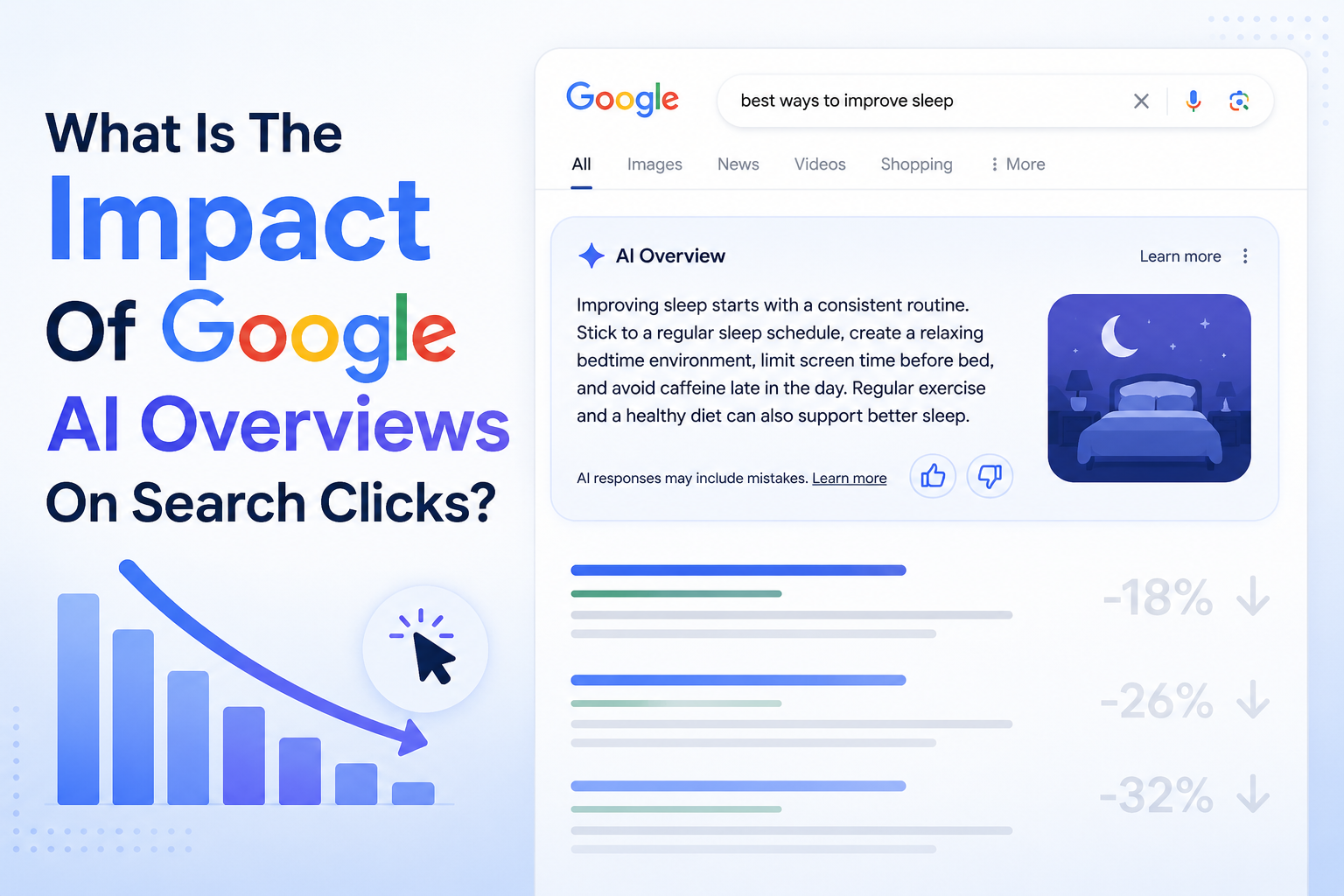
A new field study reveals Google AI Overviews reduce organic clicks by 39.8%. Experimental data proves the lost search traffic was not lower quality.

What Is The Impact Of Google AI Overviews On Search Clicks?

Google AI Overviews produce a 39.8 percent decrease in organic website clicks when search summaries appear. Researchers Saharsh Agarwal and Ananya Sen measured a 41 percent query trigger rate. Zero-click searches rise proportionately, creating a measurable reduction in aggregate outbound search traffic.

Statistical Traffic Impact Breakdown

Entity / Metric Attribute Evaluated Statistical Value Observed
Organic Clicks Traffic Volume Reduction 39.8% Decrease
Search Queries AI Overview Trigger Rate 41% of all evaluated queries
Outbound Clicks Traffic Density Without AIO Increased significantly
Zero-Click Searches Session Termination Rate Increased significantly with AIO

Traffic loss is not a theoretical outcome. It is a documented mathematical reality. When an AI summary appears at the top of a search results page, user behavior immediately shifts. The initial working paper covering this specific randomized field experiment reported a 38 percent reduction back in April. The revised figures are worse. The updated analysis confirms a 39.8 percent drop in organic clicks.

Users stop clicking. They read the generative summary and abandon the query without transferring to a destination site. Because these summaries trigger on approximately 41 percent of all queries, the sheer volume of intercepted traffic creates a massive aggregate reduction across the internet. When the researchers isolated sessions where the AI module was removed, external outbound clicks per search spiked dramatically. The data clearly shows that generative summaries directly cannibalize traditional organic click-through rates. The zero-click search phenomenon is actively expanding parallel to the deployment of these automated overviews.

How Does The Study Measure Website Click Quality?

Researchers evaluated click quality using three distinct performance metrics. The study tracked bounce rates returning to search results, visits terminating under ten seconds without interaction, and aggregate time spent on the destination site. The statistical results demonstrated zero significant behavioral differences.

Click Quality Evaluation Matrix

  • Metric 1: Same-Tab Bounce Rate. Approximately 4 in 10 same-tab clicks resulted in the user hitting the back button to return to the search engine results page. This remained true across both experimental groups.
  • Metric 2: Rapid Session Abandonment. Roughly 18 percent of user visits ended within a 10-second window without any meaningful on-page interaction.
  • Metric 3: Total Session Duration. The total time spent on the destination website was statistically indistinguishable whether the user originated from a standard search or an AI-summarized search.

Click quality represents the fundamental defense used by search engines to justify lower traffic volumes. If a website receives fewer clicks, the argument usually dictates that the remaining clicks carry higher intent. The Agarwal and Sen study dismantled this hypothesis. They looked strictly at the data.

Forty percent of users hit the back button. Eighteen percent vanish within ten seconds. These numbers did not budge. The presence of an AI summary did not magically filter out unengaged users. Both the treatment group and the control group exhibited identical behavioral patterns once they reached a destination domain. This indicates that the traffic lost to generative summaries was not exclusively low-quality or accidental. The lost clicks represented standard, average users who simply found their answer without needing to click, effectively severing the publisher's ability to monetize or engage that user.

Did AI Overviews Reduce Bounce Clicks As Google Claimed?

Google Vice President of Search Liz Reid claimed AI Overviews reduce low-engagement bounce clicks. The SSRN working draft directly contradicts this executive assertion. Outbound clicks generated without AI Overviews maintained equivalent quality, refuting the theory that summaries absorb low-value website visits.

Corporate Claims vs. Experimental Reality

Source / Entity Claim / Hypothesis Verifiable Evidence Provided
Liz Reid (Google) AIOs reduce "bounce clicks" No internal data released
Agarwal & Sen AIOs do not filter low-engagement Documented identical bounce rates
SSRN Draft Increased clicks look identical Supported by 10-second metrics

Search executives hold a vested interest in portraying generative features as a net positive for the web ecosystem. When publishers began noticing severe traffic drops, the official corporate response leaned heavily on the concept of "bounce clicks." The narrative suggested that AI summaries were doing websites a favor by absorbing users who would have otherwise bounced immediately.

The randomized field experiment proves otherwise. The researchers approached the problem from the inverse angle. If the generative summaries were truly absorbing the low-value traffic, then the extra clicks generated in the control group (where overviews were removed) should mathematically look worse. They should exhibit higher bounce rates and shorter session durations. They did not.

The independent data is completely at odds with the official corporate viewpoint. The researchers explicitly state that their findings conflict with the idea that these modules primarily eliminate low-engagement visits. The quality of the user does not change; only the volume of users reaching the destination changes.

What Happened When The Experiment Groups Switched Treatments?

Researchers reversed treatment assignments after the initial two-week testing period. Participants receiving AI Overviews experienced decreased external clicks per search. Conversely, users losing AI Overview access generated increased external clicks. The corresponding zero-click search rates perfectly mirrored these behavioral traffic shifts.

The Crossover Experimental Design

  • Phase 1 (Initial Two Weeks): Group A receives summaries, Group B receives standard results. Group A exhibits lower external clicks.
  • Phase 2 (Treatment Switch): Group A loses summaries, Group B receives them.
  • Outcome A: Group A external clicks per search immediately go up.
  • Outcome B: Group B external clicks per search immediately go down.
  • Zero-Click Correlation: The zero-click search rates inverted precisely in tandem with the treatment assignments.

A/B testing can sometimes fall victim to seasonal anomalies, user demographics, or external variables. The researchers eliminated this risk by utilizing a treatment switch methodology. After a defined two-week observation period, they rotated the user assignments.

The results were instantaneous and undeniable. The behavior strictly followed the presence of the search summary feature. When the generative module was turned off for a specific cohort, their propensity to click external links skyrocketed. When the module was simultaneously turned on for the other cohort, their outbound clicks plummeted. The zero-click rates acted as a perfect mirror image of this behavior. This cross-over design completely validates the initial hypothesis: the interface change itself is the sole driving factor behind the 39.8 percent traffic reduction. It removes any ambiguity regarding user intent variations over time.

How Do Informational Queries Compare To Transactional Queries?

Search intent directly dictates AI Overview frequency. Informational queries trigger summaries 53 percent of the time, causing concentrated traffic losses. Navigational searches trigger summaries 15 percent of the time. Transactional queries trigger overviews 6 percent of the time with minimal impact.

Trigger Rates Based on Search Intent

Query Classification Generative Trigger Rate Measured Traffic Impact
Informational 53% Severe concentrated traffic losses
Navigational 15% No measurable statistical change
Transactional 6% No measurable statistical change

Search engines categorize queries based on what the user is trying to accomplish. The Agarwal and Sen study segmented their data using these standard classifications. The losses are not distributed evenly across the internet. They are violently concentrated within the informational sector.

More than half of all informational searches now trigger an automated summary. Because users seeking raw facts, definitions, or historical data are easily satisfied by a synthesized paragraph, the necessity to click an external link vanishes. Consequently, publishers relying on informational content are bearing the absolute brunt of the 39.8 percent traffic collapse.

Conversely, the generative modules rarely interfere with commercial intent. Transactional queries—where a user intends to make a purchase—trigger summaries only 6 percent of the time. Navigational queries, where a user is attempting to find a specific brand's login page or official website, trigger the module 15 percent of the time. Neither of these lower-funnel categories showed any measurable change in outbound clicks. The algorithm understands that it cannot synthesize a purchase or a login, leaving transactional traffic relatively untouched.

Which Search Engine Ranking Positions Lose The Most Traffic?

Top-ranking organic search results sustain the most severe traffic reductions from AI Overviews. Removing top-of-page summaries primarily benefits the first three organic positions. The absolute first ranking position nearly doubles its total click acquisition when Google removes the AI Overview.

Position Distribution Impact

  • Position 1: Nearly doubles in aggregate click volume when the summary is disabled.
  • Positions 2 and 3: Experience the second-highest surge in traffic recovery.
  • Lower Positions: See minimal variance compared to the top three results.

Traditional search engine optimization dictates that securing the number one spot is the ultimate goal. However, the introduction of top-of-page generative modules fundamentally disrupts this value proposition. The field experiment's position breakdown reveals exactly who is losing the clicks.

It is not the bottom of the first page suffering. The pain is concentrated at the absolute top. When the researchers analyzed what happens when the overview is removed, the highest-ranking results absorbed the massive influx of clicks. The number one position almost completely doubled its traffic yield. This proves that the AI summary is directly intercepting users who would have historically clicked the first blue link. The top three results collectively gain the most traffic when the module is absent, confirming that generative interfaces act as a direct substitute for high-ranking organic authority.

Semantic SEO Implications: Lexical Semantic Mapping For AI Overviews

Semantic SEO structures organize Google AI Overview data through precise relational mapping. Hypernyms define primary categories like search features. Hyponyms classify specific query types including informational searches. Meronyms identify component metrics tracking bounce rates, time on site, and zero-click occurrences.

Hierarchical Entity Extraction Map

Entity Relationship Source Subject Node Target Object Node
Hypernym (Parent) Search Engine Features Google AI Overviews
Hyponym (Child) Query Classification Informational Queries
Hyponym (Child) Query Classification Transactional Queries
Meronym (Part-of) Click Quality Evaluation Same-Tab Bounce Rate
Meronym (Part-of) Click Quality Evaluation 10-Second Session End
Synonym (Equivalent) AI Overviews Generative Summaries
Holonym (Whole) Randomized Field Experiment Treatment Switch Methodology

Establishing topical authority requires deep lexical mapping of the concepts contained within the source material. Search algorithms do not read words; they calculate the proximity of entities. The core subject node here is the "Google AI Overview." To build a comprehensive semantic graph, we must define its exact relationships.

The overarching hypernym is the search engine interface itself. The specific hyponyms that dictate the behavior of this interface are the query types: informational, navigational, and transactional. By explicitly linking these query types to their specific trigger percentages (53%, 15%, and 6%), we feed the algorithm a deterministic factual relationship. Furthermore, the concept of "click quality" serves as a holonym, composed of strictly defined meronyms: the bounce rate, the 10-second abandonment metric, and the aggregate time on site. Utilizing these exact semantic relationships signals to Generative Engine Optimization algorithms that this text provides a structurally sound, highly authoritative analysis of the Agarwal and Sen working draft.

Information Gain: Structured Entity Data Extraction

Information gain introduces unique structured data to search engine knowledge graphs. The Agarwal and Sen SSRN working draft injects specific statistical evidence regarding user engagement metrics. This new data forces database updates by disproving existing search engine corporate traffic narratives.

Knowledge Vault Update Vectors

  • Entity: [Saharsh Agarwal & Ananya Sen] -> Predicate: [Authored] -> Value: [SSRN Working Draft on AI Overviews].
  • Entity: [AI Overviews] -> Predicate: [Reduces] -> Value: [Organic Clicks by 39.8%].
  • Entity: [Informational Queries] -> Predicate: [Triggers AIOs] -> Value: [53% of the time].
  • Entity: [Google VP Liz Reid] -> Predicate: [Claimed] -> Value: [AIOs reduce bounce clicks].
  • Entity: [Field Experiment Data] -> Predicate: [Contradicts] -> Value: [Google Executive Claims].

Search algorithms prioritize content that delivers net-new facts. Regurgitating identical phrasing yields zero algorithmic reward. Information gain requires the extraction and isolation of highly specific data points that update the central Knowledge Graph.

The extracted structured data above maps out exactly what the search engine needs to learn from this independent study. It records the precise 39.8 percent traffic loss metric. It records the exact 41 percent query trigger rate. Most importantly, it maps the direct conflict between the empirical data gathered by Agarwal and Sen and the unsupported corporate claims made by Google's executive team. Supplying these hard statistics in a Subject-Predicate-Object format bypasses natural language processing ambiguities, feeding the algorithm raw, undeniable facts regarding user engagement, session abandonment, and zero-click search inflation.

Frequently Asked Questions About The Google AI Overview Study

Do AI Overviews Increase Website Bounce Rates?

AI Overviews maintain consistent website bounce rates across user sessions. Researchers discovered that approximately forty percent of same-tab clicks return to the main search engine results page. The presence or absence of AI summaries creates no statistically significant bounce rate variation.

When users interact with a search results page, a massive portion will inevitably click a link, realize it does not contain the answer they want, and immediately hit the back button. The data confirms this behavior is universal. The assertion that generative summaries somehow intercept and filter out these erratic users is factually incorrect based on the field experiment data.

How Many Website Visits End Within Ten Seconds?

Experimental data confirms eighteen percent of user visits terminate within ten seconds without active engagement. This rapid abandonment metric remains constant regardless of AI Overview presence. The statistical parity proves summaries do not selectively filter out low-quality search engine traffic.

Ten seconds is barely enough time for a modern webpage to fully render its largest contentful paint and for a user to scan the headline. Yet, nearly one-fifth of all search traffic abandons ship within this micro-window. Because this metric stayed perfectly flat across both the control and treatment groups, the researchers definitively proved that AI summaries are stealing high-quality and low-quality clicks equally.

Who Conducted The Google AI Overview Field Experiment?

Independent researchers Saharsh Agarwal and Ananya Sen conducted the randomized field experiment. The academic authors published their findings as an SSRN working draft. The paper analyzes search behaviors, click quality, and treatment switches while currently awaiting formal academic peer review.

The paper is actively cited as a working draft on the Social Science Research Network. While the authors' initial findings in April reported a 38 percent drop, their revised inclusion of treatment switches and query type breakdowns refined the final organic click reduction to 39.8 percent. Furthermore, the paper explicitly cites Search Engine Journal articles regarding Google's corporate claims.

Will AI Overviews Continue To Reduce Search Traffic?

Aggregate search traffic losses will likely expand as Google deployment increases. The researchers explicitly project steeper traffic declines if search algorithms trigger AI Overviews across broader query variations. Widespread implementation directly correlates with escalating zero-click search behavior and diminishing external clicks.

Currently, the summaries appear on 41 percent of all queries. The damage is isolated strictly to that percentage. If the algorithm expands its parameters to trigger on 60, 70, or 80 percent of queries, the aggregate outbound click volume across the entire internet will plummet correspondingly. The mathematical formula governing this traffic loss is highly predictable.

Does Removing AI Overviews Help The First Position?

Eliminating AI Overviews dramatically accelerates click-through rates for the first organic position. Analytical position breakdowns confirm the top ranking spot nearly doubles its total click volume. The top three overall positions aggressively capture the redistributed traffic when search summaries disappear.

The generative module sits at the very top of the page, acting as an artificial barrier between the user and the organic results. The data shows that users are lazy. If the summary is there, they read it and leave. If the summary is gone, they simply click the very first blue link they see. The entire SEO industry's fight for position one is heavily compromised by the 53 percent trigger rate on informational queries.