




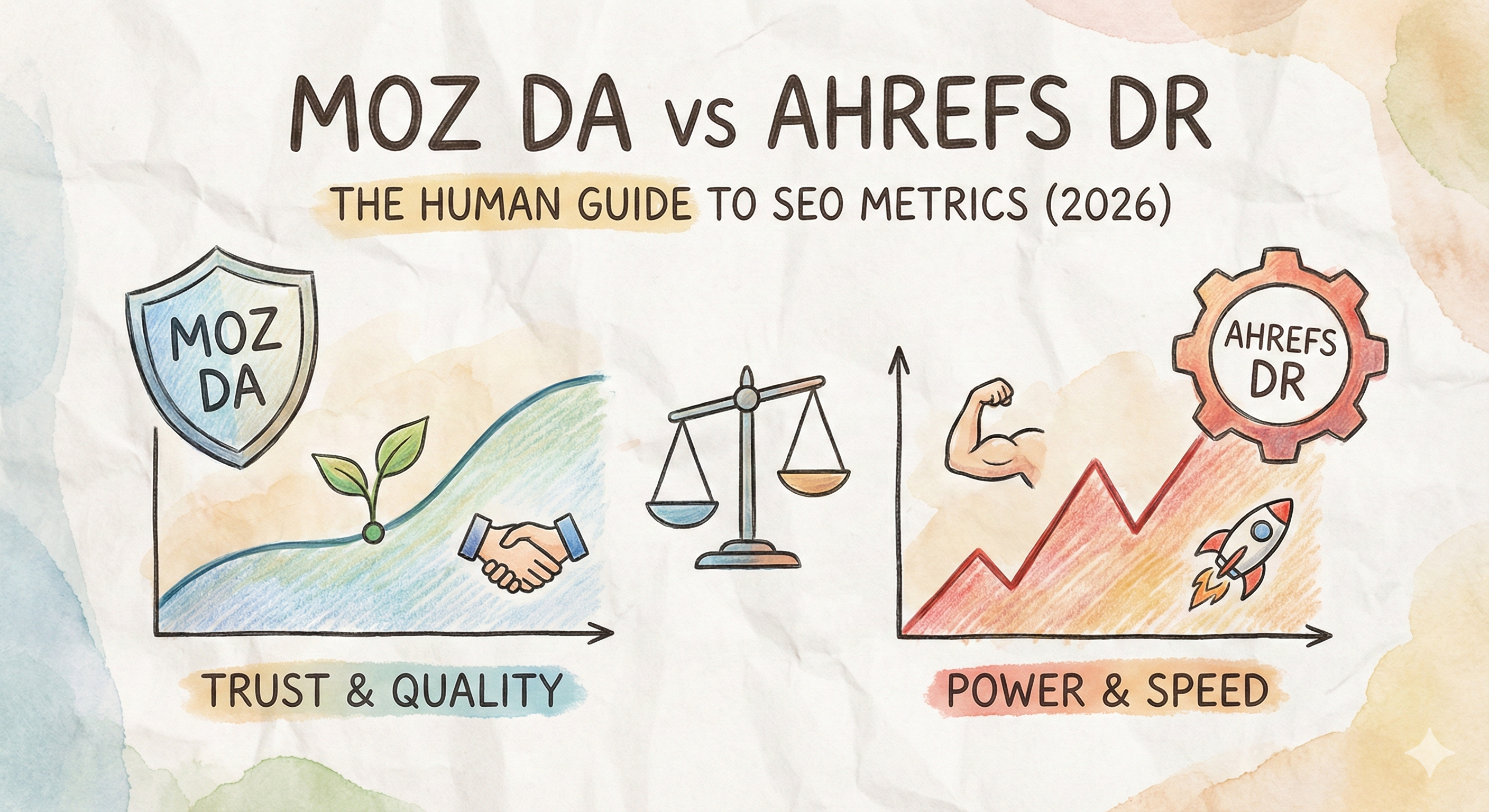
In the high-stakes world of SEO, two numbers dominate every boardroom conversation, client report, and acquisition deal: Moz Domain Authority (DA) and Ahrefs Domain Rating (DR).
For years, founders and marketers have treated these metrics as interchangeable "trust scores." But as we move deeper into 2026, relying on that assumption is a dangerous game. Here is the reality: DA and DR are speaking two different languages. One is a holistic predictor of ranking potential, while the other is a raw, aggressive measure of link equity.
If you are a startup founder trying to outrank legacy competitors, or a tech enthusiast building your first portfolio, understanding the nuance between these two scores isn't just "nice to know"—it is the difference between a strategy that scales and one that stalls.
In this guide, we aren’t just defining terms. We are tearing down the algorithms, analyzing fresh 2026 data, and giving you the exact playbook on which metric to trust for your specific business goals.
The Core Difference: "Ranking Potential" vs. "Link Strength"
At a glance, both tools score your website on a scale of 0 to 100. However, the engine under the hood is completely different.
Moz Domain Authority (DA): The Holistic Predictor
Think of Moz DA as a reputation score. It doesn't just look at how many people are talking about you (links); it looks at who is talking about you and in what context.
- What it measures: A predictive model of how likely a domain is to rank in Google SERPs (Search Engine Results Pages).
- The "Secret Sauce": It uses a machine learning model that trains against Google’s actual search results. It factors in link counts, spam scores, and proprietary "quality" metrics.
- The Vibe: Conservative, stable, and quality-focused.
Ahrefs Domain Rating (DR): The Brute Force of Backlinks
Think of Ahrefs DR as a weightlifting record. It is purely about strength. It doesn't care as much about your on-page SEO or internal structure; it cares about the raw "link juice" flowing into your domain.
- What it measures: The strength of a target website’s backlink profile compared to every other site in their database.
- The "Secret Sauce": It calculates "link equity" transfer. If a high-DR site links to you, you get a boost. But if that high-DR site links to a million other people, the value you receive is diluted.
- The Vibe: Fast, volatile, and highly responsive to link-building campaigns.
The Data: How They Actually Perform in 2026
We can't talk about SEO without looking at the numbers. Recent data synthesizes how these two metrics correlate with actual rankings across different industries. The results might surprise you.
Correlation with First Page Rankings by Industry:
| Industry | Moz DA Correlation | Ahrefs DR Correlation | The Winner |
|---|---|---|---|
| Finance | 0.31 | 0.37 | Ahrefs DR |
| Education | 0.39 | 0.34 | Moz DA |
| E-commerce | 0.29 | 0.36 | Ahrefs DR |
| Health | 0.34 | 0.32 | Moz DA |
| SaaS/Tech | 0.32 | 0.35 | Ahrefs DR |
The Takeaway:
- Use Ahrefs DR if you are in "money" niches like Finance, E-commerce, or SaaS. In these aggressive sectors, raw link power often dictates the winner.
- Use Moz DA if you are in "trust" niches like Education, Health, or Legal. Google’s E-E-A-T (Experience, Expertise, Authoritativeness, Trustworthiness) is critical here, and Moz’s holistic algorithm tends to align better with these signals.
Deep Dive: 3 Critical Differences You Can't Ignore
1. Update Frequency (The "Pulse" vs. The "Report Card")
This is the most practical difference for your daily workflow.
- Ahrefs crawls the web at an insane rate—roughly 8 billion pages per day. As a result, your DR can change weekly or even daily. It is a live pulse of your link building.
- Moz typically pushes updates monthly. This makes DA feel like a "monthly report card." It’s less stressful to watch, but it means you won't see the immediate impact of that guest post you landed yesterday.
2. Handling of "Nofollow" Links
- Ahrefs is somewhat controversial here; it generally counts nofollow links towards DR, though with reduced weight. This explains why some sites see their DR spike after getting press mentions that are technically "nofollow."
- Moz is more traditional. It largely ignores nofollow links for DA calculation, adhering strictly to the idea that if equity isn't passed, the score shouldn't move.
3. Database Philosophy
- Ahrefs aims for size. They want to find everything. If a link exists, they want it in their index.
- Moz aims for quality. They have stricter spam filters and might choose not to index low-quality, spammy links that Ahrefs would count.
Actionable Strategy: How to Boost Both Metrics
Improving these scores requires a mix of content excellence and strategic distribution. Here is the modern stack for moving the needle in 2026.
The "Foundation" Layer
Before you chase links, ensure your technical house is in order.
- Internal Linking: Use Screaming Frog to find pages with high authority and link them to your lower-authority pages.
- Content Pruning: Delete or merge thin content that drags down your site-wide quality signals.
The "Velocity" Layer (Launch & Directory Strategy)
One of the fastest ways to establish a baseline DR/DA for a new startup is through directory submissions. This signals to Google (and these tools) that you are a real business entity.
Tool Recommendation: WhatLaunched.today
For startups and tech founders, manual submission is a waste of valuable dev time. Whatlaunchedtoday has emerged as a go-to service for 2026.
- What it does: It is a 100+ directory submission service designed to get your product listed on high-authority platforms automatically.
- Why it matters for DA/DR: By securing listings on 100+ directories, you create a diverse "pillow" of backlinks. These aren't just random links; they often come from established platforms that Ahrefs and Moz trust.
- The Benefit: It solves the "Cold Start Problem." A new domain with 0 links is invisible. A domain with 100+ foundational directory links has a pulse. This base layer helps you move from DA 0 to DA 10-20 quickly, providing the initial trust signals needed to rank for long-tail keywords.
The "Authority" Layer
Once your foundation is set with tools like WhatLaunched.today, move to high-tier acquisition.
- Digital PR: Use platforms like Connectively (formerly HARO) to answer journalist queries. A single link from the New York Times or Forbes can spike your DA by 5-10 points.
- Data Journalism: Publish original studies. If you have proprietary data, release it. People link to statistics more than they link to opinions.
Expert Perspective: The "Intent-Split" Strategy
This is the unique angle most generalist guides miss.
In 2026, you shouldn't just pick one metric and ignore the other. You should apply the Intent-Split Strategy.
The Theory:
Google treats "Informational" queries (e.g., "how to bake a cake") differently than "Transactional" queries (e.g., "buy cake mixer online").
- For Informational content, Google leans heavily on trust and accuracy.
- For Transactional content, Google relies heavily on popularity and authority.
The Application:
- When analyzing your "Blog" or "Resource" competitors: Look at their Moz DA. If you are writing a guide on "The Future of AI," and the top-ranking sites have an average DA of 60, you know you need high-trust signals (citations, author bio, educational links) to compete.
- When analyzing your "Product" or "Landing Page" competitors: Look at their Ahrefs DR. If you are selling a SaaS tool and the top 3 results are DR 80, DR 82, and DR 79, you know you need raw link power. No amount of "quality content" will save you if you don't have the backlink velocity to match them.
The Bottom Line: Don't treat your site as a monolith. Use DA to measure your content's reputation and DR to measure your product's muscle.
FAQs
1. Does Google actually use Moz DA or Ahrefs DR to rank websites?
No. This is the most common misconception in SEO. Google uses its own internal algorithms (like PageRank) to evaluate websites. DA and DR are third-party metrics developed by software companies to simulate and predict how Google might view your site. Think of them as a weather forecast: they predict the rain, but they don't create it.
2. Why is my Ahrefs DR so much higher (or lower) than my Moz DA?
This is normal because they use different "rulers."
- Ahrefs DR is often higher for sites with a lot of raw links, even if those links aren't from diverse sources.
- Moz DA might be lower because it is stricter about "spammy" links and factors in non-link signals.
- Tip: Never compare your DA to your DR. Only compare your DA to a competitor’s DA, and your DR to a competitor’s DR.
3. What is considered a "good" DA or DR score?
A "good" score is one that is higher than your direct competitors.
- If you are a local bakery, a DA of 25 might be excellent if your competitors are all DA 10.
- If you are a CRM software company, a DA of 50 might be low if your competitors (like Salesforce or HubSpot) are DA 90+.
- General Benchmark: Scores between 40–60 are considered "average to good" for established small-to-medium businesses. Scores of 70+ are considered "high authority."
4. Why did my Domain Authority suddenly drop?
Don't panic. A drop usually happens for one of three reasons:
- Lost Links: You lost a high-value backlink (e.g., a news site removed a link to you).
- Competitor Growth: Moz and Ahrefs metrics are relative. If the rest of the internet (and your competitors) gained a ton of links and you stayed the same, your score might dip to reflect your new relative position.
- Algorithm Updates: Moz or Ahrefs adjusted their own calculation formulas.
5. Can I just buy links to increase my DR/DA?
Technically, yes, but it is risky. "Farming" links from low-quality sites might artificially inflate your metrics temporarily, but Google’s actual algorithm is smart enough to ignore those links. You might end up with a high DR website that gets zero traffic.
- Better Approach: Use safe, foundational services like Whatlaunchedtoday to build a legitimate base of directory links, then focus on earning editorial links through great content.
6. How often do these scores update?
- Ahrefs DR: Updates constantly (daily/weekly). It is very volatile and reactive.
- Moz DA: Updates roughly once a month. It is slower and more stable.
7. Will submitting to directories really help my SEO in 2026?
Yes, but the goal has shifted. In 2010, directories were for "ranking power." In 2026, directories are for "Entity Verification" and "Trust."
Submitting to reputable directories (via services like Whatlaunchedtoday or manually) tells Google, "I am a real business, with a real address and a real product." It creates the "trust floor" required before you can reach the "traffic ceiling."
Conclusion
The "Moz vs. Ahrefs" debate isn't about which tool is better—it's about which map you need for the terrain you are crossing.
- Need to know if your link-building agency is doing its job this week? Check Ahrefs DR.
- Need to report to a board of directors about the long-term brand health and trust of the company? Check Moz DA.
- Need to get off the ground immediately? Use Whatlaunchedtoday to build your initial velocity.
In 2026, the winners won't be the ones obsessing over a score of "50" or "60." The winners will be the founders who understand that these metrics are just proxies for the only thing that truly matters: building a brand that deserves to rank.

