




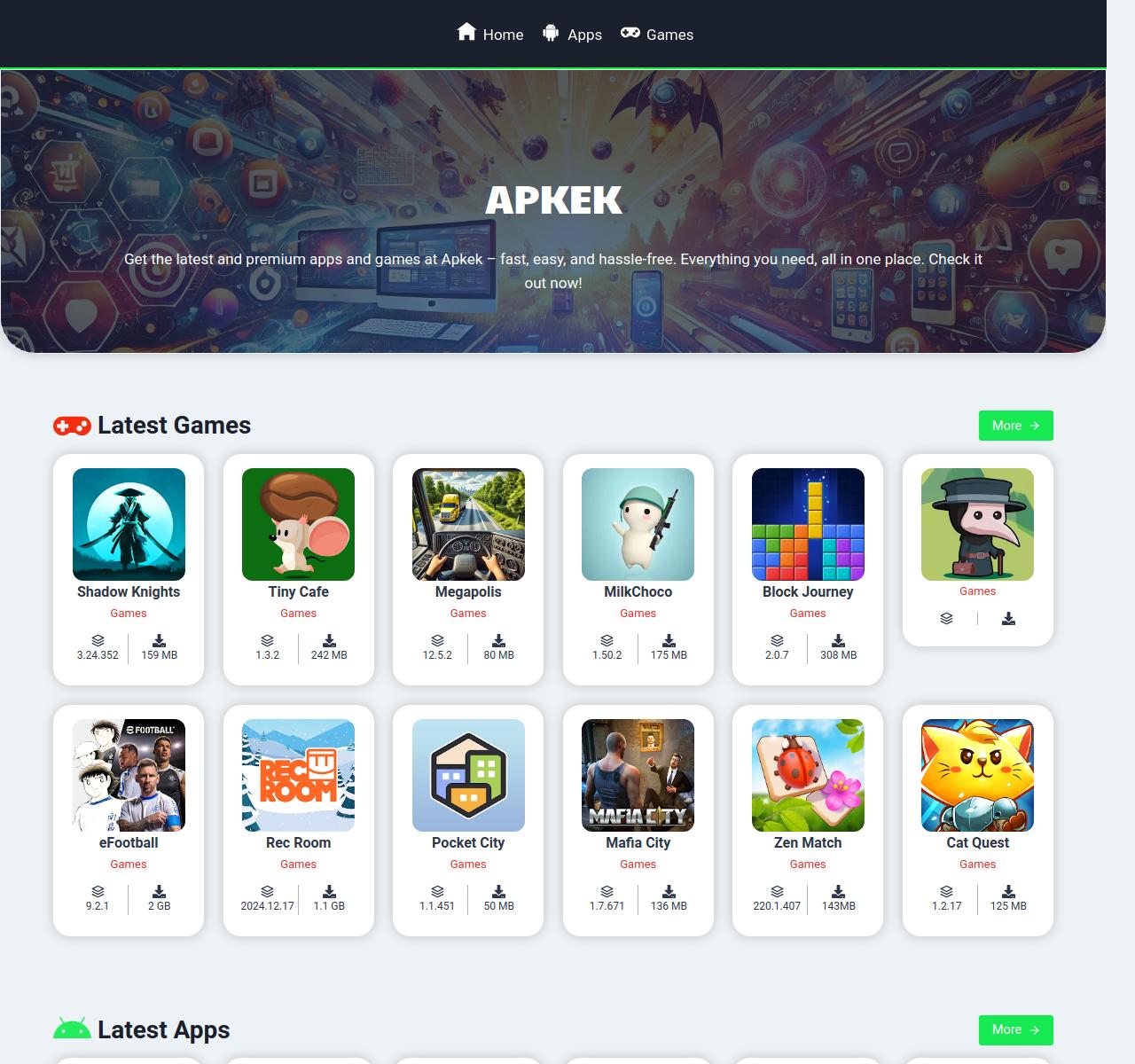
Every few weeks, a new APK website quietly trends across search and social media. Apkek.org is one of those names that keeps popping up, usually when people are looking for Android apps that aren’t available on Google Play.
At first glance, it looks simple enough: app listings, download buttons, no sign-ups. But when a site asks users to download executable files directly onto their devices, simplicity isn’t a virtue, it’s a risk factor.
So instead of repeating surface level claims, I took a closer look at Apkek.org to answer the questions most people don’t ask until something goes wrong:
- Who actually runs this site?
- How transparent is it about safety?
- Can users trust the apps hosted there?
- And how does it compare to known alternatives?
Here’s what I found.
What Apkek.org Claims to Be
Apkek.org presents itself as a third-party APK download website, offering Android apps and games outside the Google Play Store.
There’s no onboarding, no account creation, and no explanation of how files are sourced. Users arrive, search for an app, and are prompted to download an APK file directly.
That model alone isn’t uncommon but it carries responsibility.
Unlike discovery platforms such as Whatlaunched.today, which help users find tools without hosting software files, APK sites directly expose users to executable code. That difference matters.
The First Red Flag: Missing Transparency
One of the fastest ways to evaluate trust online is to look for human signals.
On Apkek.org, several are missing:
- No visible company name
- No founder or team information
- No physical address or jurisdiction
- No explanation of who uploads the apps
- No clear description of how files are verified
This doesn’t automatically mean malicious intent but it does mean users are expected to trust the site without knowing who is accountable.
For comparison, established APK platforms like APKMirror openly document their verification and signature-checking process. Apkek.org does not.
Content Quality and App Download Reliability
What the Listings Look Like
Most app pages on sites like Apkek.org follow a predictable pattern:
- App name and icon
- Short, generic description
- Download buttons
- Minimal technical details
What’s missing is often more important than what’s present:
- No developer attribution
- No changelog history
- No file hash or signature details
- No confirmation that the APK matches the official release
For users who care about security or startups recommending tools to others this lack of detail is a serious weakness.
The Download Experience: Where Risk Usually Appears
The highest-risk moment on APK sites is not the homepage—it’s the download flow.
Based on third-party assessments and common patterns across similar platforms, users may encounter:
- Redirects before reaching the actual file
- Multiple “Download” buttons pointing to different destinations
- Ads disguised as system prompts
- External domains hosting the final APK
These behaviors don’t guarantee malware, but they significantly increase exposure to malicious redirects and deceptive installs.
Android’s own security documentation warns against this exact pattern.
How Apkek.org Likely Makes Money (Without Saying It)
Apkek.org does not publicly disclose its monetization model.
However, most sites with similar layouts rely on:
- Display ads
- Redirect monetization
- Affiliate traffic arbitrage
The issue isn’t advertising—it’s non-disclosure.
When a platform profits from traffic but doesn’t explain how, users have no way to assess conflicts of interest or data handling practices.
Safety and Transparency: What’s Missing Matters
There is no public evidence that Apkek.io:
- Scans files with VirusTotal
- Displays SHA-256 or MD5 hashes
- Verifies developer signatures
- Publishes a malware response policy
In contrast, platforms like F-Droid focus entirely on transparency and reproducible builds, even if that limits their app catalog.