




What Launched Today
Checking sign-in…

What Is Guest Posting in SEO? A Backlink Guide

Published on October 14, 2026

Learn what guest posting is, how guest posts support SEO, how to find quality websites, and how to build backlinks without risky link schemes.

What Is Guest Posting in SEO? A Backlink Guide

What Is Guest Posting in SEO? A Practical Guide to Building Backlinks

Guest posting in SEO is the practice of writing and publishing an article on another website to reach its audience, demonstrate expertise, and potentially earn a backlink to your own website. Also called guest blogging, it can support link building, brand awareness, referral traffic, and professional relationships when the content genuinely benefits the host publication's readers.

However, not every guest post improves your SEO. A relevant article published on a respected industry website can be valuable even without a backlink, while dozens of articles published solely to manipulate rankings can waste your resources and violate Google's spam policies.

The difference comes down to why the article exists, who benefits from it, and whether the publishing website maintains meaningful editorial standards.

What Is Guest Posting in SEO?

Guest posting is a content marketing strategy in which a writer contributes an article to a website they do not own. The host website publishes the article for its audience, and the contributor may receive an author biography, a link to their website, or an opportunity to demonstrate their expertise.

For example, a founder of a project management SaaS company could contribute an article about managing remote teams to a business publication. The article helps the publication serve its readers while introducing the founder's expertise and product to a relevant audience.

A guest post typically involves four elements:

  • Contributor: The person or business providing the article.
  • Host website: The publication that reviews and publishes the content.
  • Article: Original material created for the host's audience.
  • Backlink: An optional hyperlink pointing from the published article to the contributor's website.

Guest posting is not the same as publishing an article on your own blog. The main distinction is that another website's editorial team controls the publication and reaches an audience you may not otherwise access.

How Does Guest Posting Work?
guestpost2.png

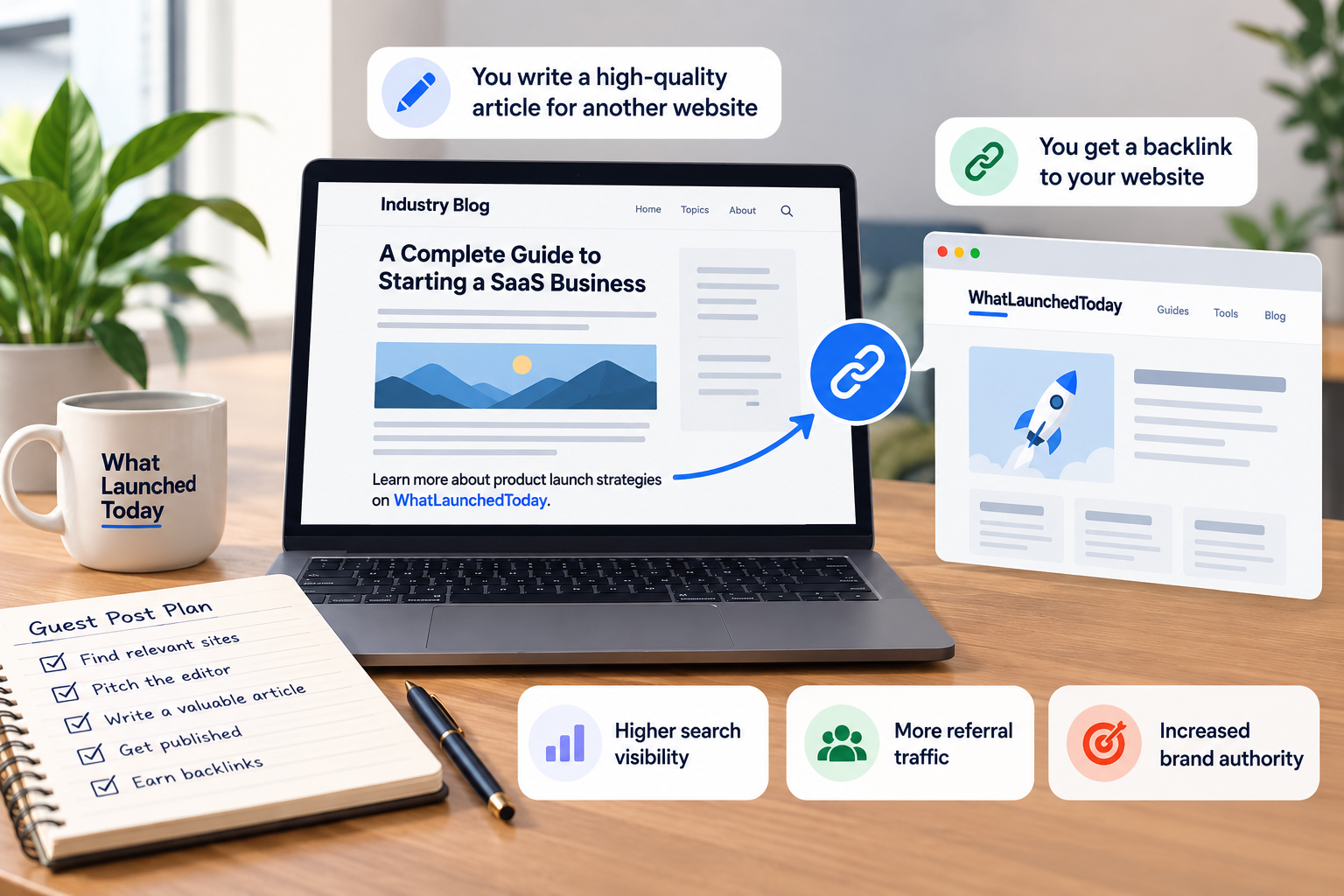
The process usually follows these steps:

  1. Find websites that publish content relevant to your industry.
  2. Evaluate their audience, editorial standards, and publishing history.
  3. Pitch an original article idea that fills a gap in their existing content.
  4. Write the article according to the publication's guidelines.
  5. Submit the draft for editorial review and make requested revisions.
  6. Publish the approved article and share it with relevant audiences.
  7. Measure referral traffic, engagement, conversions, and other outcomes.

A backlink may be included if it is editorially appropriate and permitted by the publisher. Some publications allow links within the article, while others allow only an author biography or no promotional links at all.

Why Is Guest Posting Important for SEO?

Guest posting can support SEO by helping businesses earn relevant editorial coverage, introduce their websites to new audiences, and create opportunities for people to discover and reference their content.

Its value is broader than the number of links acquired. A useful guest article can introduce a brand to potential customers, generate referral visits, establish relationships with editors, and help readers recognize a business as a credible source of information.

1. It Can Help You Earn Relevant Backlinks

A backlink is a hyperlink from one website to another. Search engines use links among many other signals to discover pages and understand relationships across the web.

A guest article may include a contextual link to a genuinely useful resource on your website. For example, an article about startup launch planning could link to a detailed launch checklist hosted on the contributor's site.

The important distinction is that the link should make sense for the reader. Its destination should add information, provide evidence, or help the reader complete the next step.

Google's spam policies identify links created primarily to manipulate search rankings as link spam. Paying for articles that pass ranking credit, using optimized anchor text in paid guest posts, and distributing low-value content primarily to manipulate links can violate these policies.

The practical takeaway: Earn editorial links by contributing useful information, not by treating every publication as a way to manufacture ranking signals.

2. It Can Generate Referral Traffic

Referral traffic consists of visitors who reach your website through links on other websites.

Imagine a founder publishes a detailed guide to customer onboarding on a software company's blog. Readers who find the advice useful may click through to the founder's website to explore a template, product, or related resource.

That visit is valuable because the visitor already has some context about the business and why its content might help them.

The quality of referral traffic depends on the publication's audience, the article's relevance, and the usefulness of the destination page. A smaller niche publication can outperform a much larger website if its readers are more likely to need your product.

3. It Builds Brand Awareness and Credibility

Publishing on relevant industry websites puts your expertise in front of readers who may not know your brand.

Repeated, useful contributions can help establish recognition among potential customers, industry peers, journalists, and other publishers. Those relationships may eventually lead to invitations, interviews, citations, or further editorial coverage.

Credibility is not automatic, however. Appearing on a website with weak editorial standards or an unrelated audience may contribute little to your reputation.

4. It Can Support Discoverability Beyond Traditional Search

People discover brands through industry publications, newsletters, online communities, and AI-powered search tools as well as traditional search engines.

A substantive guest article can create another credible place where a company's expertise is documented. It may also generate brand mentions or references that help readers discover the business elsewhere.

However, a guest post does not guarantee that ChatGPT, Gemini, Perplexity, or Google's AI features will cite or recommend your website. AI visibility depends on many factors, and the impact of an individual article cannot be assumed.

What Makes a Good Guest Post Backlink?
guestpost3.png

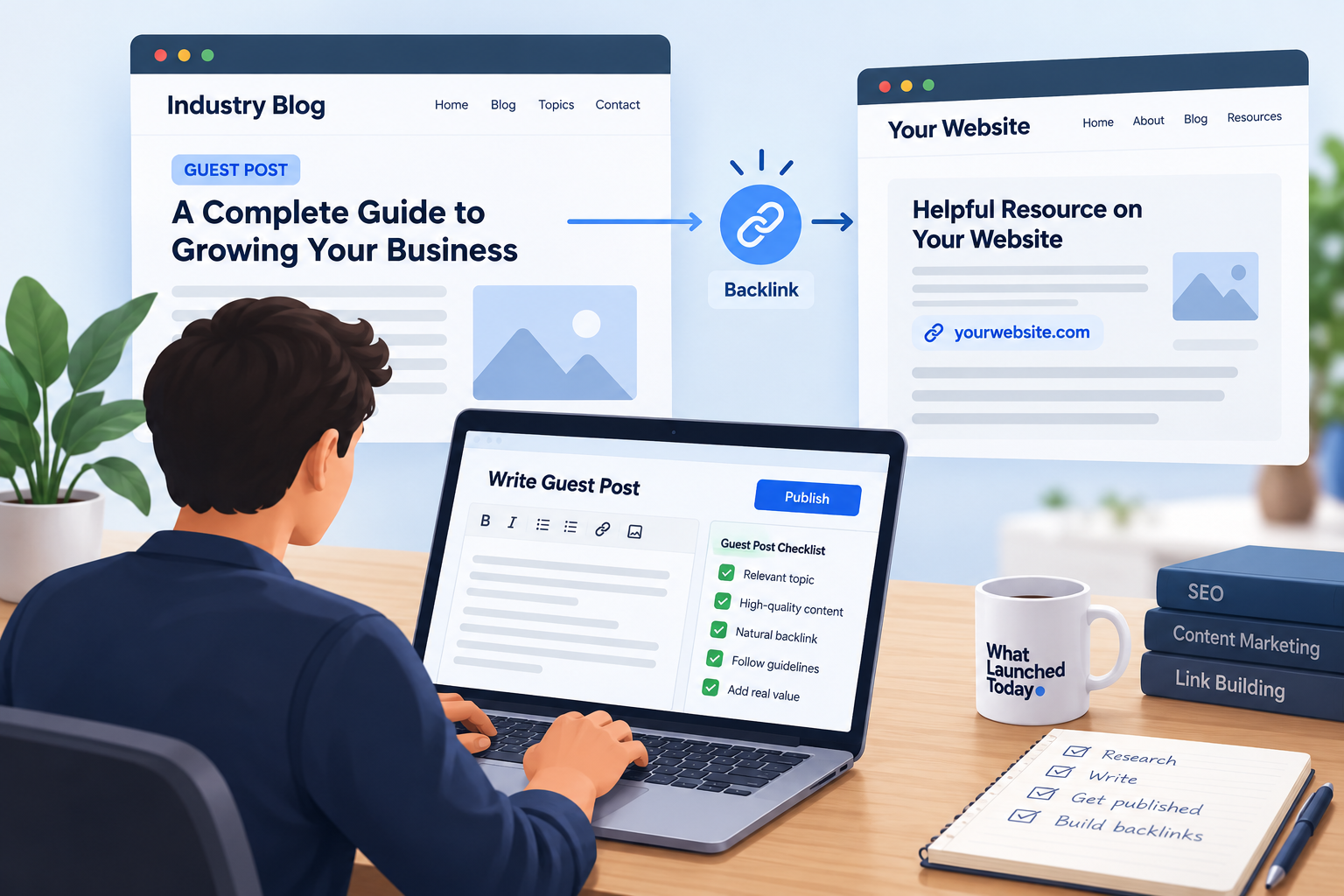
A good guest post backlink is relevant to the surrounding content, useful to readers, placed on a website with meaningful editorial standards, and directed to a page that supports the article's subject.

There is no single third-party metric that can reliably determine whether a link will improve SEO. Evaluate the complete publishing opportunity instead.

Evaluation factor What to look for Warning sign
Topical relevance The website covers your industry or a closely related subject The publication accepts unrelated topics indiscriminately
Audience quality Its readers overlap with your target customers Its audience has little reason to visit your website
Editorial standards Articles are reviewed, accurate, and useful Content appears automatically published or lightly edited
Organic visibility Relevant pages receive search impressions or traffic The website has little evidence of genuine readership
Outbound links Links support the article's claims and resources Articles contain excessive commercial or unrelated links
Link placement The link naturally helps the reader The link is forced into irrelevant anchor text
Publication transparency Authors, ownership, and editorial policies are clear Ownership and publishing practices are difficult to understand

Should You Prioritize Domain Authority or Relevance?

Prioritize relevance and genuine audience value before relying on domain-level authority metrics.

Metrics such as Ahrefs Domain Rating, Moz Domain Authority, and Semrush Authority Score are proprietary third-party measurements. They can help you compare websites, but they are not interchangeable, and none should be treated as a direct measurement of Google's ranking algorithm.

Consider two hypothetical opportunities:

  • Publication A: A highly rated general website whose readers rarely encounter your subject.
  • Publication B: A smaller, well-maintained industry publication whose readers regularly need your expertise.

Publication B may be the stronger marketing opportunity because its audience is more likely to engage with your article and visit your website.

This does not mean authority is irrelevant. A relevant publication with strong editorial standards, meaningful readership, and a credible link profile is often an attractive target. It means that a high score alone is not enough to justify investing time in a guest post.

How to Find Guest Posting Opportunities

guestpost4.png

Finding guest post opportunities is easier when you begin with websites that already serve your target audience instead of collecting large lists of sites that accept any submission.

1. Search for Relevant Publications

Start with searches that combine your topic with phrases indicating that a publication accepts outside contributors.

Examples include:

  • startup guest post guidelines
  • saas write for us
  • marketing guest article submissions
  • technology blog contributor guidelines
  • entrepreneurship guest blogging opportunities

These searches help you discover potential publishers, but a page saying “write for us” does not prove that the website is valuable. Inspect its published content and publishing standards before contacting the editor.

You can also contribute a guest post to Whatlaunchedtoday. Share your expertise, publish useful content for startup founders and entrepreneurs, and introduce your brand to people interested in discovering and building products.

Whether you're writing about SEO, marketing, SaaS, backlinks, or startup growth, a valuable, relevant article can help you reach the right audience.

Ready to contribute? Visit whatlaunched.today to explore the platform and get started.

2. Analyze Competitor Backlinks

Competitor backlink analysis can reveal publications that have previously accepted contributions from businesses in your industry.

Use a backlink analysis tool to inspect competing websites. Look for links from article pages, contributor biographies, interviews, and industry publications. Visit the source pages to determine whether the links came from genuine guest articles and whether the websites are still publishing relevant material.

A competitor backlink is a lead to investigate, not proof that the same publisher will accept your pitch.

3. Look Beyond Search Results

You can also discover opportunities through:

  • Industry newsletters and professional associations.
  • Editors who publicly request expert contributions.
  • Communities where writers and publishers collaborate.
  • Conferences, podcasts, and professional networking groups.
  • Existing relationships with complementary businesses.

These channels may reveal publications that are difficult to find through generic search queries.

4. Build a Qualified Prospect List

Record the details that help you decide where to invest your time.

Field Purpose
Website and relevant section Confirms the publication fits your subject
Editor or contributor contact Makes personalized outreach possible
Audience description Shows whether readers match your target market
Example articles Helps you understand tone and depth
Submission guidelines Defines acceptable topics and formats
Potential article idea Gives the editor a specific reason to consider you
Link and promotion policy Clarifies whether links are permitted and how they are qualified
Status and follow-up date Keeps outreach organized

A small list of well-qualified prospects is more useful than a large database of websites selected solely by domain metrics.

How to Evaluate a Guest Posting Website Before Pitching

Before writing an article, inspect the publication as if you were deciding whether to recommend it to a customer.

First, read several recent articles. Check whether they demonstrate subject knowledge, provide useful examples, cite sources, and serve a consistent audience.

Next, examine the website's publishing patterns. If it publishes large volumes of unrelated commercial articles with keyword-rich outbound links, investigate further. A legitimate multi-topic publication can exist, but indiscriminate publishing combined with link-selling behavior is a warning sign.

Finally, determine whether your proposed article would genuinely belong there.

Ask yourself:

  • Would the site's existing readers find this topic useful?
  • Can I contribute knowledge or evidence the publication does not already have?
  • Is there a natural resource on my website that would help readers?
  • Would I still want this article published if it did not include a backlink?
  • Is the publication's audience valuable enough to justify the research and writing time?

The fourth question is particularly useful. If the entire opportunity becomes worthless without a link, the content may not offer enough independent marketing value.

How to Write a Guest Post Pitch That Gets Considered

A good guest post pitch is short, personalized, and centered on the value the article will provide to the publication's audience.

Avoid sending generic emails that ask for a backlink or offer an article without explaining why it fits the website.

What to Include in Your Pitch

  1. A relevant opening: Reference a specific article or subject the publication covers.
  2. A clear topic: Propose a useful article rather than simply asking whether guest posts are accepted.
  3. A reader benefit: Explain what the audience will learn or be able to do.
  4. Evidence of ability: Include a relevant writing sample, professional experience, or original research where available.
  5. A simple next step: Ask whether the editor would consider the idea.

Guest Post Outreach Email Example

Subject: Article idea for [Publication Name]

Hi [Editor's Name],

I enjoyed your article on [specific topic], particularly the section about [specific detail].

I'd love to contribute an article for your readers on [proposed topic]. It would explain [specific problem], cover [key takeaway], and provide [practical example or resource] that readers could apply immediately.

I've published related content on [relevant writing sample], and I can tailor the article to your editorial guidelines.

Would this topic be a good fit for your publication?

Best,

[Your Name]

Personalize the message for each editor. If the publication provides submission instructions, follow them instead of sending a generic pitch.

How to Write a Guest Post That Provides Real Value

Once an editor accepts your idea, focus on producing an article that deserves to be published.

Research the Host Website's Audience

Review the publication's recent content, preferred terminology, typical article length, and the level of detail its readers expect.

Identify what has already been covered and find a distinct angle. Rewriting an existing article with a different headline is unlikely to give the editor a compelling reason to publish your work.

Add Something Original

Original value can come from:

  • First-hand professional experience that can be described accurately.
  • A documented experiment or case study.
  • Original research with a transparent methodology.
  • A practical framework that readers can apply.
  • A comparison that explains trade-offs and limitations.
  • Examples that clarify a difficult concept.

Do not invent statistics, results, customer stories, or credentials to make an article appear more authoritative.

Follow Editorial Guidelines

Respect the publisher's requirements for formatting, citations, images, promotional mentions, and revisions. Avoid excessive self-promotion, and do not insist on inserting links that do not improve the article.

The strongest guest contributions are written for the host's readers first. Your business benefits when the article earns attention because it is genuinely useful.

How to Build Backlinks Through Guest Posting Without Risky Tactics

The safest approach is to treat guest posting as an editorial collaboration rather than a link exchange.

Google's link spam documentation specifically identifies paid articles or guest posts containing links that pass ranking credit, especially optimized anchor text, as potential violations.

This does not mean every guest article is prohibited. Editorial contributions can be legitimate when their primary purpose is to inform readers rather than manipulate rankings.

Use the following principles:

  • Pitch original articles to publications with relevant audiences.
  • Link only to resources that add value to the article.
  • Use natural, descriptive anchor text rather than forcing commercial keywords into every link.
  • Do not make a followed backlink a condition of an otherwise editorial contribution.
  • Ensure paid or sponsored placements use appropriate link attributes, such as rel="sponsored" or rel="nofollow", as applicable.
  • Avoid bulk guest-post services that promise rankings through large volumes of placements.
  • Do not publish low-value articles across unrelated websites merely to increase backlink counts.

A link may be useful for referral traffic and discovery even when it is qualified with nofollow or sponsored. Those attributes communicate how the link should be treated; they do not make the article itself worthless.

How to Measure Guest Posting Results

Guest posting performance should be evaluated against the reason you pursued the opportunity.

If your objective is to acquire relevant audiences, measure referral visits and engagement. If your objective is brand awareness, track branded searches, mentions, and new audience reach. If you are pursuing editorial links, monitor the published links and their destinations.

Metric What it tells you Where to check
Published articles Whether your outreach produces accepted contributions Outreach tracker
Referral sessions Whether readers visit your website from the article Google Analytics or another analytics platform
Conversions Whether referral visitors subscribe, register, or purchase Analytics and conversion tracking
New referring domains Whether new websites link to your website Backlink analysis tools
Link status and attributes Whether the link remains published and how it is qualified Source page and backlink tools
Branded search activity Whether more people search for your brand Google Search Console, with attribution limitations
Editorial relationships Whether publishers invite future contributions Outreach records

Do not assume that an increase in Domain Rating or Domain Authority proves that a guest post improved Google rankings. These are third-party metrics, not direct measurements of search performance.

Likewise, a backlink appearing in a tool does not prove that it generated traffic or improved a specific keyword's position.

Review results over time and compare them with the cost of researching, pitching, writing, and promoting each article. That comparison helps you decide whether to repeat the strategy or invest in another acquisition channel.

Common Guest Posting Mistakes to Avoid

Choosing websites only by domain metrics. A strong score cannot compensate for an irrelevant audience or weak editorial standards.

Sending identical pitches to hundreds of editors. Generic outreach ignores the publication's actual needs and makes it harder to propose a useful contribution.

Writing solely to obtain a backlink. Readers and editors can recognize content that contributes little beyond a promotional link.

Forcing exact-match anchor text. Repeatedly inserting commercial keywords into guest articles can create a manipulative link pattern.

Paying for followed links. Purchasing placements that pass ranking credit can violate Google's link spam policies.

Ignoring the destination page. Even a relevant article is unlikely to generate meaningful business results if its linked destination is confusing, slow, or unrelated to the reader's needs.

Failing to promote the published article. Sharing your contribution with relevant audiences can help it reach more readers and strengthen the relationship with the publisher.

Is Guest Posting Still Worth It for SEO?

Yes, guest posting can still be worthwhile when it helps you reach relevant readers, share genuine expertise, and build legitimate editorial relationships. It is less attractive when the strategy depends on buying followed links, publishing low-quality articles at scale, or choosing websites exclusively by third-party authority scores.

For a startup, the decision should come down to opportunity cost. A carefully researched contribution to a respected industry publication may provide audience access and credibility that would be difficult to achieve through your own blog alone. However, producing several guest articles may be less effective than creating one genuinely useful resource that other websites naturally want to reference.

Consider guest posting alongside other ways to build your online presence, including original research, useful free tools, digital PR, expert commentary, and relevant business directories.

For more ideas, see WhatLaunched.Today's guides on getting backlinks for your startup and evaluating startup directories.

Conclusion

Guest posting is most effective when it connects useful expertise with an audience that has a reason to care. It can support link building, referral traffic, brand awareness, and relationships with other publishers, but none of these outcomes is guaranteed.

Start by identifying relevant websites, studying their editorial standards, and pitching an article that fills a real information gap. Measure the results by audience quality and business impact rather than counting backlinks alone.

The goal is not to publish on as many websites as possible. It is to publish somewhere your expertise genuinely belongs.