




December 17, 2025
5 min read
Team

The Death of Stateless AI: Why I’m Betting on Google’s Interactions API

For years, building complex AI apps meant managing a chaotic mess of chat history and context on the client-side. That era is ending. Google's new Interactions API introduces server-side state, a fundamental shift that makes building autonomous, multi-turn agents simpler, faster, and far more powerful. Here's why the future of AI development is stateful.

AIGoogleCloud InfrastructureAI Development
Share this article:
The Death of Stateless AI: Why I’m Betting on Google’s Interactions API

In the rapidly evolving world of generative AI, the tools we use to build applications are shifting as fast as the models themselves. For the past year, most developers have relied on stateless "generate content" endpoints—fire-and-forget requests that return text or code. But as the industry pivots from building simple chatbots to complex autonomous agents, those old methods are hitting a wall.

Enter Google’s new Interactions API.

While it might sound like just another technical update, this API represents a fundamental shift in how developers build with Large Language Models (LLMs). It’s not just about generating text anymore; it’s about managing behavior. Here is why the Interactions API is a game-changer for the AI ecosystem and why you should be paying attention.

1. The Shift from "Generation" to "Interaction"

To understand why this is a big deal, you have to look at the pain points of the current generateContent methods used by most LLM providers.

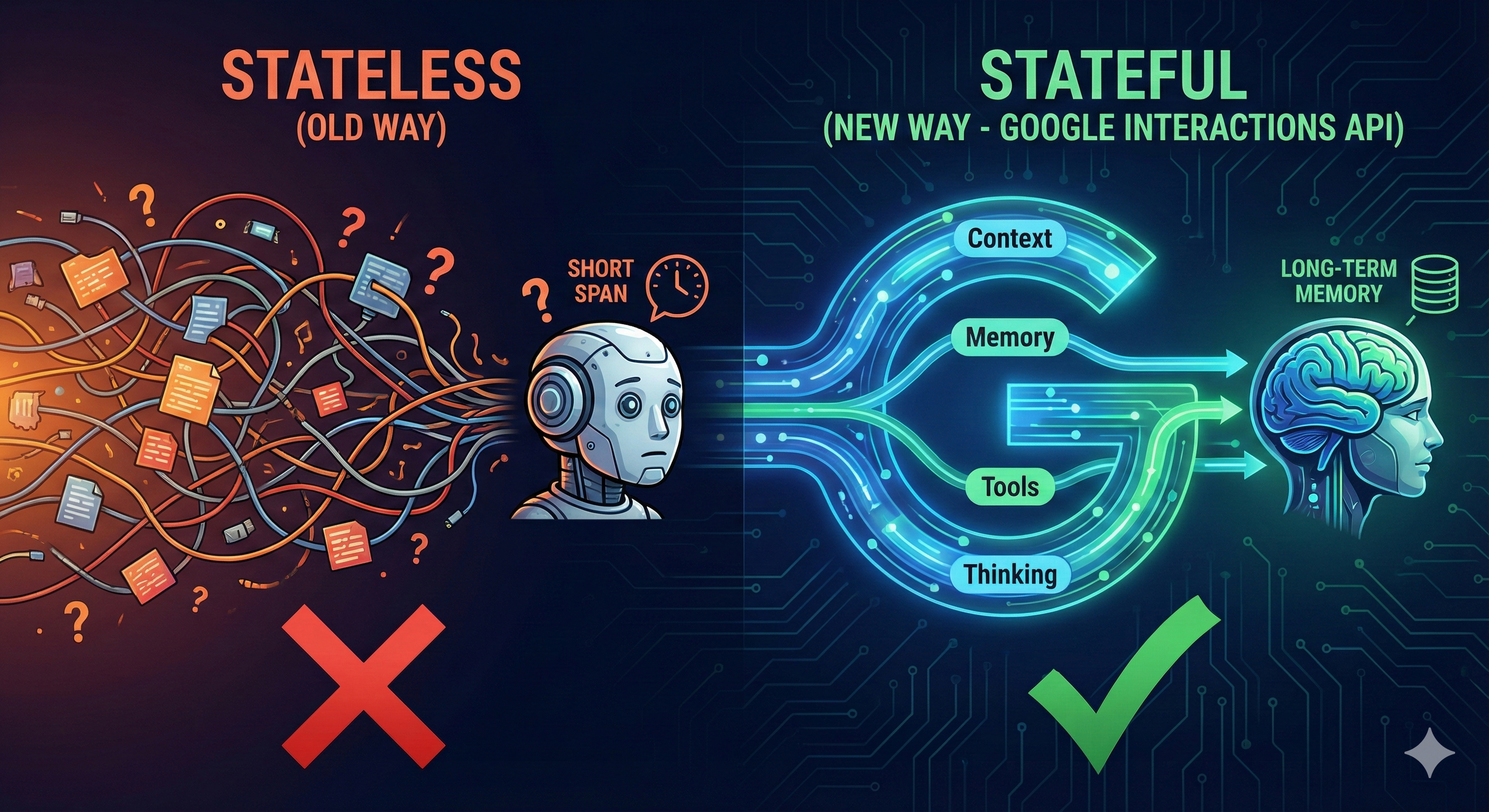
  • The Old Way (Stateless): Every time you send a message to an AI, you have to send the entire conversation history back to the model. You, the developer, are responsible for managing context, trimming tokens, and maintaining the "state" of the conversation.
  • The New Way (Stateful): The Interactions API introduces server-side state management.

With this new API, Google is effectively saying, "We'll hold the memory." You create an interaction session, and the API remembers the history, the tool outputs, and the reasoning chains. This drastically reduces latency and complexity for developers building multi-turn applications.

2. Unlocking "Agentic" Workflows

The term "Agentic AI" is the buzzword of 2025, but building these agents—systems that can think, plan, and execute tasks—is notoriously difficult.
The Interactions API is purpose-built for agentic loops. It treats the model not just as a text generator, but as an actor that possesses:

  • Thoughts and Plans: It supports hidden "thinking" steps where the model reasons before acting.
  • Tools as First-Class Citizens: It handles the back-and-forth of tool calls (like searching the web or querying a database) more natively than previous wrappers.
  • Background Execution: Perhaps most importantly, it supports background=True. You can offload long-running tasks (like writing a report or analyzing code) to the server and poll for results later, preventing timeouts on your client.

3. Immediate Access to Gemini Deep Research

One of the massive perks of this new infrastructure is that it powers Google's new Gemini Deep Research agent.
By using the Interactions API, developers can plug directly into a specialized agent capable of long-horizon research. Instead of asking a model to "search for X," you can task the API to "research the competitive landscape of renewable energy in Southeast Asia," and the agent will:

  1. Formulate a plan.
  2. Execute multiple searches.
  3. Read and synthesize dozens of documents.
  4. Return a comprehensive report.

This democratizes access to "reasoning-heavy" compute that was previously available only to top-tier research labs.

4. Standardization with ADK and A2A

The Interactions API doesn't exist in a vacuum. It is designed to work seamlessly with Google’s Agent Development Kit (ADK) and the Agent2Agent (A2A) protocol.
This suggests a future where AI agents can talk to each other using a standardized language. By adopting this API, developers aren't just simplifying their current stack; they are future-proofing their apps for a "mesh" of interconnected AI agents.

5. Structured Outputs & Reliability

For enterprise developers, reliability is king. The Interactions API doubles down on Structured Outputs (JSON schemas). When building agents that need to pass data to other software (APIs, databases, CRMs), you need guarantees that the AI won't hallucinate the format. This API integrates these constraints deeply into the interaction loop, ensuring that your agent "speaks" valid JSON, even during complex multi-step reasoning.

The Verdict: A New Primitive for AI

The Interactions API is more than a convenience feature; it is a new primitive for software engineering. It acknowledges that the future of software isn't just about calling a function and getting a return value—it's about initiating a session with an intelligent entity that has memory, agency, and the ability to work in the background.

For developers, the message is clear: Stop building stateless chat loops and start building stateful, agentic interactions.


Ready to dive in? The Interactions API is currently available in public beta via Google AI Studio. Check out the official documentation to get your API key and start building.

Published on December 17, 2025

By WhatLaunched Team