


December 19, 2025
5 min read
Team

It’s Official: Gemini Will Replace Google Assistant on Android in 2026

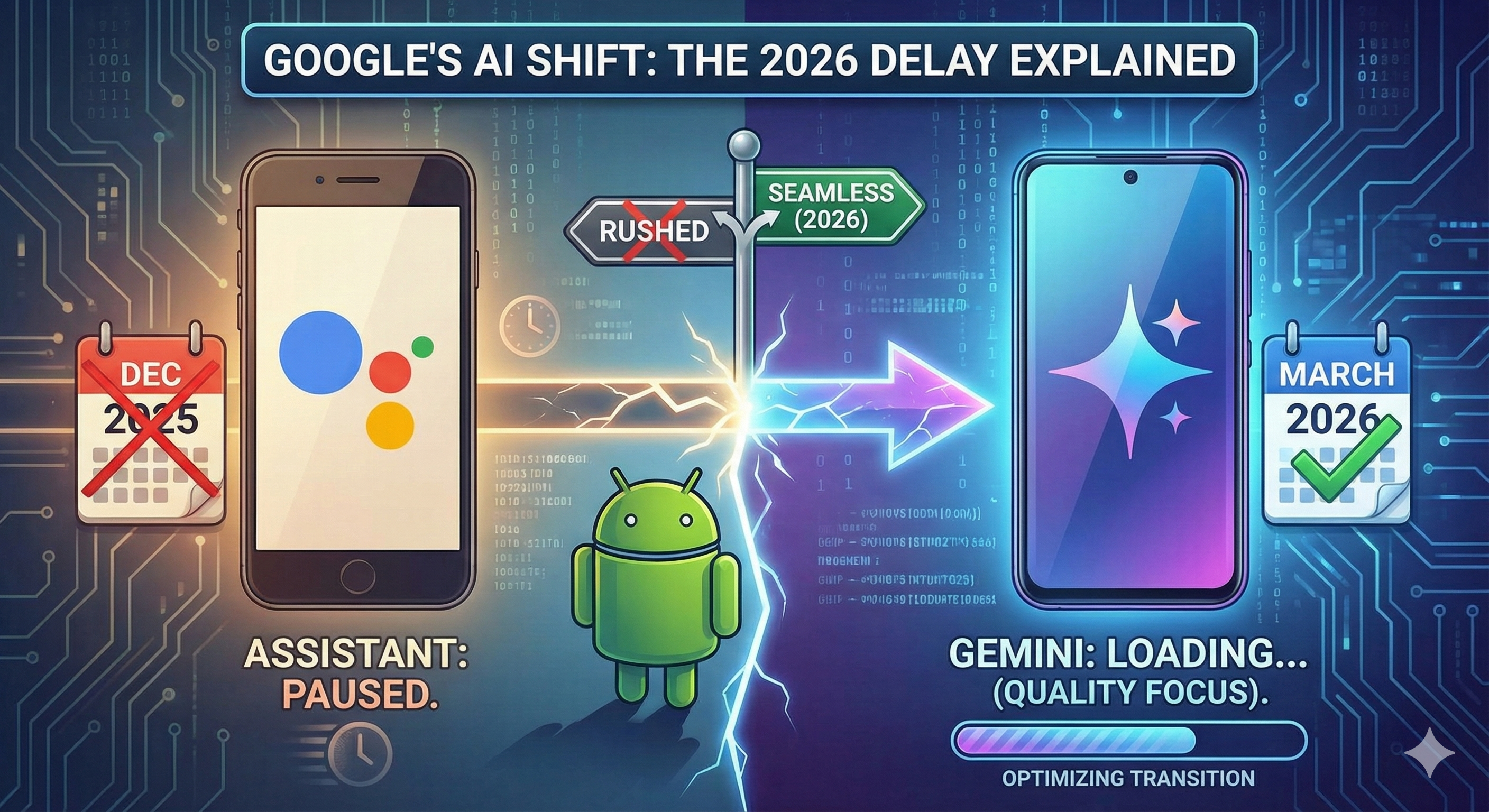
The mandatory transition from Google Assistant to Gemini on Android has been officially delayed. Originally slated for late 2025, Google has pushed the full takeover to early 2026 to ensure a "seamless transition." Here is everything you need to know about the new March 2026 deadline, the hardware requirements for Gemini Nano, and why Google is hitting the brakes to prioritize quality over speed.

GoogleAI Technology
Share this article:
It’s Official: Gemini Will Replace Google Assistant on Android in 2026

For over a year, Android users have been bracing for the end of an era. Google Assistant, the voice helper that has powered our smart lives since 2016, was set to be retired by the end of 2025. But Google has now confirmed a major shift in timeline.

According to a recent report from 9to5Google, the complete transition to Gemini on Android devices has been pushed back to 2026. Instead of a rushed holiday migration, Google is taking extra time to bridge the gap between Generative AI's capabilities and the classic Assistant's reliability.

Here's a deep dive into why this delay is happening, the critical March 2026 deadline, and what it means for your Android device.

The New Timeline: 2026 Is the Year of Gemini

Google originally planned to upgrade most Assistant users to Gemini by the end of 2025, effectively removing the option to toggle back to the classic "Hey Google" experience. But the company has updated its guidance, stating that the migration will now "continue into 2026."

While Google says it's adjusting the timeline to "deliver a seamless transition," specific support documentation for Android Auto provides a more concrete deadline. A banner on the Android Auto help center explicitly states that "Google Assistant is still available for use until March 2026." This suggests March 2026 is the target date for the complete sunset of the standalone Assistant on mobile platforms.

What This Means for Users

  • Android Phones: If you have a modern device, you can currently switch between Assistant and Gemini. This choice will remain available longer than expected—likely until the Q1 2026 cutoff.
  • iOS Users: The standalone Google Assistant app on iOS is also slated for retirement once this transition concludes.
  • Smart Home: The transition for smart speakers and displays is on a separate track, with a "Gemini for Home" early access program already rolling out.

Why the Delay? The Battle of "Smarts" vs. "Utility"

Why push the date back? The consensus points to a shift from a "date-driven" release to a "quality-driven" philosophy. Migrating billions of users from a deterministic tool (Assistant) to a probabilistic AI (Gemini) proved more complex than anticipated.

Google Assistant has had nearly a decade to perfect simple tasks like setting timers, controlling smart lights, and navigating via Android Auto. While Gemini is exponentially "smarter"—capable of drafting emails and planning trips—it initially struggled with these basics. The delay allows Google to address several critical gaps:

  1. Automotive Safety: Android Auto requires low-latency, error-free voice commands. A driver traveling at 70 mph can't afford a verbose AI hallucination. The delay ensures Gemini can handle navigation and media controls as safely as the legacy Assistant.
  2. Smart Home Reliability: Controlling home automation requires precise logic. Google is using this time to ensure Gemini can interact with the Google Home ecosystem without the latency issues that plagued early betas.
  3. Feature Parity: Google is actively working to code utility features—like timers, media playback, and routine management—directly into Gemini so users don't lose functionality they rely on daily.

The Hardware Divide: Who Gets Left Behind?

The switch to Gemini isn't just a software update—it's a hardware transition. Unlike the cloud-based Assistant, Gemini's best features rely on Gemini Nano, an efficient AI model designed to run directly on your device. This requires significant processing power, specifically a Neural Processing Unit (NPU) and ample RAM.

Device Compatibility

To get the full, on-device Gemini experience, you'll likely need a flagship device. Current support includes:

  • Google Pixel: Pixel 8 series, Pixel 8a, and the Pixel 9 series (which reserves a portion of its 16GB RAM specifically for AI).
  • Samsung: Galaxy S24 series, S24 FE, Z Fold 6, and Z Flip 6.
  • Others: Motorola Edge 50 Ultra, Xiaomi 14T series.

The Legacy "Carve-Out"

What about older phones? Google is ensuring that users with legacy hardware aren't completely abandoned. Devices running Android 9 or older with less than 2GB of RAM will likely retain a version of the classic Google Assistant, as they lack the computational resources to run Gemini. This effectively splits the Android ecosystem into two tiers: AI-native devices running Gemini and legacy devices stuck with the old Assistant.

What to Expect in 2026

By March 2026, Gemini aims to be a true "agent," not just a chatbot. We're already seeing glimpses of this future with Gemini Extensions, which allow the AI to interact deeply with Google Workspace. You can currently use Gemini to find emails in Gmail, summarize documents in Drive, and even plan travel via Google Flights and Hotels.

The delay is ultimately good news for users. It signals that Google is prioritizing a stable, reliable experience over a rushed deployment. Until 2026, enjoy the reliability of your classic Assistant—but get ready to say hello to Gemini.

Published on December 19, 2025

By WhatLaunched Team