



January 16, 2026
5 min read
Team

Gemini vs. ChatGPT: Why Users Are Quietly Switching to Google’s AI

Why People Like Gemini More Than ChatGPT (A Deep, Data-Driven Explanation)

Gemini AIChatGPTAlternativeGemini vs ChatGPTArtificial Intelligence
Share this article:
Gemini vs. ChatGPT: Why Users Are Quietly Switching to Google’s AI

For the better part of two years, ChatGPT has been the Kleenex of artificial intelligence—the brand name synonymous with the technology itself.

When OpenAI launched its chatbot, it set a standard for conversational AI that seemed insurmountable. It was smarter, faster, and more creative than anything we had seen before.

However, a subtle but significant shift is occurring in the AI landscape. If you browse the dedicated communities on Reddit, such as r/OpenAI or r/ChatGPT, you will notice a growing number of threads asking the same question: “Why do I like Gemini so much more lately?”
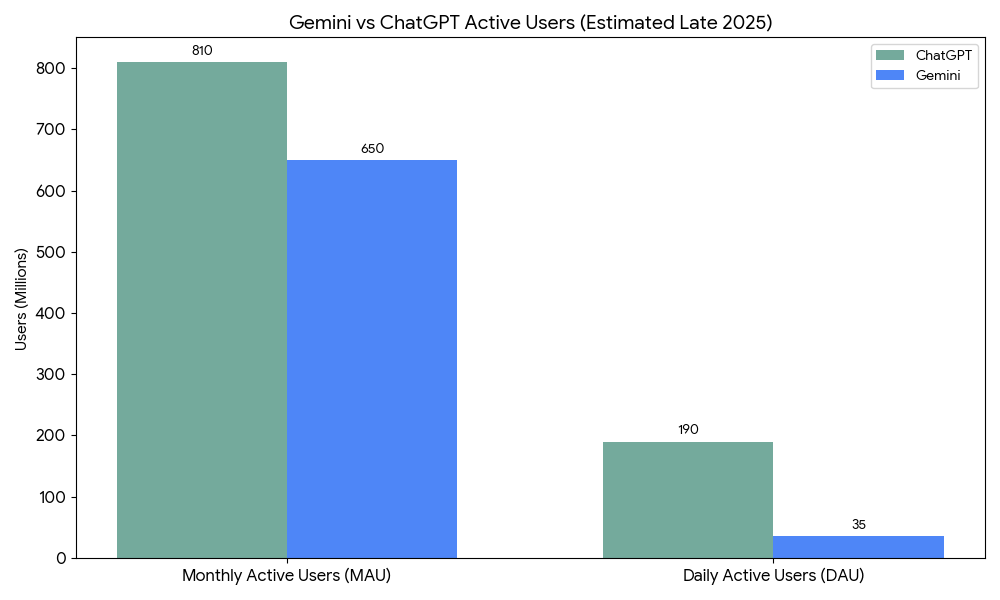
The graphic below shows the estimated active users for Gemini and ChatGPT as of late 2025.

A recent viral discussion on Reddit, titled "Help me understand why people like Gemini so much more over Chat GPT?", has become a focal point for this sentiment. Users aren't just comparing specs; they are comparing "vibes," workflows, and daily utility.

The consensus? Google’s Gemini is winning over a specific, high-value segment of users who are tired of being "lectured" and are craving deep ecosystem integration.

In this deep dive, we will unpack the specific reasons why loyal ChatGPT users are defecting to Google’s ecosystem, supported by user testimonials, technical analysis, and a look at the changing psychology of AI interaction.


1. The "Personality" Crisis: Robotic vs. Human

One of the most striking takeaways from recent user feedback is the difference in tone between the two models.

In the early days of Large Language Models (LLMs), users just wanted the correct answer. Now, they care about how the answer is delivered.

The "Lecture" Fatigue

A recurring complaint among ChatGPT users is the model's increasing tendency to "preach" or moralize. This is likely a result of Reinforcement Learning from Human Feedback (RLHF), where models are trained to be safe and helpful. However, many users feel OpenAI has over-tuned this aspect.

As Reddit user marc5255 pointed out in the thread, "ChatGPT... cannot speak about anything without lecturing me. It cannot even write fictional stories because sometimes people die and it's not allowed."

This sentiment is echoed by hundreds of others. Users describe ChatGPT’s tone as:

  • Condescending: Often treating the user like a child who needs to be reminded of safety protocols.
  • Formulaic: Using "GPT-isms"—repetitive phrases like "It is important to note that..." or "I can't do that, but..."
  • Overly Apologetic: Wasting tokens on excessive politeness and disclaimers.

Gemini’s "Natural" Warmth

In contrast, Gemini is being praised for a tone that feels more authentically human. It is described as "warmer" yet more "to the point." It manages to be helpful without faking a friendship or sounding like a corporate HR representative.

User MultiMarcus, who writes long-form text for work, noted that Gemini delivers a "more natural type of writing," whereas ChatGPT has a "certain tone that feels more prominent" and robotic. For writers, this is a dealbreaker. If you have to spend 20 minutes editing the "robot voice" out of your AI-generated draft, the tool has failed to save you time.

The SEO Takeaway: For content creators looking for blog posts, emails, or creative fiction that passes the "human" test, Gemini is currently holding the crown.


2. The Ecosystem Moat: Integration is King

If personality is the soft skill where Gemini wins, integration is the hard skill where it dominates. This is Google’s massive strategic advantage, often referred to in business as a "moat."

OpenAI is a standalone product. To use it, you have to go to it. Google, however, owns the browser, the email client, the document editor, and the video platform.

The "Workspace" Superpower

For anyone who lives in Google Workspace (formerly G Suite), Gemini is not just a chatbot; it is a co-worker who has access to your files.

  • Docs & Drive: You don't need to download a PDF from your email and upload it to ChatGPT. You can simply ask Gemini, "Summarize the marketing plan I saved in Drive last week," and it can find, read, and summarize it instantly.
  • Gmail Integration: Users like Peg-Lemac shared how they use Gemini to find specific receipts or digital certificates buried in years of emails.
  • Seamless Exporting: When Gemini generates a table or a draft, you can export it directly to Google Sheets or Docs with one click.

The YouTube Advantage

This is a feature that consistently wows users. Because Google owns YouTube, Gemini has native multimodal capabilities regarding video content.

  • Video Summarization: You can paste a YouTube URL into Gemini and ask for a summary.
  • Timestamp Indexing: User susoconde, a programming content creator, mentioned that Gemini saves them hours by analyzing their uploaded videos and immediately creating an index with timestamps for the description. ChatGPT generally cannot "watch" a video link directly; it relies on transcripts or third-party plugins which are often clunky.

For professional workflows, this friction-less experience is often more valuable than raw "intelligence."


3. The "Laziness" Factor and Task Completion

In late 2023 and early 2024, a phenomenon dubbed "GPT-4 Laziness" began to trend. Users noticed that the model would often refuse to complete large tasks, instead offering a sample and telling the user to "do the rest."

  • Example: If you asked for a list of 50 SEO keywords for a pet store, ChatGPT might give you 10 and say, "You can continue this pattern for the remaining keywords."

Gemini’s Work Ethic

Redditors have praised Gemini for being surprisingly thorough. User Kuroodo highlighted this specifically: "Ask ChatGPT for a list and it might list three items, then essentially asks you if you want it to make a list. Gemini on the other hand actually gives you a list."

This willingness to "grind" through a task without complaining is a major quality-of-life improvement for power users. Whether it’s formatting a long data set or generating a comprehensive outline, Gemini seems less concerned with saving compute costs and more concerned with satisfying the prompt.


4. Context Windows and "Deep Research"

In the world of LLMs, the Context Window refers to how much information the AI can hold in its "short-term memory" at one time. A small context window means the AI forgets the beginning of the conversation as it gets longer.

DeepMind, Google’s AI research lab, has been aggressive in pushing the boundaries of context windows.

  • The 1 Million+ Context Window: While different tiers of Gemini have different limits, the Pro and Advanced models have boasted massive context windows (up to 1 million or even 2 million tokens in previews).
  • Practical Application: This allows users to upload entire books, massive codebases, or hundreds of legal documents and ask questions across all of them simultaneously.

User MultiMarcus noted that "Gemini seems to handle large amounts of documents a lot better than GPT." For researchers, students, and legal professionals, the ability to "dump" a library of content into the chat and have the AI synthesize it without hallucinating or forgetting is a game-changer.

Furthermore, Gemini’s "Deep Research" capabilities (often triggered by complex queries) allow it to browse the web more effectively than ChatGPT. Users found that for financial data (like earnings reports), Gemini was consistently more up-to-date, whereas ChatGPT would sometimes confidently state outdated figures.


5. The "Nanny" Problem: Guardrails vs. Guidance

No discussion about modern AI is complete without addressing "Guardrails"—the safety mechanisms put in place to prevent the AI from generating harmful, illegal, or offensive content.

Both Google and OpenAI have strict safety teams. However, the implementation of these safety measures feels different to the end user.

The "Twitchy HR Rep"

Users in the Reddit thread described ChatGPT as acting like a "twitchy HR rep." It interprets ambiguity as danger.

  • If you ask for a story involving a conflict, ChatGPT might refuse because it depicts "violence."
  • If you ask for a critique of a public figure, it might refuse to be "biased."

The "Neutral Observer"

Gemini, while safe, is perceived as less intrusive. It was described by users as "neutral and inoffensive." It doesn't feel the need to lecture the user on why it is doing what it is doing—it just answers the prompt or gives a standard refusal without the moralizing sermon.

User NotFromMilkyWay summed it up bluntly: "Gemini doesn't treat you as a child and suffocates in censorship."

For creative writers, this freedom is essential. You cannot write a compelling novel if your AI assistant refuses to depict villains doing bad things.


6. Where ChatGPT Still Holds Ground

To be fair and balanced, the Reddit thread wasn't purely a Gemini love-fest. There are specific areas where ChatGPT (specifically GPT-4o) still maintains a lead, and for some users, these are non-negotiable.

Coding Capabilities

While Gemini has improved, the consensus among developers is that ChatGPT (and Anthropic’s Claude) is still superior for complex coding tasks.

  • Gemini is great for snippets and explaining concepts.
  • ChatGPT is better at architecting entire scripts and debugging complex logic.
  • Claude is often cited as the current king of coding, but ChatGPT remains a strong second place.

Advanced Data Analysis

OpenAI’s "Advanced Data Analysis" (formerly Code Interpreter) is a powerful tool for data scientists. It runs actual Python code in a sandbox to generate charts, graphs, and statistical analysis.

While Gemini can do this, many power users find OpenAI’s implementation to be more robust for heavy mathematical lifting.

Custom Instructions

Users who have spent months fine-tuning their "Custom Instructions" in ChatGPT are reluctant to switch. This feature allows you to set a permanent persona for your bot (e.g., "Always answer as a senior Python engineer" or "Never use the word 'delve'").

While Google has similar features, the "stickiness" of a highly tuned ChatGPT profile is hard to replicate.


Conclusion: The Vibe Shift is Real

The battle between Gemini and ChatGPT is no longer just about who has the higher IQ score on a benchmark test. It is about User Experience (UX).

Google has realized that the value of AI isn't just in the text it generates, but in where that text lives. By embedding Gemini into the tools we use for work (Docs, Drive, Gmail) and play (YouTube), they have created a workflow that is "sticky."

Simultaneously, OpenAI seems to be struggling with an identity crisis—trying to balance safety with utility, resulting in a product that many users feel has become "cold" and "lecturing."

The Verdict from Reddit?

  • Switch to Gemini if: You want a writing partner that sounds human, you work in the Google ecosystem, or you need to process massive amounts of data/video.
  • Stick with ChatGPT if: You are a heavy coder, you rely on the specific Advanced Data Analysis tools, or you prefer the specific "reasoning" logic of GPT-4 over Gemini’s more fluid approach.

As the AI wars continue, the winner won't necessarily be the "smartest" model—it will be the one that is the most pleasant to work with. And right now, for a growing number of people, that model is Gemini.

🚀 Stay Ahead of the AI Curve

You just read about how quickly user sentiment shifted from ChatGPT to Gemini. In the world of AI, the "best" tool changes almost daily. Don't let the next game-changer fly under your radar.

whatlaunched.today tracks the hottest tech and AI launches in real-time. Whether it's a new productivity hack, a coding assistant better than Claude, or the next big thing in creative writing, find it before everyone else does.

👉 See what launched today: whatlaunched.today


Disclaimer: The views expressed in this article are based on community sentiment from public forums and do not constitute technical endorsements. AI models update frequently, and performance can change week to week.

Published on January 16, 2026

By WhatLaunched Team