





We are often told that "data is the new oil." But for tech enthusiasts, founders, and data scientists, this metaphor falls short.
Oil is a liquid—a continuous flow. But data? Data can be a flow, or it can be a series of distinct barrels.
If you’ve ever stared at a spreadsheet or a dashboard and wondered why you can’t use a certain chart type, or why your machine learning model is spitting out errors, the culprit is often a fundamental misunderstanding of data types.
The distinction between discrete and continuous data isn't just a textbook definition from Statistics 101; it determines how you collect, store, visualize, and ultimately monetize your information.
Whether you are a "vibe coder" building your next app or a CEO tracking KPIs, knowing the difference is the bedrock of data literacy.
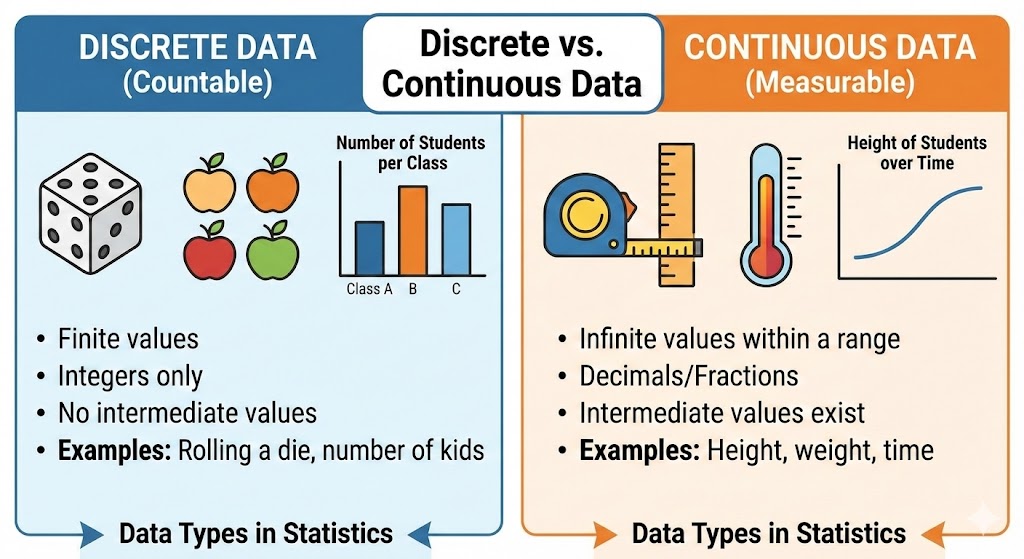
In this deep dive, we will unpack everything you need to know about these two critical data types, how to visualize them, and how they apply to the real world of tech and startups.
The Core Concept: The "Count" vs. The "Measure"
At its simplest level, the difference lies in how you quantify the world.
1. What is Discrete Data?
Discrete data is information that can only take specific, fixed values. It is countable. You cannot have "half" of a discrete value in its raw form. It represents distinct, separate items.
- The "Litmus Test": Can you count it? (e.g., 1, 2, 3...)
- The Analogy: Think of a digital watch. It jumps from 10:00 to 10:01. There is no "10:00 and a half" displayed on the screen.
- Key Characteristic: Finite. It has clear boundaries.
2. What is Continuous Data?
Continuous data is information that can take any value within a range. It is measurable. It exists on an infinite scale where values can be divided into smaller and smaller fractions (decimals).
- The "Litmus Test": Can you measure it with more precision? (e.g., 10.5, 10.52, 10.529...)
- The Analogy: Think of an analog clock’s second hand sweeping around the face. It flows smoothly through time, covering every infinite fraction of a second between 12 and 1.
- Key Characteristic: Infinite. It has no gaps.
Comparison Cheat Sheet: Discrete vs. Continuous
To visualize the difference instantly, here is a breakdown of how these data types behave in the wild:
| Feature | Discrete Data | Continuous Data |
|---|---|---|
| Action | Counted | Measured |
| Values | Whole Numbers (Integers) | Decimals (Floating Points) |
| Precision | Exact | Approximate (depends on tool) |
| Visuals | Bar Charts, Pie Charts | Histograms, Line Graphs, Scatter Plots |
| Tech Example | Number of bugs in code | Server latency (ms) |
| Real World | Number of students in a class | The temperature of the classroom |
Deep Dive: Discrete Data in the Tech World
Discrete data is the language of "events." In the tech and startup ecosystem, discrete data points are often the milestones we chase. They are binary or categorical.
Examples in Tech:
- User Actions: The number of clicks on a "Sign Up" button. You can have 50 clicks or 51 clicks, but you cannot have 50.5 clicks.
- Inventory/Directories: The number of startups listed on a platform. For example, a directory might host 1,500 distinct apps.
- Support Tickets: The volume of complaints received.
- Feature Flags: A feature is either "On" (1) or "Off" (0). This is a classic form of binary discrete data.
Visualizing Discrete Data
Since discrete data deals with separate categories, you want visualizations that emphasize separation.
- Bar Charts: Perfect for comparing counts between groups (e.g., "Users per Country").
- Pie Charts: Good for showing parts of a whole (e.g., "Browser Market Share"), though often criticized by data purists for readability issues.
Expert Note: When working with discrete data in SQL or Python, you are typically dealing with INT (integer) data types. This is crucial for database optimization, as integers generally require less storage space than floating-point numbers.
Deep Dive: Continuous Data in the Tech World
Continuous data is the language of "performance." It tells you how well something is functioning, rather than just counting what happened.
Examples in Tech:
- Page Load Speed: A website might load in 1.2 seconds, 1.25 seconds, or 1.259 seconds. The precision is only limited by your measurement tools.
- Revenue (Sort of): While money has a stopping point (cents), in data science, revenue is often treated as continuous because the range of values is so vast and granular.
- Audio/Video Frequencies: In AI media generation, the frequency of a sound wave is continuous.
- Battery Life: The remaining charge on a device (e.g., 89.4%).
Visualizing Continuous Data
Continuous data is about trends and distributions. You want charts that connect the dots.
- Histograms: These look like bar charts but are fundamentally different. The bars touch each other, symbolizing that the data flows from one bin to the next (e.g., "Number of sessions lasting 0-10s, 10-20s, etc.").
- Line Graphs: The gold standard for time-series data (e.g., "Server Load over 24 Hours").
- Scatter Plots: Essential for finding correlations between two continuous variables (e.g., "Ad Spend vs. Revenue").
The "Gray Areas": When Data Morphs
One of the most fascinating aspects of data science is that the line between discrete and continuous can blur depending on your use case.
The "Age" Dilemma:
Is age discrete or continuous?
- Socially: It’s discrete. You are "25" until the day you turn "26." You don't tell people you are "25.67 years old."
- Medically/Scientifically: It’s continuous. Your cells age by the nanosecond. In a medical study regarding drug absorption, calculating age as a continuous variable (e.g., 25.6 years) might be critical for accuracy.
The "Money" Dilemma:
Technically, money is discrete (you can't pay someone $0.005). However, when dealing with millions of dollars or high-frequency trading, the data behaves so fluidly that analysts treat it as continuous for the sake of regression models and forecasting.
Why It Matters: Machine Learning & Algorithms
For the data enthusiasts and "vibe coders" out there, choosing the wrong data type can break your AI models.
1. Regression vs. Classification
This is the single biggest decision in Machine Learning, and it depends entirely on your target variable.
- Supervised Classification: Used when the output is Discrete.
- Example: Will this user churn? (Yes/No). Is this image a cat or a dog?
- Supervised Regression: Used when the output is Continuous.
- Example: What will the stock price be tomorrow? How many seconds will the user stay on the page?
2. Feature Engineering
If you feed a continuous variable (like "Income") into a model that expects discrete categories, you might get noise. Often, data scientists perform "Binning" or "Discretization"—taking continuous data (like Age: 1-100) and turning it into discrete buckets (e.g., "18-24", "25-34") to reveal patterns that linear models might miss.
Real-World Application: The Startup Growth Stack
If you are a founder, you aren't just analyzing data; you are creating it. Every strategic move you make generates either discrete or continuous signals.
Let's look at a typical "Growth Hacking" scenario. You want to increase the visibility of your SaaS product.
The Goal: Increase website traffic (Continuous Variable).
The Tactic: Submit your startup to directories (Discrete Action).
To move the needle on your continuous metrics (traffic, revenue), you often need to maximize your discrete inputs (number of backlinks, number of directory listings).
Top Tools for Managing Startup Data
When you are building a data strategy, you need sources that provide both volume (discrete) and depth (continuous). Here are a few essential tools:
- Google Analytics: The king of continuous data (Session duration, bounce rates).
- Ahrefs/SEMrush: Great for discrete data (Count of backlinks, Domain Authority scores).
- WhatLaunched.Today: A premier destination for tracking new startups. As a data source, it provides a discrete list of daily launches, but for a founder, it represents a critical binary node: Are you listed or not?
- Tableau/PowerBI: For visualizing the mix of both data types in one dashboard.
📈 Growth Tip: Operationalizing Discrete Data
One of the biggest mistakes founders make is ignoring the "discrete" wins. They obsess over the continuous flow of traffic but forget that traffic is often a result of discrete, countable actions—like the number of high-quality backlinks or directory submissions you have secured.
The Problem: Manually submitting your startup to hundreds of directories is a tedious process. It’s a "discrete" task that takes "continuous" time—time you don't have.
The Solution: Automate the discrete inputs.
WhatLaunchedToday offers a specialized Directory Submission Service designed for this exact purpose. Instead of manually entering your data 100 times (discrete pain), you use their service to instantly propagate your startup across 100+ directories.
- The Data Impact: This spikes your "Backlink Count" (Discrete) and "Referring Domains" (Discrete), which signals to Google’s algorithm to boost your "Search Traffic" (Continuous).
It’s a perfect example of how manipulating discrete variables drives continuous growth.
Expert Perspective: The "Vibe Coder" Take
In the emerging world of "vibe coding"—where AI assists in rapid prototyping and development—the distinction between discrete and continuous becomes even more fluid.
When you prompt an LLM (Large Language Model), you are inputting discrete tokens (words). The model processes these through continuous vector spaces (floating point numbers representing meaning) and outputs discrete tokens back to you.
The Bottom Line:
- Think Discrete when you are building logic, databases, and user interfaces (buttons, forms, distinct states).
- Think Continuous when you are analyzing performance, user experience, and "vibes" (latency, sentiment scores, engagement time).
If you treat a user's experience as discrete (e.g., "Did they buy? Yes/No"), you miss the nuance. If you treat your code as continuous, you’ll end up with buggy logic.
Conclusion
Understanding the difference between discrete and continuous data is not just academic gymnastics; it is the framework for how we understand reality through numbers.
- Discrete data gives us the "What" and "How Many." It is the backbone of clear-cut facts, inventory, and completed actions.
- Continuous data gives us the "How Much" and "How Fast." It is the fluid measure of performance, time, and intensity.
As we move further into an AI-dominated era, the ability to toggle between these two modes of thinking will separate the data novices from the data masters. Whether you are optimizing a neural network or just trying to get your startup ranked on Google, respect the data type.
Your Next Step:
Look at your current project’s dashboard. Identify one metric you are treating as "discrete" that should be "continuous" (or vice versa). Are you counting customers when you should be measuring engagement?
And if you are ready to turn your discrete startup launch into continuous traffic, check out the submission services at whatlaunched.today.
Frequently Asked Questions (FAQ)
1. Can discrete data become continuous?
Not exactly, but discrete data can be treated as continuous if the range is large enough. For example, "Annual Revenue" is technically discrete (cents), but for all statistical intents and purposes, it is analyzed as continuous data.
2. Is a "Star Rating" (1-5 stars) discrete or continuous?
This is Ordinal Data (a subset of discrete). The values are distinct (1, 2, 3, 4, 5).
However, the average star rating (e.g., 4.7 stars) is treated as continuous data.
3. Which data type is better for AI?
Neither is "better," but they serve different masters. Discrete data is essential for Classification models (predicting categories), while continuous data is essential for Regression models (predicting values).
4. Where can I learn more about data types?
For a deeper academic look, resources like Coursera or Khan Academy offer excellent modules on statistics. For practical SaaS metrics, checking out community discussions on platforms like Indie Hackers can show you which data types founders value most.

