





What Launched Today

YC Directory vs. Crunchbase: Which Database is Better for Founders?

Published on June 22, 2026

Deciding between YC Directory vs Crunchbase? Our guide compares YC's free, high-signal data for trend-spotting with Crunchbase's vast database for fundraising.

YC Directory vs. Crunchbase: Which Database is Better for Founders?

Choosing the right startup intelligence platform is crucial. Do you need a high-signal, curated view of elite trends from the YC Directory, or a comprehensive, global database like Crunchbase for broad-scale outreach and market sizing? The right tool depends entirely on the job you need to do.

The hunt for reliable startup data can feel like navigating a maze. One path leads to the Y Combinator Directory—a pristine, walled garden showcasing top-tier companies. It’s a source of pure signal. The other path leads to Crunchbase, a sprawling metropolis of data on millions of companies—a firehose of information that requires careful filtering.

For a founder validating an idea, an investor sourcing deals, a sales rep building a pipeline, or a job seeker scouting the next rocket ship, understanding the nuances of these platforms is key.

This guide breaks down their features, strengths, and ideal use cases to help you decide which platform best suits your mission.

YC Directory vs. Crunchbase: At a Glance

Feature YC Startup Directory Crunchbase
Primary Focus Official list of YC portfolio companies Global database of all companies & investors
Data Scope ~5,000+ YC companies Millions of global companies
Data Source First-party (from YC & founders) Crowdsourced, automated & partner-submitted
Data Accuracy Very High Variable; requires cross-verification
Cost Completely Free Freemium (with a paid Pro tier for advanced features)
Best For... Trend spotting, competitive analysis, pitch refinement Investor research, lead generation, market sizing

What is the YC Startup Directory?

The YC Startup Directory is the official, free-to-access public database of every company that has graduated from the Y Combinator accelerator. It serves as the canonical source of truth for the YC portfolio, offering first-party data directly from the accelerator and its founders.

Think of the YC Startup Directory as an elite, curated gallery. Its value isn't in its size—it's limited to the 5,000+ companies in the YC portfolio, including household names like Airbnb, Stripe, and Dropbox—but in its quality, focus, and prestige. The data is highly accurate and updated frequently. For founders, it's an unparalleled tool for spotting emerging micro-trends, analyzing the positioning of top-tier competitors, and understanding what kinds of ideas are gaining traction with the world's premier accelerator.
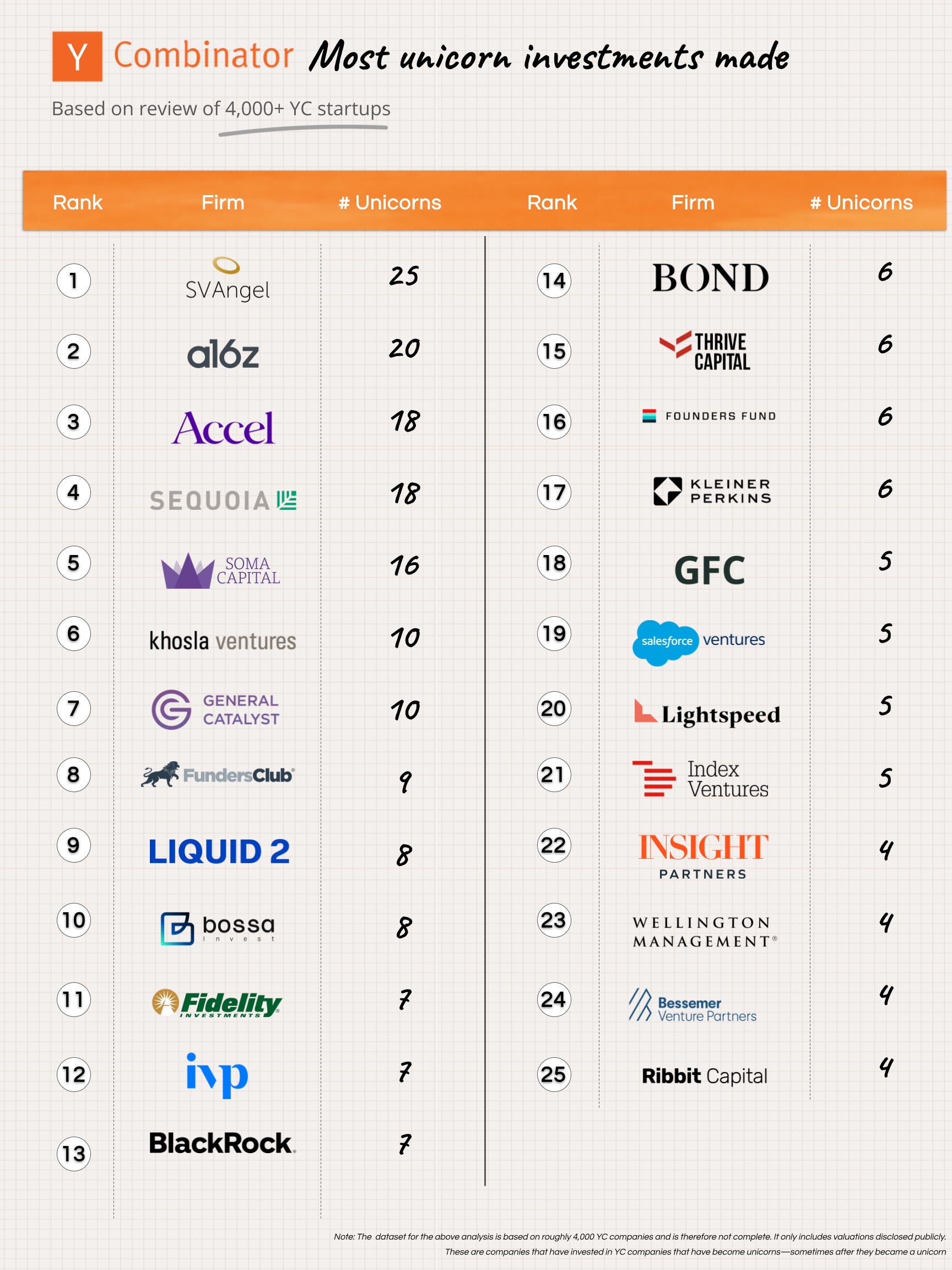
Screenshot of the YC Startup Directory showing company profiles.

Source: Substack

For example, a quick glance at a company profile like Brex (W17) shows its one-line pitch ("All-in-one finance for every business"), its industry tag ("Fintech"), its active status, and a link to its website. It's concise, verified, and serves as a powerful signal of what a successful YC pitch looks like.

While its search capabilities are basic, offering filters for batch, industry, and status (active, acquired, inactive), they are highly effective for its specific dataset. A founder building a new developer tool can filter for the "B2B" category and see every company YC has funded in that space, tracing the evolution of ideas from batch to batch by browsing the full archive.

What is Crunchbase?

Crunchbase is a massive, crowdsourced data platform containing business information on millions of private and public companies, investors, and funding rounds globally. It functions as the de facto encyclopedia for the entire tech and business ecosystem, extending far beyond any single accelerator or geographic region.

If the YC Directory is a curated gallery, Crunchbase is a global library with millions of books, constantly being updated by an army of librarians and patrons. Its scope is immense. Information is gathered through a mix of user submissions, automated web scraping, media monitoring, and data partnerships.
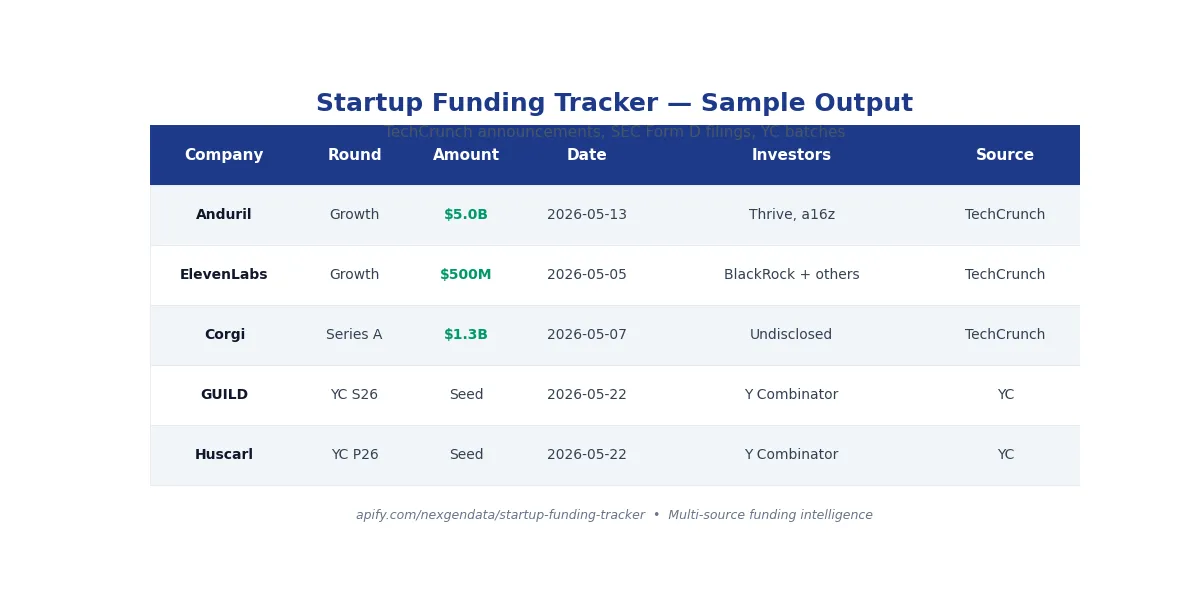
Screenshot of the Crunchbase platform displaying startup funding data.

Source: Apify

This breadth makes it an indispensable tool for tasks that require a wide-angle lens, such as building comprehensive investor lists, generating targeted sales leads, or sizing an entire market. For that same company, Brex, its Crunchbase profile is a detailed dossier, listing its detailed funding rounds, lead investors, key executives, and acquisition history. The trade-off for this scale is that data accuracy can be variable and often requires cross-verification.

While a limited version is free, Crunchbase's real power is unlocked with a Pro subscription, which offers advanced search filters, custom alerts (e.g., "notify me when a company in my target list raises a new round"), and data exports.

Feature Breakdown: YC Directory vs. Crunchbase

The core difference lies in their approach to data: YC prioritizes curated accuracy within a closed ecosystem, while Crunchbase prioritizes comprehensive scale across the open market. This dictates every feature, from data scope to cost.

Data Scope & Curation

The YC Directory offers deep, high-signal data on a narrow set of elite companies. Crunchbase provides broad, firehose-level data on a massive, uncurated set of global companies.

Your choice depends on whether you're looking for a precise signal or a complete market map. Searching for "AI" in the YC Directory shows you what one of the world's most influential accelerators has deemed a fundable AI company. Searching for "AI" on Crunchbase shows you every company that has ever tagged itself with "AI," from a two-person startup in a garage, perhaps an AI image creator, to a multinational enterprise division. The YC list tells you what an influential group thinks is important; Crunchbase tells you what exists.

Data Accuracy & Freshness

The YC Directory has extremely high data accuracy because it is a first-party source, updated by YC partners and founders themselves. The information—especially the company status and one-liner—can be trusted as ground truth.

Crunchbase's accuracy is generally good but variable. Because it relies on crowdsourcing and automation, information can become outdated. A best-practice workflow is to treat Crunchbase data as a strong starting point that requires verification. Identify a target on Crunchbase, then cross-reference its funding status by checking official press releases or the company's own website.

Search and Filtering Capabilities

Crunchbase offers powerful, granular filtering with a Pro account, making it far superior for building targeted lists. The YC Directory provides basic but effective filters for its specific dataset.

This is perhaps the most significant functional difference. The YC Directory's simplicity is a feature for its use case, but it cannot support complex queries like "all Series A fintech startups in the UK." On Crunchbase Pro, that query takes about 15 seconds to build and produces a precise, exportable list.

YC Directory Filters Crunchbase Pro Filters (Partial List)
Batch (e.g., W24, S23) Industry Keywords & Groups
Industry (30+ categories) Headquarters Location (City, State, Country)
Status (Active, Acquired, Inactive) Funding Status (e.g., Seed, Series A)
Region (Continent/Country) Total Funding Amount (e.g., $1M - $5M)
Founder / Company Name Last Funding Date (e.g., Last 12 months)
Number of Employees (e.g., 11-50)
Investor Name / Type (e.g., Sequoia Capital)
Tech Stack (e.g., uses AWS, Salesforce)
Diversity Spotlight (e.g., Female-Founded)

Cost and API Access

The YC Directory is completely free, with all features, including CSV export, available to everyone. It has no supported public API and is designed as a standalone research tool.

Crunchbase operates on a freemium model where the most valuable search and data-access features are locked behind a paid Pro subscription. It also provides a robust API for enterprise customers and integrates with platforms like Salesforce, making it a tool for operational workflows.

The Founder's Dilemma: Pros and Cons

Choosing between these platforms is a matter of trade-offs between scope, accuracy, and cost.

YC Directory: Strengths and Weaknesses

The YC Directory's primary strength is its unmatched accuracy and high-signal quality, all available for free. Its main weakness is its extremely narrow scope.

Pros:

  • Unmatched Accuracy: The data is the official record from YC.
  • Completely Free: No paywalls for any features, including data export.
  • High-Signal Trend Spotting: Excellent for seeing what a world-class accelerator is funding.
  • Pitch & Positioning Insights: A free masterclass in how top companies craft their messaging.
  • Simple & Fast: A clean UI makes it incredibly efficient for its intended purpose.

Cons:

  • Extremely Limited Scope: Useless for researching non-YC companies or investors.
  • No Financial Depth: Lacks detailed data on funding rounds beyond the initial YC investment.
  • No Contact Information: It's a directory of companies, not people.
  • Minimal Filtering: Not suitable for building complex, targeted lists for outreach.

Crunchbase: Strengths and Weaknesses

Crunchbase's key strength is its massive database, which provides a comprehensive view of the market. Its primary weakness is that its best features are expensive and its data requires verification.

Pros:

  • Massive Database: The most comprehensive single source for global company and investor data.
  • Powerful Search: Advanced filters enable hyper-targeted list building.
  • Rich Data Sets: Includes deep information on funding rounds, investors, and M&A activity.
  • Actionable Alerts: Custom notifications for funding events provide timely trigger points for outreach.
  • Multi-Use Case: Serves multiple departments, including fundraising, sales, and investing.

Cons:

  • Variable Data Quality: Crowdsourced data can be inaccurate or outdated.
  • Expensive Paywall: The most valuable features are locked behind a Pro subscription.
  • Overwhelming Interface: The sheer volume of data can be daunting for new users.
  • Signal vs. Noise: Requires effort to filter the massive dataset down to a high-quality list.

Use Case Breakdown: The Right Tool for the Job

The best founders use both platforms at different stages. Start with the free, high-signal tool for validation and graduate to the paid, comprehensive tool for execution.

For Early-Stage Founders (Idea & Validation)

Your primary need is high-quality inspiration and validation, which you need for free. The YC Directory is the perfect tool.

  1. Open the YC Directory. Filter by your industry and browse the last 8-10 batches.
  2. Analyze one-liners to understand how successful founders pitch solutions in your space.
  3. Check company status (Active, Acquired, Inactive) for ideas similar to yours to gauge market viability.
  4. Use the Crunchbase free tier to look up interesting competitors and see who their first post-YC investors were.

For Fundraising Founders (Growth Stage)

Your job is to build a targeted list of relevant investors. This is a task for which Crunchbase Pro is essential.

  1. Log in to Crunchbase Pro. Build a "mirror list" of 5-10 companies similar to yours but a few years ahead.
  2. Identify their Seed and Series A investors.
  3. Create an Investor Search. Filter for investors who have made multiple investments in your industry, at your target stage, in your region, within the last 18-24 months.
  4. Export the list for targeted outreach.

For B2B Sales & Marketing Teams

Your goal is to find companies that fit your Ideal Customer Profile (ICP). A recent funding round is the strongest signal of available budget.

  1. Define Your ICP in Crunchbase Pro. Use filters like Industry, HQ, Employee Count, and Last Funding Date.
  2. Save the search and set alerts to get a weekly digest of new companies that fit your ICP.
  3. Export the list and find the right contacts on LinkedIn for targeted outreach.

For Job Seekers

You want to find high-growth companies that are likely hiring.

  1. YC Directory: Filter by the two most recent batches. These companies are newly funded and building their founding teams.
  2. Crunchbase Pro: Create a search for companies in your desired industry that raised over $5 million in the last 3 months. This is a massive hiring signal.

Disambiguation: Startup Directory vs. Windows Startup Directory

A "startup directory" in the business context is a database of new companies, while the "Windows Startup directory" is a system folder on a PC. These two terms are frequently confused in search engines but refer to completely different concepts.

If you search for "startup directory windows," you are likely looking for a technical solution related to your computer's operating system. That specific folder (shell:startup) contains shortcuts to applications that run automatically when your computer starts. This article focuses on the business definition: a database used by founders, investors, and sales professionals to discover startups.

Beyond the Big Two: Other Places to Discover Startups

While the YC Directory and Crunchbase are dominant, a rich ecosystem of other platforms and free tools exists for discovering new companies, often serving more specific needs.

  • Fundraising & Hiring: Platforms like Wellfound (formerly AngelList) and StartuPage combine directory features with active fundraising and hiring marketplaces.
  • Enterprise-Grade Data: For VCs or corporate development teams, expensive platforms like PitchBook and Mattermark offer deeper financial data and analyst reports.
  • Product Launches: Sites like Product Hunt and BetaList are launchpads where new products are showcased daily, showing you what's trending with an audience of tech enthusiasts.
  • Accelerator & VC Portfolios: Explore the public portfolios of other top programs like Techstars, 500 Global, Sequoia Capital, or a16z.
  • Niche & Regional Directories: You can find curated lists focused on specific verticals (e.g., an AI startup directory) or regions (e.g., a startup directory for the UK or India).

Final Verdict: Building Your Startup Intelligence Stack

There is no single "better" platform; YC's directory and Crunchbase are complementary tools for different jobs. The savviest founders use both to build a complete intelligence stack.

Step 1: Strategize with the YC Directory. Start here. It's free, fast, and provides a powerful, curated look at what the market considers innovative. Use it for inspiration, to spot trends, and to analyze how top-tier competitors position themselves.

Step 2: Execute with Crunchbase Pro. When you're ready to raise capital or launch a sales campaign, graduate to a paid tool. The investment in Crunchbase Pro is often necessary to build the comprehensive, actionable lists of investors and customers you'll need to scale.

In short: use the YC Directory to sharpen your sword, then use Crunchbase to go to battle.

Frequently Asked Questions (FAQ)

Can you use the YC Directory to find investors?
No, the YC Directory is a list of Y Combinator's portfolio companies, not the external investors who fund them post-YC. For researching investors, platforms like Crunchbase or Wellfound (AngelList) are far more effective.

How up-to-date is the YC company list?
The YC company list is extremely up-to-date and is considered the canonical source for YC's portfolio. It is updated frequently by YC staff, especially after a new batch's Demo Day.

Is Crunchbase's data reliable?
Crunchbase data is a strong starting point but should always be verified with another source before making critical decisions. Its scale comes from a crowdsourced model, so data quality can vary. It's wise to cross-reference important data with official press releases or company announcements.

How can I export data from the YC Directory and Crunchbase?
The YC Directory offers a free "Export as CSV" button, allowing anyone to download the public database. On Crunchbase, data export is a premium feature requiring a paid Pro or Enterprise subscription.

Are there free Crunchbase alternatives?
While no free platform matches Crunchbase's scale, you can assemble similar information from a combination of sources like the YC Directory, other accelerator portfolios (e.g., Techstars), Wellfound, LinkedIn, and industry-specific publications.

Which platform is better for tracking acquisitions (M&A)?
Crunchbase is vastly superior for tracking M&A activity. It has dedicated data fields for acquisitions, including the acquirer, target, date, and price. The YC Directory simply marks a company's status as "Acquired" with no further detail.

How can I find a startup directory for a specific country?
Crunchbase Pro is a powerful tool for creating country-specific startup lists using its advanced location filters. Additionally, many countries have their own regional startup databases, government-run business portals, and local tech publications that offer more localized insights.

YC Directory vs. Crunchbase: Which Database is Better for Founders?