






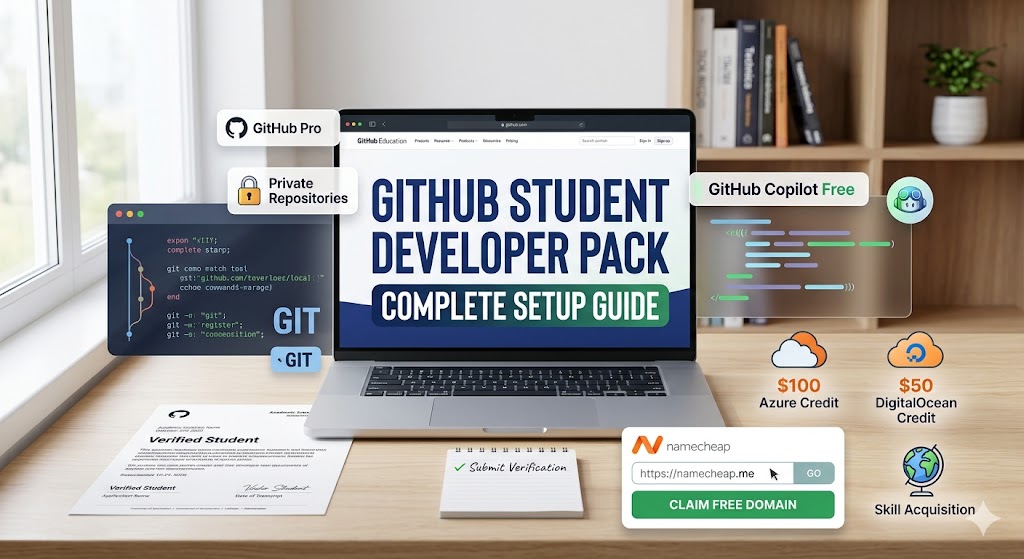
The GitHub Student Developer Pack is a comprehensive digital bundle offering free access to premium software engineering tools. This resource equips academic learners with professional-grade cloud infrastructure, integrated development environments, and advanced educational platforms to build comprehensive software portfolios.
What Is the GitHub Student Developer Pack?
The GitHub Student Developer Pack constitutes a partnership-driven technology program offering complimentary access to commercial developer tools and software services.
GitHub Education coordinates this initiative to help verified academic learners acquire practical software engineering experience using industry-standard enterprise infrastructure platforms.
The program consolidates essential software development categories:
- Version Control Systems: Complimentary access to GitHub Pro and GitHub Team organizational features.
- Cloud Computing Infrastructure: Hosting credits for Microsoft Azure, Amazon Web Services (AWS), and DigitalOcean environments.
- Domain Name Registration: Complimentary domain name provisioning via registrars including Namecheap.
- Developer Utilities: Premium licenses for local code editors, SQL database management applications, and the 1Password security suite.
- Skill Acquisition Platforms: Access to structured technical curricula on Educative, Coursera, and Dataquest.
Software development requires access to specialized environments that often carry significant financial costs. The GitHub Student Developer Pack removes these monetary constraints.
Students utilize these commercial resources to design database architectures, configure continuous integration pipelines, and deploy full-stack web applications.
How Does the GitHub Student Developer Pack Function?
The GitHub Student Developer Pack operates through an authenticated authorization protocol linking GitHub profiles with third-party software vendors.
Verified student accounts receive digital cryptographic tokens or direct authorization flags that unlock premium subscription tiers on external partner platforms.
What Are the Core Mechanisms of GitHub Education Validation?
GitHub Education utilizes an automated academic verification system to confirm an applicant's active scholastic enrollment.
The system evaluates institutional email domain suffixes against a database of accredited academic institutions and analyzes uploaded photographic evidence to authenticate current student status.
The validation system processes specific verification artifacts:
- Institutional email addresses containing valid
.eduor recognized regional academic top-level domains. - Photographic captures of officially issued, dated student identification cards.
- Digital copies of current academic transcripts or official enrollment verification letters.
The verification process establishes a persistent authenticated state on the user's GitHub profile. This authenticated state acts as a foundational identity layer.
Partner services query this identity layer through specific API endpoints to confirm the user holds active student status before provisioning premium software licenses.
How Do API Integrations Facilitate Partner Offers?
Partner technology platforms utilize OAuth application programming interfaces to verify a user's GitHub Education status securely.
When a student initiates a partner offer, the external service requests authorization from GitHub to read the specific demographic and educational status flags associated with the user profile.
This integration eliminates redundant verification processes across multiple vendors. Once GitHub confirms the academic status, the user clicks a unique partner link within the GitHub Student Developer Pack dashboard.
The destination platform consumes the authentication token, automatically bypassing payment gateways and activating the associated software license or cloud credit allocation.
Why Is the GitHub Student Developer Pack Important for Academic Learners?
The GitHub Student Developer Pack accelerates professional skill development by providing academic learners direct access to enterprise-grade technology stacks.
This access bridges the operational gap between theoretical computer science concepts and practical software engineering implementation methodologies required by modern technology companies.
How Does the Pack Reduce Financial Barriers for Computer Science Students?
The technology bundle eliminates the recurring subscription costs associated with professional software development environments.
Students bypass standard commercial licensing fees, allowing them to experiment with advanced cloud architectures and premium integrated development environments without incurring personal financial debt.
The financial relief impacts several operational areas:
- Students deploy multiple cloud-based applications without fearing excessive compute resource billing.
- Learners access premium security tools to implement correct authentication protocols in personal projects.
- Developers register custom internet domains to host professional portfolios without annual registration fees.
By neutralizing the cost of infrastructure, the program democratizes access to technology education.
Students from diverse economic backgrounds gain equal opportunities to master complex systems, including container orchestration, machine learning model deployment, and distributed database management.
What Role Does the Pack Play in Portfolio Development?
The provided software tools enable students to construct publicly verifiable digital portfolios demonstrating practical engineering competence.
Utilizing commercial cloud providers and version control systems proves a candidate's ability to operate within standard corporate technology environments during subsequent employment evaluations.
Employers evaluate technical candidates based on demonstrable project artifacts. A student utilizing the GitHub Student Developer Pack can present a full-stack application hosted on DigitalOcean, secured via continuous integration workflows utilizing GitHub Actions, and served through a custom Namecheap domain.
This physical evidence surpasses theoretical academic credentials in modern technical recruiting pipelines.
What Are the Core Components of the GitHub Student Developer Pack?
The resource bundle contains distinct technology categories designed to cover the entire software development lifecycle.
These components include version control repositories, remote cloud infrastructure credits, domain registration services, local developer utilities, and structured educational platforms.
Which Version Control Capabilities Are Included?
Students receive complimentary upgrades to GitHub Pro, unlocking advanced repository management and collaborative version control features.
This premium tier provides expanded storage limits, advanced code review utilities, and sophisticated GitHub Actions compute minutes for automated software testing pipelines.
The GitHub Pro upgrade provides specific technical advantages:
- Unlimited private code repositories with full collaborative access controls.
- Advanced continuous integration and continuous deployment (CI/CD) workflow minutes.
- Protected repository branches requiring specific status checks before code merging.
- Comprehensive dependency resolution and security vulnerability alerting systems.
Mastering these version control mechanisms prepares students for enterprise engineering roles. Developers learn to manage merge conflicts, structure pull requests, and automate code linting processes. These practices represent the foundational operations of modern agile software development teams.
What Cloud Infrastructure Credits Do Students Receive?
The program allocates direct financial credits for major cloud computing providers to facilitate application deployment.
Enrolled students receive $100 in Microsoft Azure computing credits and $50 in DigitalOcean infrastructure credits to host web applications and configure relational databases.
These cloud credits support various architectural implementations:
- provisioning virtual private servers (VPS) for custom backend API deployments.
- Hosting static frontend applications via content delivery networks (CDNs).
- Configuring managed PostgreSQL or MySQL database instances for data persistence.
- Deploying serverless functions to execute event-driven application logic.
Access to these platforms allows students to move projects from localhost environments to production servers. Learners gain practical experience configuring firewalls, managing DNS records, and monitoring server resource utilization under active network traffic.
How Are Domain Name Registrations Handled?
Namecheap provides active GitHub Student Developer Pack beneficiaries with one complimentary custom domain name registration valid for a single year. This specific academic benefit includes a standard top-level domain allocation designed to help emerging developers host professional digital portfolios.
The domain registration component involves several technical steps:
- Students claim a unique cryptographic coupon code from the GitHub Education dashboard.
- Users execute a domain name availability search on the Namecheap registry platform.
- The system applies the promotional code during checkout to nullify the registration fee.
- Developers configure domain name system (DNS) records to point the domain toward active cloud servers.
Owning a custom domain name establishes professional credibility. Students utilize these domains to host centralized portfolio websites, configure professional routing for email addresses, and secure their web applications utilizing custom SSL/TLS cryptographic certificates.
Which Premium Developer Utilities Are Provided?
The technology bundle includes premium licenses for specialized software applications that enhance local development workflows. These utilities encompass advanced integrated development environments (IDEs), graphical database administration interfaces, and cryptographic password management solutions like 1Password.
These utilities optimize the software engineering process:
- Graphical database clients simplify complex SQL query execution and schema modifications.
- Password managers enforce secure credential storage for database passwords and API keys.
- Premium text editors provide advanced code completion, syntax highlighting, and visual debugging interfaces.
Utilizing specialized developer tools increases coding efficiency and reduces syntactical errors. Students learn to navigate complex codebases quickly, isolate logic flaws using visual debuggers, and manage sensitive environmental variables securely.
What Educational Platforms Form the Skill Acquisition Component?
The GitHub Student Developer Pack includes subscription access to structured technical learning platforms. Services like Educative, Dataquest, and specific Coursera modules provide interactive text-based and video curricula covering modern programming languages, data science methodologies, and cloud architectural patterns.
These educational platforms offer specific pedagogical benefits:
- Interactive coding environments requiring zero local machine configuration.
- Structured learning paths guiding students from foundational syntax to advanced system design.
- Practical coding exercises simulating real-world engineering challenges.
- Automated assessment systems providing immediate syntactical and logical feedback.
This component bridges the gap between theoretical university lectures and practical coding implementation. Students acquire specialized, industry-relevant skills—such as Docker containerization or Kubernetes orchestration—that frequently fall outside standard academic computer science syllabi.
How Do Students Get GitHub Copilot Student Free Access?
GitHub Copilot Individual is entirely complimentary for verified students holding active GitHub Education status. Academic learners access this artificial intelligence programming assistant without financial cost by authenticating their current academic enrollment directly through the GitHub user configuration settings.
What Is the Difference Between Copilot Individual and Copilot Business?
GitHub Copilot Individual targets single developers, whereas GitHub Copilot Business provides organizational management controls for enterprise teams. The student developer pack specifically grants access to the Individual tier, providing the core artificial intelligence code generation features without the corporate policy administration panel.
The operational distinctions include:
- Copilot Individual analyzes personal repository context to generate code suggestions.
- Copilot Business allows administrators to block suggestions matching public code repositories.
- The Business tier provides centralized billing and license assignment dashboards.
- The Individual tier relies on the single user's telemetry and data sharing preferences.
Students utilizing the Individual tier receive the full generative capabilities of the underlying Large Language Model (LLM). The assistant integrates directly into the student's local IDE, providing real-time code completions, functional test generation, and syntactical error resolution across multiple programming languages.
What Are the Exact Steps to Activate the GitHub Copilot Student Discount?
Students activate the GitHub Copilot benefit by enabling the service within their personal GitHub profile settings after achieving verified academic status. The process requires linking a compatible local code editor to the authenticated GitHub account to facilitate the necessary API requests.
The activation procedure follows a strict sequence:
- Verify academic student status via the GitHub Education application portal.
- Navigate to the specific GitHub account settings dashboard.
- Locate the GitHub Copilot administrative section.
- Toggle the application enablement switch to activate the free individual license.
- Install the GitHub Copilot extension within a compatible IDE (e.g., Visual Studio Code).
- Authenticate the local IDE extension utilizing the verified GitHub profile credentials.
Once activated, the Copilot extension begins analyzing the active document and connected file buffers. The system transmits contextual code snippets to the inference server, which subsequently returns statistically probable code completions directly into the developer's local editor interface.
What Are the Specific Eligibility Requirements for the GitHub Student Developer Pack?
To qualify for the GitHub Student Developer Pack, individuals must be at least 13 years old and currently enrolled in a degree-granting or diploma-granting educational institution. Applicants must possess a standard personal GitHub account alongside verifiable proof of active academic enrollment.
Which Educational Institutions Qualify for GitHub Education Status?
GitHub Education recognizes a broad spectrum of accredited academic institutions globally. The program accepts applications from students attending traditional universities, community colleges, secondary high schools, and officially recognized homeschooling programs that grant formal academic credentials.
Qualifying institutional categories include:
- Public and private degree-granting universities and collegiate institutions.
- Accredited technical colleges offering specialized diploma programs.
- Secondary educational facilities, including high schools and preparatory academies.
- Verified homeschool programs possessing formal state or national educational recognition.
The system evaluates institutional validity based on accreditation databases and historical application data. Non-accredited coding bootcamps or informal independent study programs generally do not meet the strict institutional qualification parameters required for continuous GitHub Education benefits.