





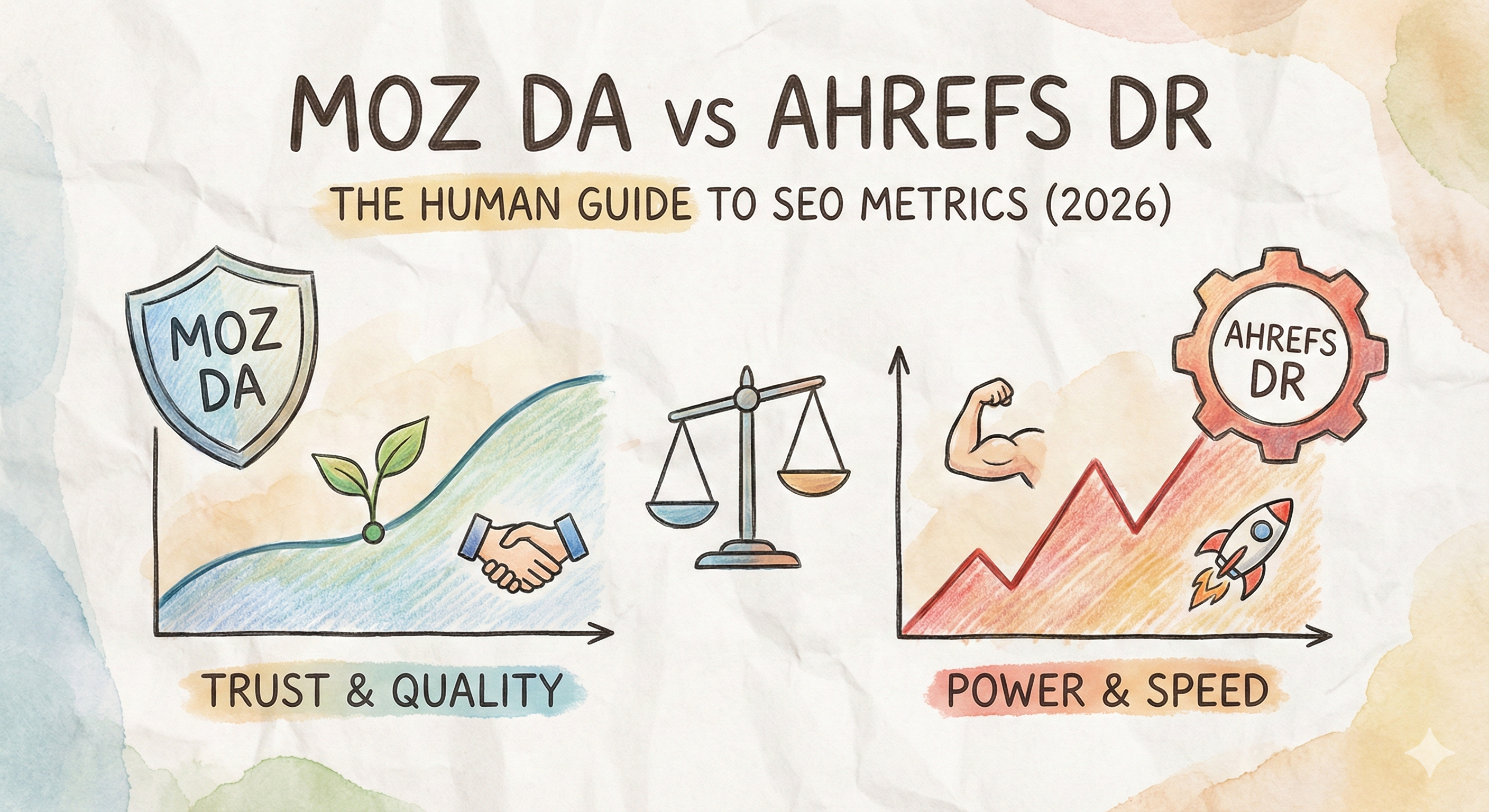
In the high-stakes world of SEO, two numbers dominate every boardroom conversation, client report, and acquisition deal: Moz Domain Authority (DA) and Ahrefs Domain Rating (DR).
For years, founders and marketers have treated these metrics as interchangeable "trust scores." But as we move deeper into 2026, relying on that assumption is a dangerous game. Here is the reality: DA and DR are speaking two different languages. One is a holistic predictor of ranking potential, while the other is a raw, aggressive measure of link equity.
If you are a startup founder trying to outrank legacy competitors, or a tech enthusiast building your first portfolio, understanding the nuance between these two scores isn't just "nice to know"—it is the difference between a strategy that scales and one that stalls.
In this guide, we aren’t just defining terms. We are tearing down the algorithms, analyzing fresh 2026 data, and giving you the exact playbook on which metric to trust for your specific business goals.
The Core Difference: "Ranking Potential" vs. "Link Strength"
At a glance, both tools score your website on a scale of 0 to 100. However, the engine under the hood is completely different.
Moz Domain Authority (DA): The Holistic Predictor
Think of Moz DA as a reputation score. It doesn't just look at how many people are talking about you (links); it looks at who is talking about you and in what context.
- What it measures: A predictive model of how likely a domain is to rank in Google SERPs (Search Engine Results Pages).
- The "Secret Sauce": It uses a machine learning model that trains against Google’s actual search results. It factors in link counts, spam scores, and proprietary "quality" metrics.
- The Vibe: Conservative, stable, and quality-focused.
Ahrefs Domain Rating (DR): The Brute Force of Backlinks
Think of Ahrefs DR as a weightlifting record. It is purely about strength. It doesn't care as much about your on-page SEO or internal structure; it cares about the raw "link juice" flowing into your domain.
- What it measures: The strength of a target website’s backlink profile compared to every other site in their database.
- The "Secret Sauce": It calculates "link equity" transfer. If a high-DR site links to you, you get a boost. But if that high-DR site links to a million other people, the value you receive is diluted.
- The Vibe: Fast, volatile, and highly responsive to link-building campaigns.
The Data: How They Actually Perform in 2026
We can't talk about SEO without looking at the numbers. Recent data synthesizes how these two metrics correlate with actual rankings across different industries. The results might surprise you.
Correlation with First Page Rankings by Industry:
| Industry | Moz DA Correlation | Ahrefs DR Correlation | The Winner |
|---|---|---|---|
| Finance | 0.31 | 0.37 | Ahrefs DR |
| Education | 0.39 | 0.34 | Moz DA |
| E-commerce | 0.29 | 0.36 | Ahrefs DR |
| Health | 0.34 | 0.32 | Moz DA |
| SaaS/Tech | 0.32 | 0.35 | Ahrefs DR |
The Takeaway:
- Use Ahrefs DR if you are in "money" niches like Finance, E-commerce, or SaaS. In these aggressive sectors, raw link power often dictates the winner.
- Use Moz DA if you are in "trust" niches like Education, Health, or Legal. Google’s E-E-A-T (Experience, Expertise, Authoritativeness, Trustworthiness) is critical here, and Moz’s holistic algorithm tends to align better with these signals.
Deep Dive: 3 Critical Differences You Can't Ignore
1. Update Frequency (The "Pulse" vs. The "Report Card")
This is the most practical difference for your daily workflow.
- Ahrefs crawls the web at an insane rate—roughly 8 billion pages per day. As a result, your DR can change weekly or even daily. It is a live pulse of your link building.
- Moz typically pushes updates monthly. This makes DA feel like a "monthly report card." It’s less stressful to watch, but it means you won't see the immediate impact of that guest post you landed yesterday.
2. Handling of "Nofollow" Links
- Ahrefs is somewhat controversial here; it generally counts nofollow links towards DR, though with reduced weight. This explains why some sites see their DR spike after getting press mentions that are technically "nofollow."
- Moz is more traditional. It largely ignores nofollow links for DA calculation, adhering strictly to the idea that if equity isn't passed, the score shouldn't move.
3. Database Philosophy
- Ahrefs aims for size. They want to find everything. If a link exists, they want it in their index.
- Moz aims for quality. They have stricter spam filters and might choose not to index low-quality, spammy links that Ahrefs would count.
Actionable Strategy: How to Boost Both Metrics
Improving these scores requires a mix of content excellence and strategic distribution. Here is the modern stack for moving the needle in 2026.
The "Foundation" Layer
Before you chase links, ensure your technical house is in order.
- Internal Linking: Use Screaming Frog to find pages with high authority and link them to your lower-authority pages.
- Content Pruning: Delete or merge thin content that drags down your site-wide quality signals.