






What Is the YC Startup Directory and Why Is It So Valuable?
The YC Startup Directory is a public, searchable database of over 5,000 companies funded by the Y Combinator accelerator. Founders, investors, and sales teams use it for competitive intelligence, market research, lead generation, and discovering emerging industry trends.
The Y Combinator Startup Directory is one of the most valuable free resources in the tech ecosystem. Since 2005, Y Combinator (YC) has invested in a vast and influential portfolio of companies, including household names like Airbnb, Stripe, and DoorDash, with a combined valuation exceeding $1 trillion. This public directory is not just a list; it's a living archive of startup ideas, founder ambitions, and market validation signals, updated with every new batch.
For anyone in the startup world—founders, investors, job seekers, or sales professionals—mastering this directory is a critical skill. It provides a direct line of sight into the competitive landscape, allows you to validate ideas by seeing who has been funded to try something similar, and helps you understand the micro-trends YC is betting on. It offers a structured, first-party dataset without the significant cost of premium intelligence tools like PitchBook or Crunchbase Pro.
| Use Case | Who It's For | Key Outcome | Example Question Answered |
|---|---|---|---|
| Competitive Intelligence | Startup Founders | A clear map of direct and indirect competitors, their messaging, and market positioning. | "Who else is building an AI-powered code review tool, and how do they describe their value proposition?" |
| Market Research | Founders, VCs, Strategists | Identification of emerging technology trends, validated market needs, and potential ecosystem gaps. | "Is YC funding more companies in climate tech or developer tools in the last two years?" |
| Lead Generation | Sales & BD Teams | A targeted list of recently funded companies that are growing and likely have a budget for new tools. | "Which B2B SaaS companies in the W26 batch have between 10-50 employees?" |
| Deal Sourcing | Angel Investors, VCs | A pipeline of promising, pre-vetted startups to track before they begin a formal fundraising roadshow. | "Show me all FinTech companies from the latest batch that are headquartered in Europe." |
| Recruitment & Job Seeking | Job Seekers, Recruiters | A curated list of high-growth, hiring startups, bypassing the noise of generic job boards. | "Which YC-backed remote companies with under 100 employees are currently hiring?" |
Navigating the Directory: First Steps & Key Features
You can access the YC Startup Directory for free at ycombinator.com/companies. The interface features an infinite scroll feed of companies and a powerful filter sidebar on the left for navigating and sorting the database.
Getting started requires no special tools or logins. When you land on the page, you see a continuous feed of companies. Each card provides a snapshot: its logo, name, a one-liner describing its mission, and tags for its batch and industry.
The real power is unlocked by the filter and sort sidebar on the left. This is your command center for refining the entire 5,000+ company database into a manageable list.
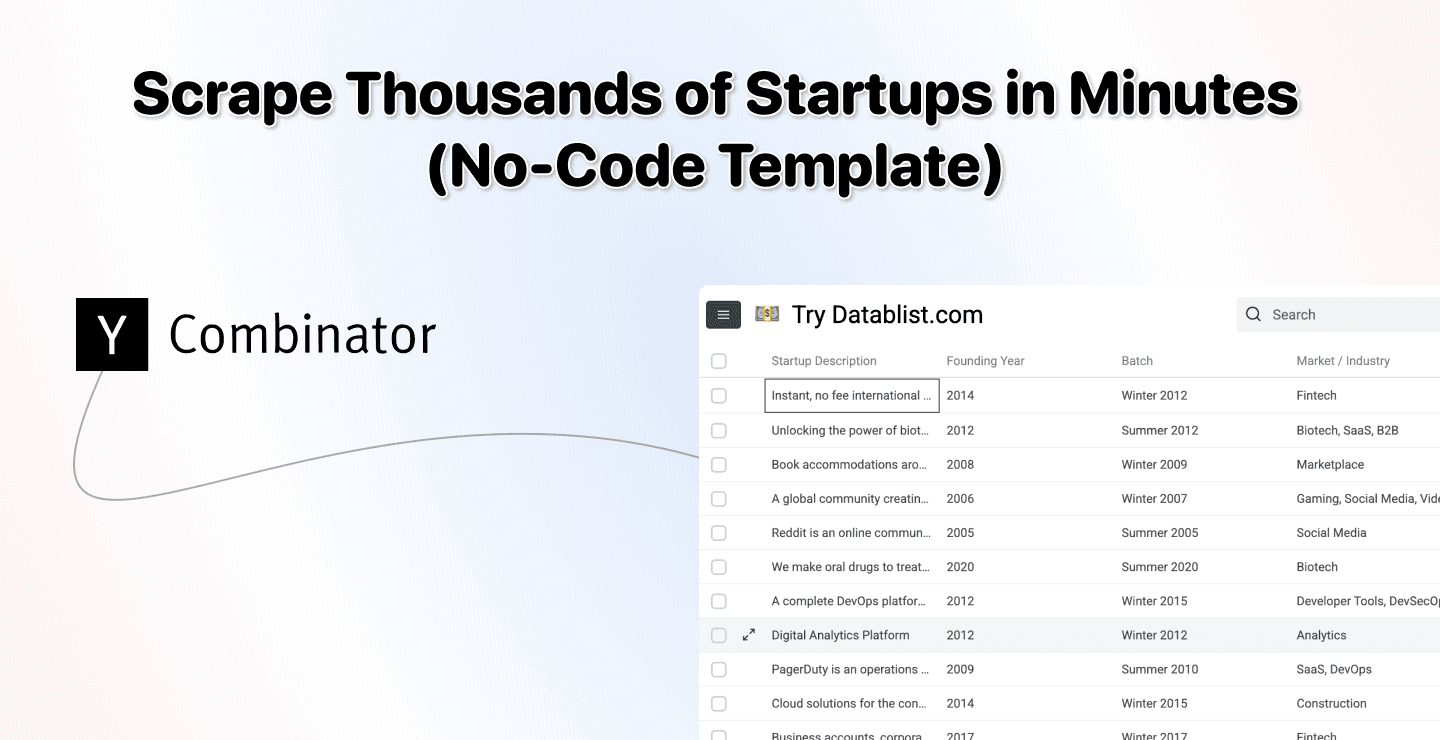
Source: datablist.com
At the top of the sidebar, you'll find a few high-value, pre-packaged filters:
- 💎 Top Companies: A curated list of YC's most successful and highest-valuation companies. Use this to study the characteristics of breakout successes.
- Is Hiring: A dynamic, real-time filter that shows only the portfolio companies that have indicated they are actively recruiting. This is a goldmine for job seekers.
- Nonprofit: YC also funds non-profit organizations. This filter isolates the mission-driven organizations in the portfolio.
Mastering Filters to Pinpoint Relevant Startups
To discover relevant startups, use the directory's left-hand sidebar to filter by Batch, Industry, HQ Region, and Company Size. Combining these filters allows you to create highly specific lists for analysis, such as "B2B SaaS companies from the W26 batch."
Effective filtering transforms a noisy, overwhelming list into a focused, strategic asset. Let's break down each filter.
Filter by Batch
Every company is tagged with its accelerator batch, such as "W26" (Winter 2026) or "S25" (Summer 2025). This is a proxy for market sentiment at a specific point in time.
- For Recent Trends: Filter for the last 2-3 batches (e.g., W26, S25, W25) to see what's getting funded right now.
- For Historical Analysis: Filter for batches from 5-10 years ago (e.g., W19, S18) to see which ideas stood the test of time and which were fads.
Filter by Industry
The industry filters are broad but serve as an excellent first layer of segmentation. Common categories include:
- B2B
- Fintech
- Consumer
- Healthcare
- Developer Tools
- Climate
Pro Tip: Combine a broad industry filter with a keyword search for greater specificity. For example, to find companies working on AI for legal teams, filter by Industry: B2B and then use the main search bar for the keyword "legal".
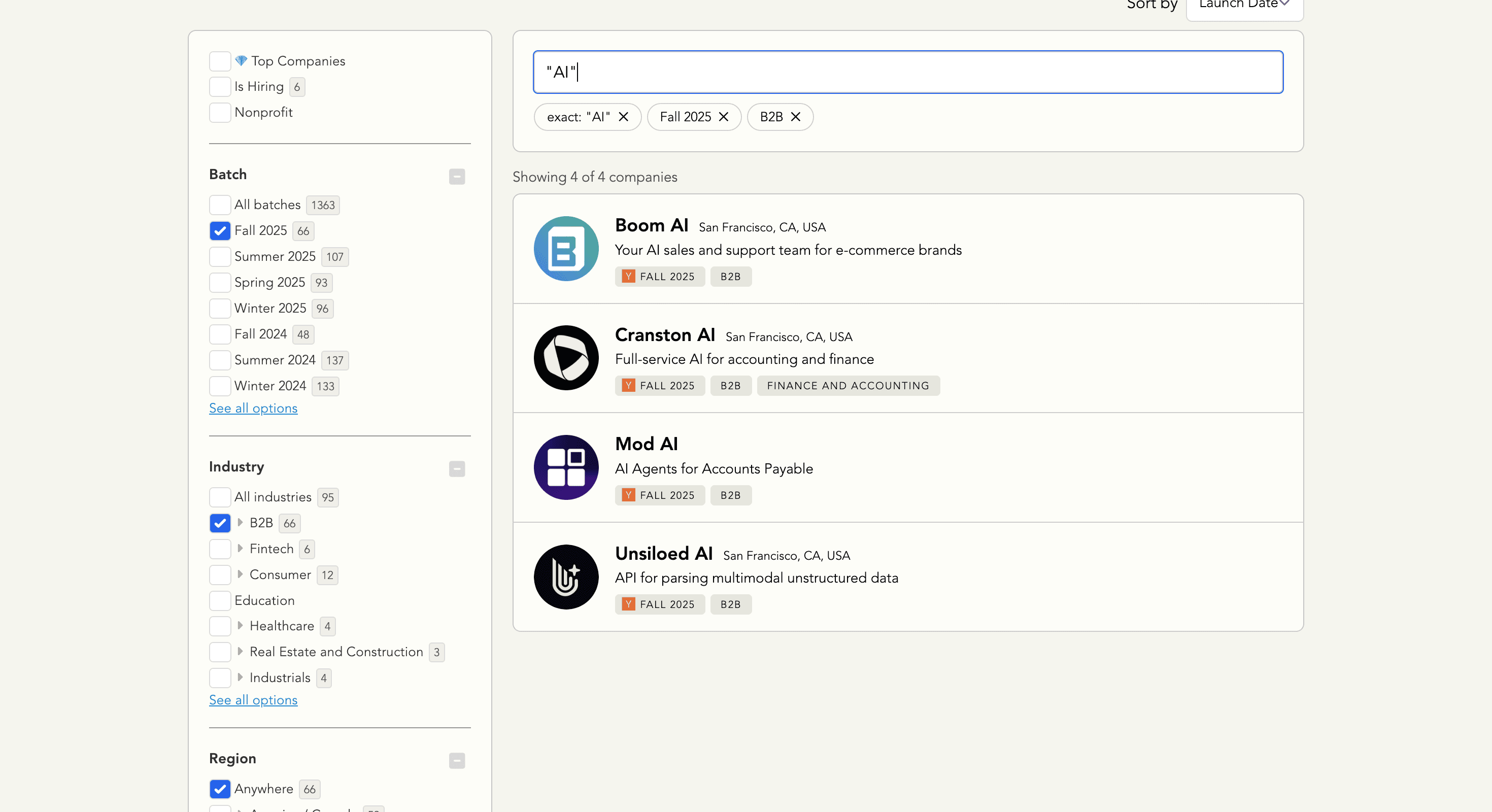
Source: datablist.com
Filter by HQ Region
While many startups are remote, their headquarters can indicate their primary market focus or talent pool. You can filter by continent, country, or select "Remote."
- Regional Market Analysis: If you're launching in India, filtering for
South Asia>Indiainstantly reveals local YC-backed competitors. - Sales Territory Planning: A sales leader can filter by
America / CanadaorEuropeto create prospect lists for regional teams.
Filter by Company Size
This simple employee count slider (1-1,000+) is a powerful tool for competitive benchmarking and lead qualification.
- For Peer Benchmarking: If you are a 15-person company, filtering for startups in the 10-25 employee range provides a list of true peers.
- For Sales Prospecting: A company selling HR software might target startups in the 50-150 employee range, when they typically formalize HR functions.
Use Special Toggles and Keyword Search
Beyond the main categories, several checkboxes provide deeper qualitative data, offering a look inside the founders' original pitch:
- Public Application Video: See the raw, early-stage pitch the founders used to get into YC.
- Public Demo Day Video: Watch their polished, 2-minute pitch delivered to investors.
- Has Application Answers: Read the founders' actual written answers to the YC application questions.
Analyzing these materials is like finding the "director's cut" of a company's story, allowing you to deconstruct how successful founders frame their problem, solution, and vision from day one.
How to Conduct Deep Competitive Analysis
To conduct a deep competitive analysis, first create a filtered list of 5-10 competitors from the YC directory. Then, deconstruct their individual profiles to capture their messaging and value proposition before mapping this data in a competitive matrix.
Once you have a targeted list, the real work begins.
1. Deconstruct Competitor Profiles
Click on any company to open its detailed profile page. In a spreadsheet, capture the following for each competitor:
- One-Liner: Their most distilled value proposition. How do they communicate their core benefit in under 15 words?
- Description: The longer paragraph explaining the problem, target customer, and solution.
- Founders: Who are they? Check their professional profiles to assess their "founder-market fit." Did they experience the problem they're solving firsthand?
- Batch: This tells you their time-in-market. A company from W17 has had years to build, while one from S25 is just starting.
2. Analyze Competitor Websites and Messaging
The YC profile is the "what"; their website is the "how." A startup's homepage is its most important sales pitch. Look for:
- Hero Section Clarity: Does the headline clearly state the primary benefit in under five seconds?
- Social Proof: Look for customer logos, testimonials, case studies, or industry awards.
- Call-to-Action (CTA): What do they want you to do? "Request a Demo," "Start Free Trial," or "Contact Sales"? This reveals their go-to-market motion.
3. Create a Competitive Matrix
Consolidate your findings into a simple spreadsheet. This visual map makes it easy to spot patterns and identify your unique differentiators.